Foreword by Kate Sylvester.
Chiming into the current status of the world, where democracy is under pressure and political and social issues continue to shape our societies, the European Kendo Championships (EKC) also reflects how world politics can impact kendo. Kendo practitioners are citizens of the world, and while we share the same practice, we are not all affected equally by global events. Issues such as trans (exclusion) sporting policies, the ongoing Russian invasion of Ukraine, and Israel’s destruction of Palestinians in the occupied Gaza Strip (see Amnesty International) show that that wider political realities do impact on international sporting communities, including kendo.
These circumstances can also affect participation and representation, such as the absence of the Ukrainian men’s team from the EKC. In addition to the exclusion of trans gender kendoka from the event―even when uninformed logic regarding trans gender participation does not support the exclusion of trans men competing in the men’s categories at the EKC―for example.
It is clear that global politics shape who is able to participate―or―not participate in major international kendo competitions in respect to their identity or their country’s political circumstances or alliances. These situations remind us that global events do have an impact on global kendo participation and development.
Regarding the tournament, there were some phenomenal performances from women, with countries reaching the podium after long hiatuses. Germany, for example, defeated France in the semi-finals going on to win gold. Other teams also achieved breakthrough results, with Great Britain winning silver and the Czech Republic taking bronze.
The women’s individual final was a high-level demonstration of fundamentally strong and technically accomplished kendo between Mia Murakami (Austria) and Adélie Robin (France). Following a closely contested bout that went into extra time, Murakami’s men strike edged past Robin’s to claim the European title. The final showcased the high technical standard of women’s kendo in Europe, with both competitors displaying excellent pressure, composure, and tactical awareness throughout the match. Both Murakami and Robin are young in terms of age, but they have been on the international scene for a number of years, both starting competitive kendo as juniors.
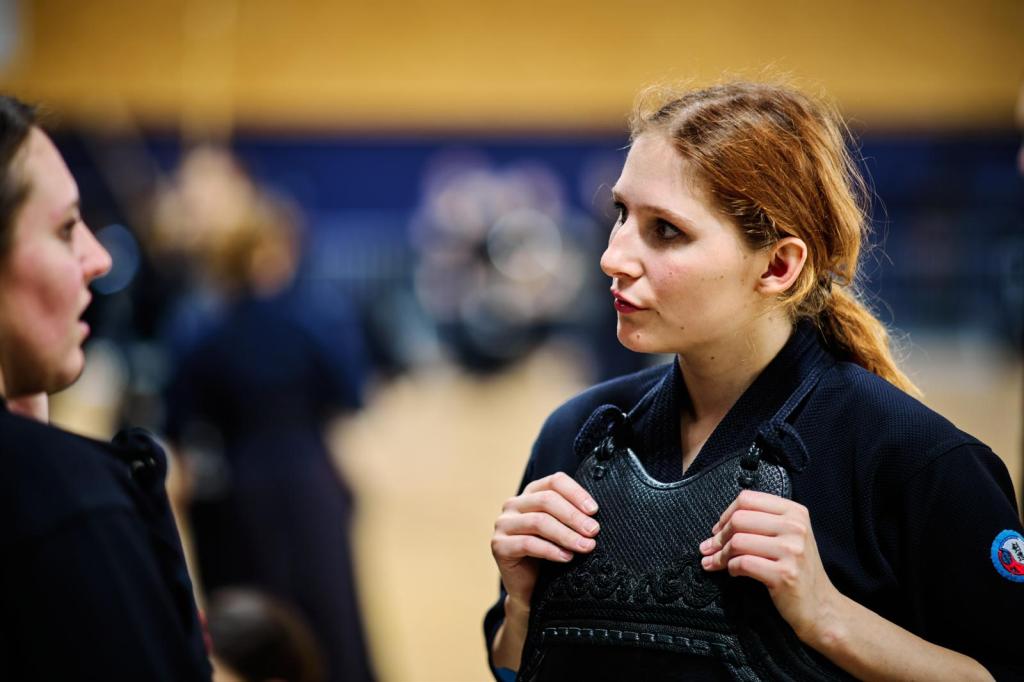
This article focuses on Viktorie Eichlerová’s experience of the EKC as a member of the Czech Republic national team. At the 34th EKC, held from 19–21 June 2026 in Podgorica and hosted by the Montenegrin Kendo Federation, 36 member federations were represented. The Czech Republic women’s national team won the nation’s first team medal in EKC history. This achievement was not accidental, but the result of the team’s progressive rise over recent years, establishing its place on the international competition stage through self-investment, together with the investment, support, and belief of its coaches, family and friends.
I have followed the development of the Czech Republic women’s team for several years, having previously interviewed fellow team member and individual gold medallist at the 32nd EKC, Nicole Eichlerová. I also have immense respect for their coach Jana Ziegelheimová sensei (7 dan kyoshi) who was also interviewed in the lead up to the 2024 World Kendo Championships (WKC).
The Czech Republic team has something special and this radiates through Viktorie’s positive presence and her passion for kendo, which is immediately evident when conversing with her. It is reflected in the person she presents herself to be and was equally demonstrated at this tournament, where it was observed how she fought with great tenacity and determination in every match.
I have had the pleasure of communicating with Viktorie over the past few years and have experienced her kendo first-hand. Despite her warning me about her gyaku-dō, I still became one of its victims during our keiko. After being scored on, I could not help but smile―a testament not only to the quality of her technique but also to the enthusiasm and enjoyment she brings to her kendo and those she connects with.
Before we delve into responses to questions presented to Viktorie about her experiences at the EKC, I will provide some 2026 EKC highlights and a brief overview of the development in women’s EKC kendo since my last article on women’s participation at the 2023 EKC in France.
The following text shares some of Viktorie’s insightful perspectives on kendo and her experiences from the 2026 EKC held in Podgorica, Montenegro.
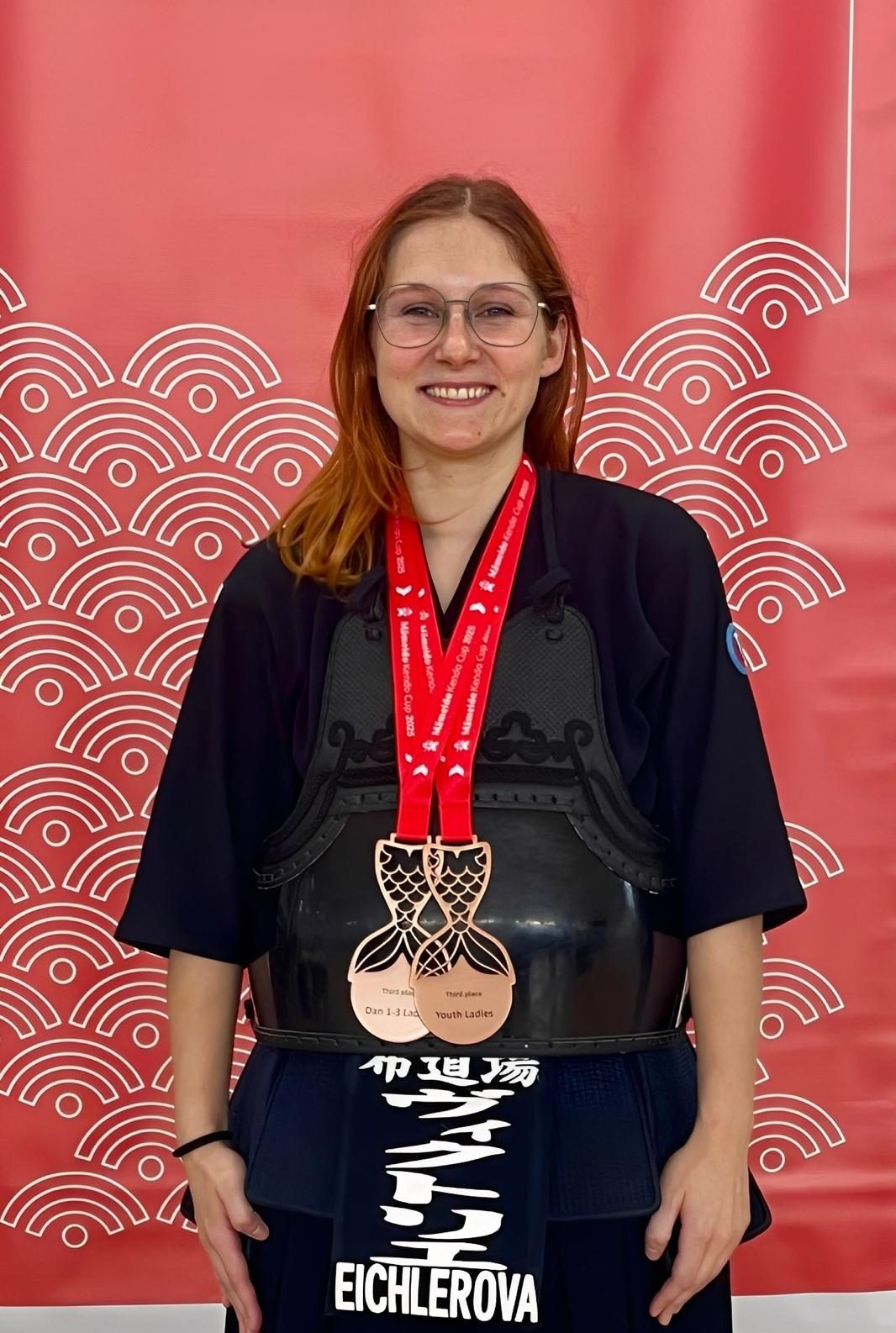
Please share the journey leading up to the bronze medal at the European Kendo Championships.
When I look back at our journey to winning the bronze medal at the European Kendo Championships, I believe our greatest strength was not only how hard we trained, but how well we worked together as a team. We are a group of young women who are not only teammates but also close friends, and I think that made a huge difference.
Over the years, we have built a great deal of trust in one another, both on and off the shiai-jo. I know that every member of the team will always give her best, and I can rely on them not only during a match but also whenever I need their support. That trust and friendship created an atmosphere in which everyone could perform with confidence.
Of course, we could not have achieved this result without the incredible support of our coaches and managers, especially Jana Ziegelhaimová and Martin Fritz, who have guided us, supported us, and helped us grow not only as athletes but also as a team. Their experience, dedication, and belief in us have been an essential part of our journey, and we are truly grateful for everything they have done for us.
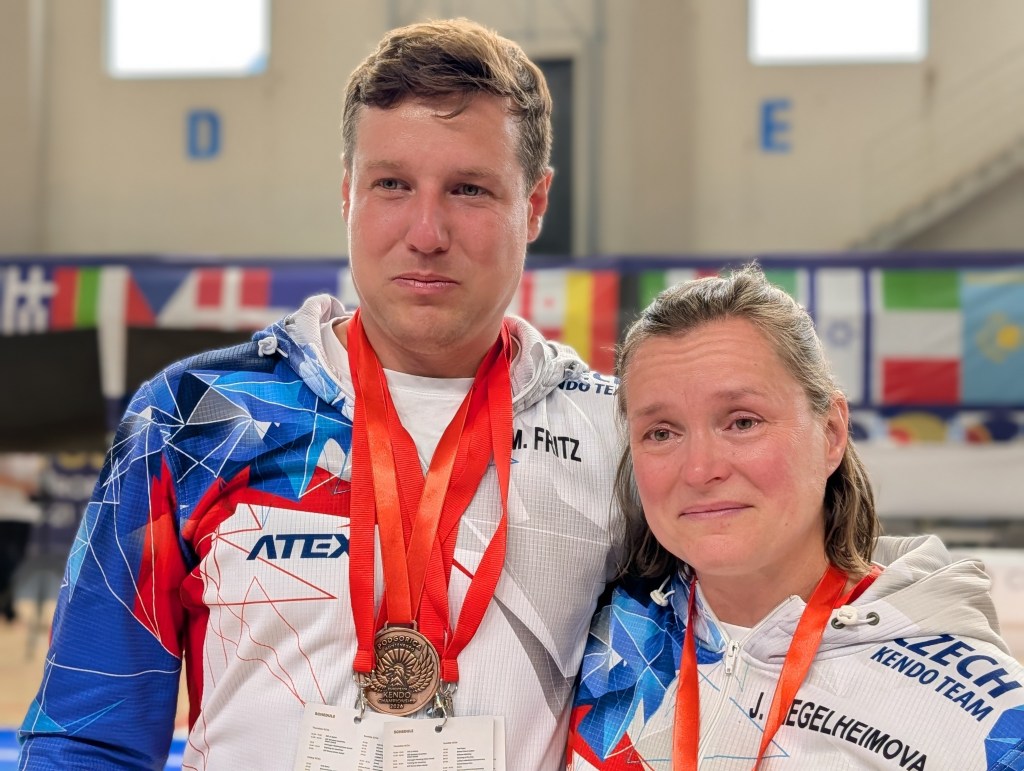
Photo by Honza Cílek
A key moment on our journey was our victory over Poland at the 2024 WKC. It showed us what we were capable of and gave us the confidence to believe that we could compete against the strongest teams in Europe. That experience, together with our dedication and teamwork, ultimately led us to the bronze medal at the 2026 EKC.
I would also like to acknowledge my teammates―Lizzie Štajerová, Nanako Seo, Dita Vavrlová, Nikol Eichlerová, and myself. Every one of us contributed to this achievement, and I am incredibly proud of what we accomplished together as a team.
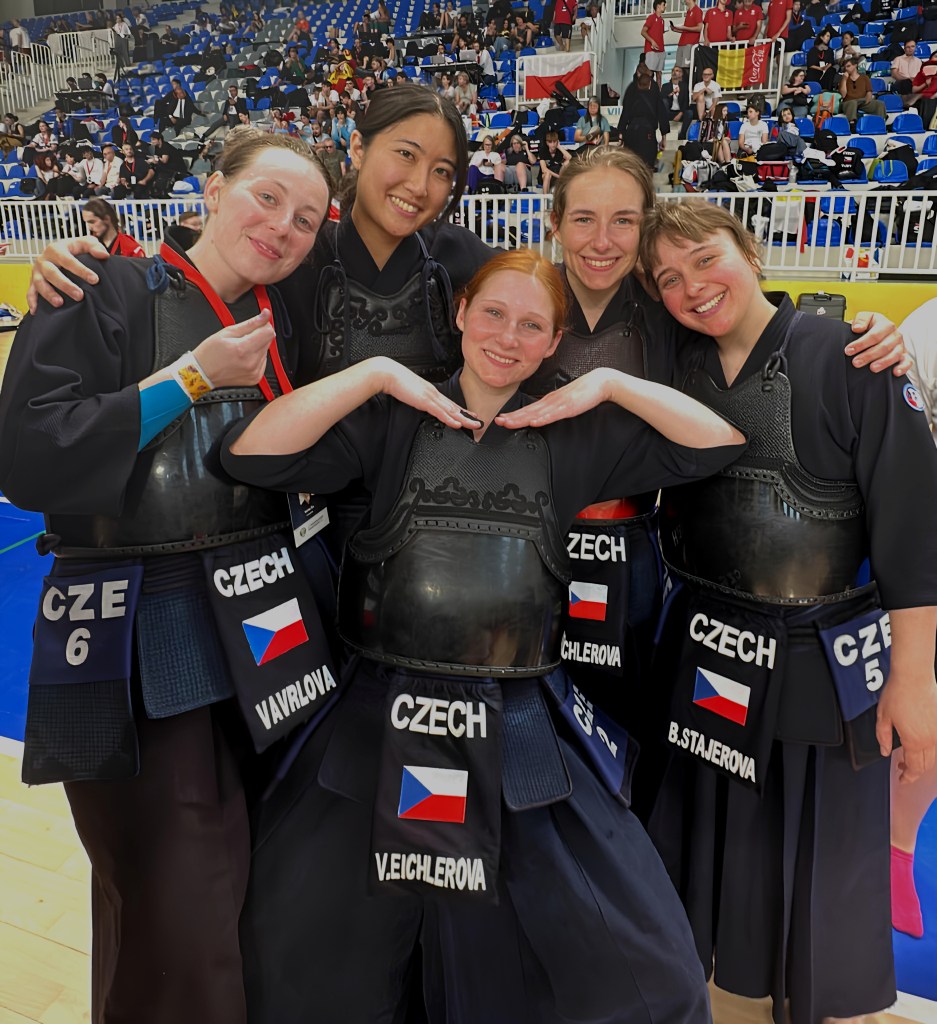
What does the bronze medal result mean to you, your team, and kendo in Czech Republic.
This medal means a lot to me because it is something I have hoped for a very long time. I think it had been more than ten years since the Czech women’s team had come so close to winning a medal, but never quite achieved it. We reached several quarter-finals and lost several matches by just one ippon. This year, we finally made it.
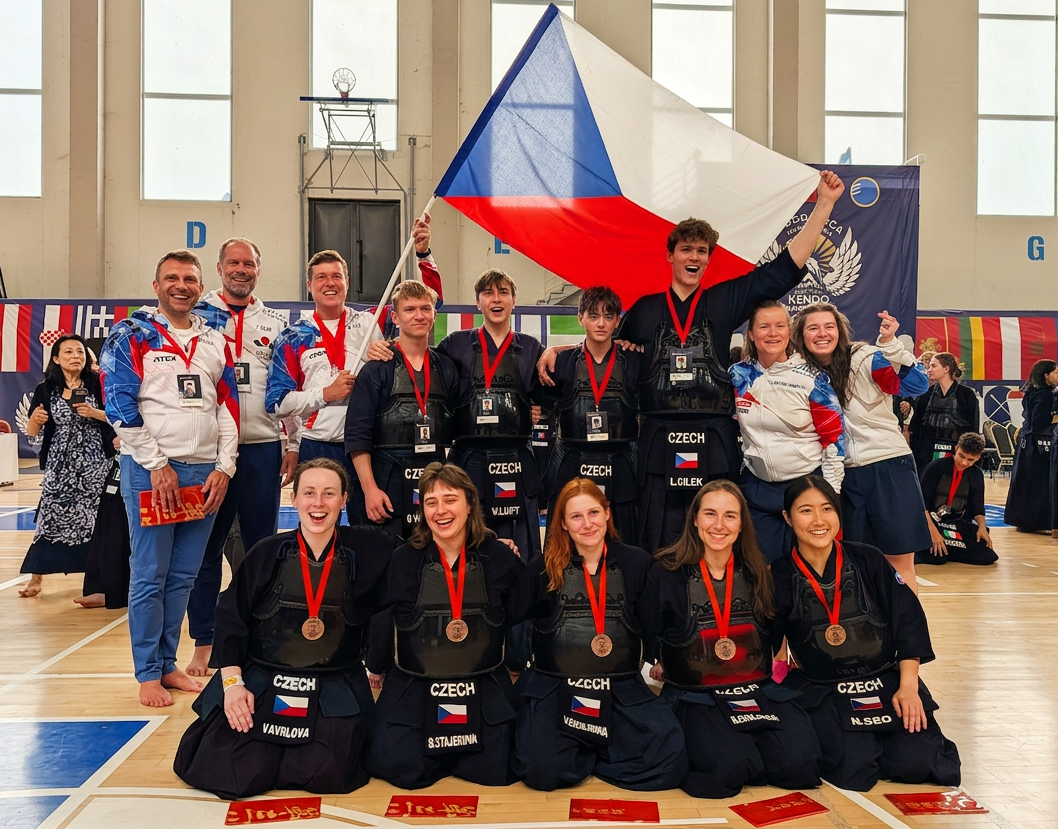
I believe this bronze medal has shown us that we are capable of competing with the best teams in Europe. It gives us the motivation to keep working hard and aim even higher in the future. I also hope it will inspire the younger generation of kendoka, who will one day replace us in the national team and show them that winning a European medal is possible.
Aside from winning the bronze medal, what was the highlight moment of the 2026 European Kendo Championships for you?
I have to say it was a very “girly” moment before the Sayonara Party. We got ready together as a team―one person was doing make-up, another was helping with dresses, we were borrowing things from one another and making sure that everyone looked amazing. And I think we definitely succeeded! It was such a fun and special moment because it reminded me that we are not only teammates, but also close friends.
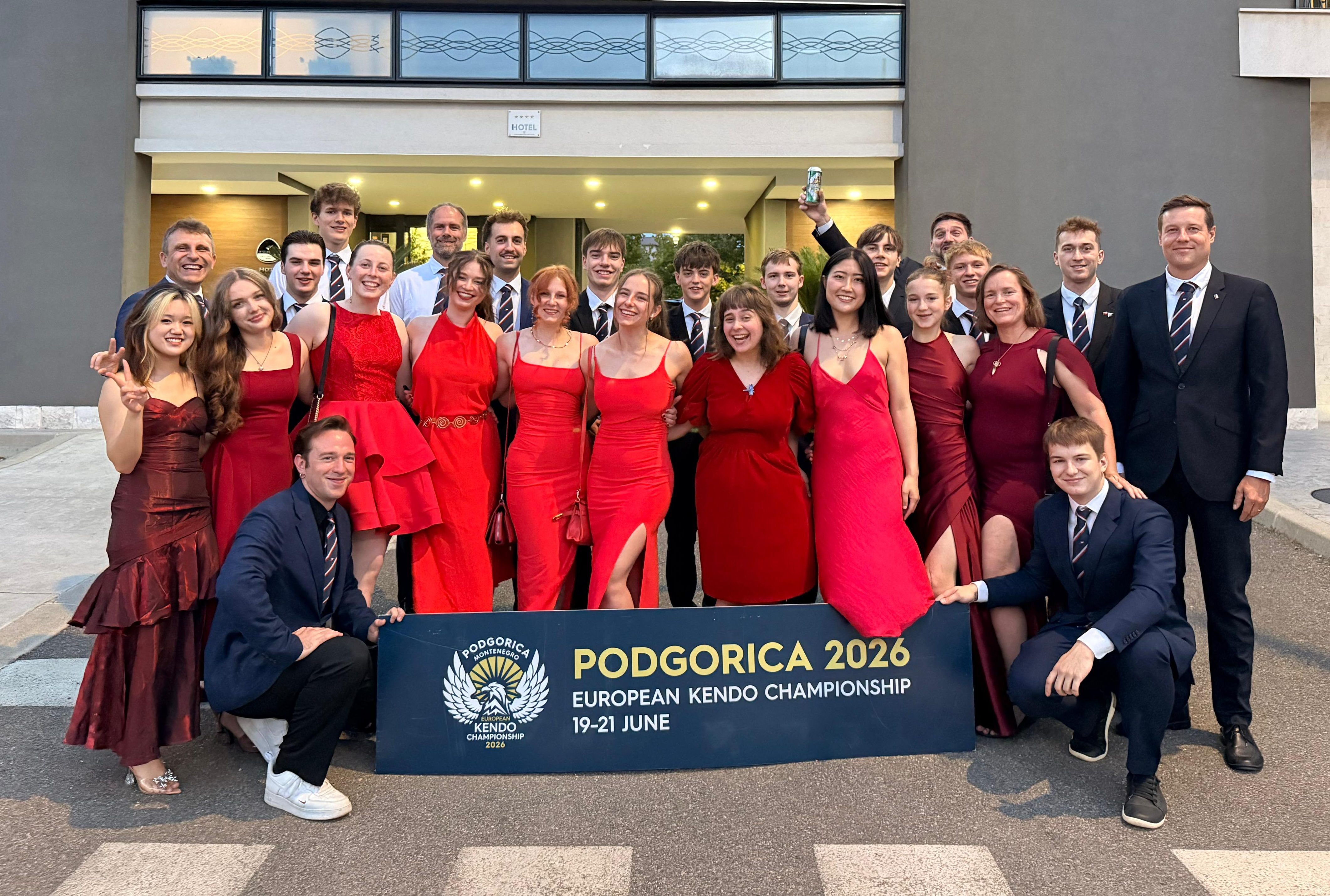
But I also must mention something that has become a special tradition for our women’s team since the 2024 WKC. After our victory over Poland, we were celebrating together, hugging each other in a circle, and someone suddenly started singing the Czech folk song “Vysoký Jalovec.” Since then, it has become part of our team.
So, after winning the bronze medal, we simply had to sing it again. I absolutely love this moment because it is something that belongs only to us—it represents our team spirit and the bond we share. The same applies to several other songs that have become part of our preparation and team rituals.
What motivates you to commit to the sacrifice (cost, time) of competitive kendo?
For me, the biggest motivation is my team―not only the women’s team, but the entire Czech national team. I really enjoy the energy that everyone brings, especially the younger members. Seeing how hard they train pushes me to work even harder myself. They constantly challenge us to improve, and I think we all make each other stronger.
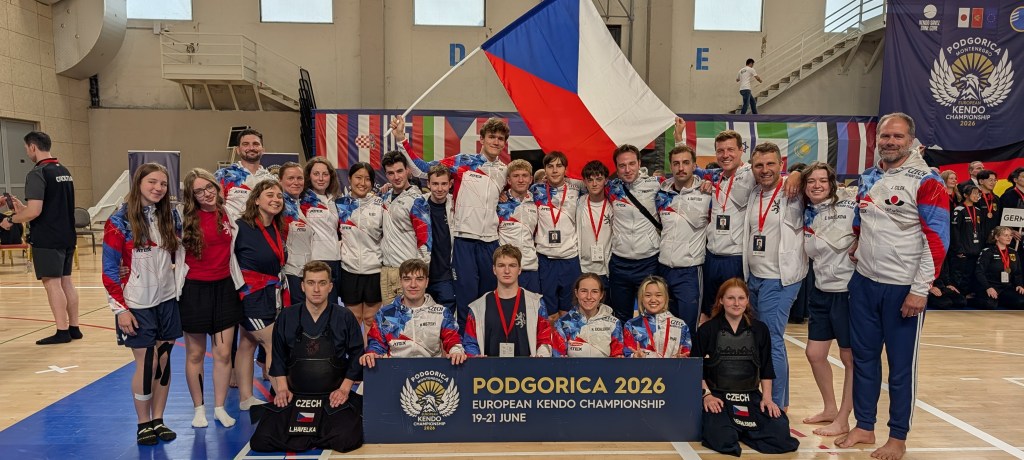
Competing at this level is about much more than attending training sessions or national team trainings. It also requires a lot of individual preparation, including workouts, suburi, and mental preparation. It takes a significant amount of time, effort, and commitment.
At the same time, I know I wouldn’t be able to do any of this without the support of the people closest to me―especially my family, friends and my boyfriend. They have always encouraged me, supported me through both the highs and the lows, and made it possible for me to continue pursuing my goals. I am incredibly grateful to have them by my side.
What is kendo for you?
Kendo is something I cannot imagine my life without it. Even when I am tired, busy, or have a lot on my mind, I still want to continue training and give my best. It has become much more than just a sport―it is a part of my life.
For me, kendo is also a second family. Through kendo, I have met some of the most amazing people, many of whom have become my closest friends—not only in the Czech Republic, but also around the world. I have met many people through kendo while they were still children, and even though they are now members of different teams, I feel incredibly proud to see them grow into amazing kendoka and wonderful people.
The lessons, experiences, and friendships that kendo has given me are something I truly value, and I cannot imagine my life without them. Kendo has shaped who I am, both on and off the shiai-jo.
How do you think women’s kendo in Europe has improved and what do you think could be done to further support the development?
In recent years, women’s kendo in Europe has improved significantly. With every EKC and WKC, the overall standard continues to rise, and the competition becomes stronger. This constantly pushes us to work harder, improve ourselves, and become better every year if we want to succeed at the highest level.
I believe one of the most important factors for the future development of women’s kendo is the growth of experienced referees and coaches. I already see many amazing kendoka who have finished competing for their national teams and have chosen to continue contributing to kendo by becoming referees or coaches.
Referees play a very important role in the development of kendo. When they are young, active, and still connected with the high-level kendo they experienced as competitors, they can bring valuable experience and insight and help move European kendo forward. Supporting and developing more referees and coaches will be essential for continuing the growth of women’s kendo in Europe.
About Viktorie Eichlerová
Viktorie Eichlerová is 23-years-old and holds the rank of 4 dan in kendo. She has been practising kendo for 18-years, and it has become an important part of her life. Through kendo, she has learnt discipline, perseverance and respect, and has met many inspiring people from around the world. She is a member of Nozomi Dojo and has proudly represented the Czech Republic at the European Kendo Championships since 2019. Outside of kendo, she studies law at university. Her goal is to continue improving both as a kendoka and as a person, while making the most of every opportunity to compete and learn.
2026 EKC RESULTS
Women’s Team
🥇 Gold – Germany
🥈 Silver – United Kingdom
🥉 Bronze – Czech Republic
🥉 Bronze – France
Fighting Spirit Awards
Maja Pantić (Serbia)
Alisa Strupp (Germany)
Sofia Kanna Niba (Italy)
Mona Jančytė (Lithuania)
Senior Women’s Individual
🥇 Gold – Mia Murakami (Austria)
🥈 Silver – Adélie Robin (France)
🥉 Bronze – Sara Van Laecken (Belgium)
🥉 Bronze – Katarzyna Babinska (Poland)
Fighting Spirit Awards
Sofia Favaro (Spain)
Sofia Kanna Niba (Italy)
Tomomi Nakashima (Germany)
Saadet Kök (Turkey)
Junior Female Individual
🥇 Gold – Maya Urrero Shiozawa (Spain)
🥈 Silver – Sara Chesneau (France)
🥉 Bronze – Sayaka Zalewska (United Kingdom)
🥉 Bronze – Nagomi Fisher (United Kingdom)
Fighting Spirit Awards
Zlata Pletska (Poland)
Kaede Goto-Fuksiewicz (Belgium)
Veronica Victoria Takacs (Ireland)
Joud Bouaita (France)
Afterword
How far have we come?
In the past decade, women’s kendo in Europe has developed in terms of skill and leadership at a steady rate. Some development had been lost during COVID which was evident at the first EKC after the pandemic where there was a clear gap between the competitive level of kendo between the women’s and men’s categories. However, since, European women’s kendo has propelled itself forward and a generation of players are setting new performance bench marks. The development impressed the Korean shinpan at the 2024 WKC where it was quoted that the kendo level has excelled exponentially compared to the previous WKC in 2018. The performances across all the female categories demonstrated the growing competitiveness of European kendo and showed that determination and grit can lead to success on the international stage.
However, the development of women’s kendo in Europe can largely be attributed to the efforts, experience, vision, and confidence of women kendoka themselves. Increasingly, women are investing in their own development by travelling to compete, attending and leading various seminars. There has also been a steady increase in the number of women achieving the rank of 7 dan, with Europe currently having 30 women with the rank.
Looking at the 2026 EKC programme, there has been a slight increase in the number of women serving as coaches, managers, and shinpan. While these developments are encouraging, the numbers remain relatively low. As Viktorie Eichlerová highlights in this article, continued support and greater investment is needed to create sustainable growth and ensure that women are represented at all levels of European kendo, specifically in coaching and refereeing.
Regarding gender representation, women’s participation at the 2026 EKC has shown both progress and continuing challenges. In 2023, 15% of shinpan were women (6 out 38) and increased to 26% (11 out of 42) in 2026. The increase has highlighted that, despite the growing number of women participating in kendo, women remained underrepresented in positions of authority and recognition within the competition structure.
At the 2026 EKC, 102 women participated in the senior individual categories, with 23 women’s teams competing, of which 19 were full women’s teams. This is a decrease from 2025 where 25 team and 2023, 24 teams competed. Some federations were unable to send women’s teams or any competitors at all, including countries that had previously participated in women’s categories. This raises important questions regarding the level of focus and resources dedicated to women’s kendo development within national federations. That kendo is not attractive to women is not the answer as there are approximately 500, 000 women and girls training in Japan and over 1300 women now hold the the rank of 7 dan in Japan. So what are the challenges federations face recruiting and retaining women national team members? Is there really a sincere interest in developing women’s competitive kendo participation across the 36 member federations of the European Kendo Federation?
Investment in our juniors is one certain way to raise the level of kendo in Europe as displayed by the medal winners across all categories whose competitive kendo journeys started as juniors in international tournaments such as the Ko Jika International Spring Tournament in Belgium. The introduction of the junior female category at the 2025 EKC in Leiden created a new pathway for younger female practitioners to compete internationally. The category began with 16 participants and continued to grow, with 21 female juniors (and 54 male juniors) in 2026. The disparity in gender representation again demonstrates both the importance of creating these opportunities. Investment in younger female practitioners and leaders from economic and organisational perspectives will create stronger foundations for the future of women’s kendo. Women role models in leadership that show women there is a rewarding kendo life after competitive kendo.
The developments in women’s EKC kendo show that progress is taking place, but they also highlight that women’s kendo development remains dependent on stronger structural support. The challenges cannot be understood only as a matter of whether women choose to participate. The development of women’s kendo is influenced by the structures created by dojo and federations, including encouragement and financial support for women to coach/teach, referee, grade, compete and train.
The continued growth of women’s kendo requires federations to recognise that supporting women’s participation is not an additional activity but an important part of developing the entire kendo community. The progress seen between 2023 and 2026 demonstrates that change is possible when opportunities are created, but the remaining gaps show that further commitment and structural investment are necessary to ensure sustainable development.
Regardless of these global tensions that many of us carry every day in our bodies, it is important that we continue fighting for equality, democracy, each other and for ourselves. Kendo is one sphere where we have the opportunity to make the world a better place if its principles are followed from a non-egocentric stance, with respect, understanding, empathy and consideration for others irrespective of age, rank, gender identity, race, religion, class, sexuality, and (dis-) ability―as examples of the diversity within our broader kendo community.
In our dojo and the shiai-jo, we have the greatest opportunity to be generous bright lights for one another and to move with grace through this distressing and difficult time in our world. Czech Republic national team member Viktorie Eichlerová is one such person that casts a much needed light on those around her.
What are your thoughts on this article? Please comment below.
Disclosure Statement
The articles published on this website present the owner of this blog website’s perspective, based on personal experiences, unless stated otherwise. They do not represent those of people, institutions or organisations that the owner may or may not be affiliated with in a personal or professional capacity unless explicitly stated. All content in these articles are for informational purposes only. People’s perspectives that may appear as information in these articles do not reflect the perspective of the owner or other people’s perspectives. Any views or opinions are not intended to malign any religion, ethnic group, club, organisation, company or individual. The owner of this blog makes no representations as to the accuracy or completeness on this site or found by following a link on this site. The owner will not be liable for any errors or omissions in this information nor for the availability of this information. The owner will not be liable for any loses, injuries or damages from the display or use of this website.

