Women’s voices and achievements are under-represented across kendo-related media and literary channels. Guest essays published on this website share personal experiences, perspectives, and reflections on martial arts and combat sports that are written by women.
The 49th International Kendo Leaders’ Seminar 2025 by Linda Xi (Norway).
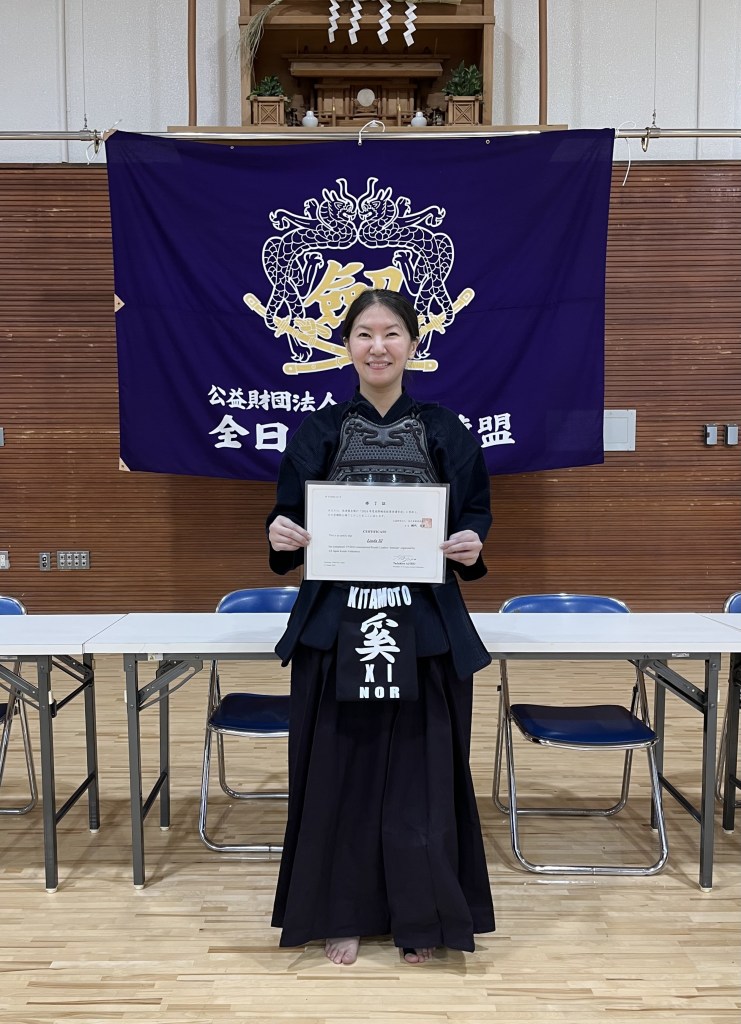
From March 18 to 24, 2025, I had the opportunity to attend the 49th International Kendo Leaders Seminar, held in Katsuura, Chiba Prefecture. Officially named the International Kendo Leaders Seminar, it is better known to many as the “Kitamoto Summer Camp,” a name that reflects its long-standing tradition of being hosted during the summer months in Kitamoto, Saitama Prefecture.
First held in 1975, this week-long seminar brings together kenshis around the world to help us strengthen our skills and deepen our understanding so that we can return home to promote correct kendo and become better leaders within our communities.
Coming from a nation with a small kendo population, I had long been interested in ‘Kitamoto’, not only for my own kendo development and growth as an instructor, but even more so for the opportunity to learn from a pool of top-level teachers and train alongside kenshis from all over the world. I was fortunate to receive a recommendation from the Norwegian Kendo Committee after submitting my application and was thrilled to be selected as one of this year’s participants.
Aside from completing the training program, I had also a personal goal: to take the 5-dan examination on the last day of the seminar, a challenge I will revisit later.
While excited, I also felt a bit anxious about how my body would hold up through the week, especially with the added pressure of shinsa and lingering jetlag. So I decided early on that, no matter the exam’s outcome, I would stay present and maintain my physical condition as best as possible, and above all, enjoy the experience.
Seminar overview
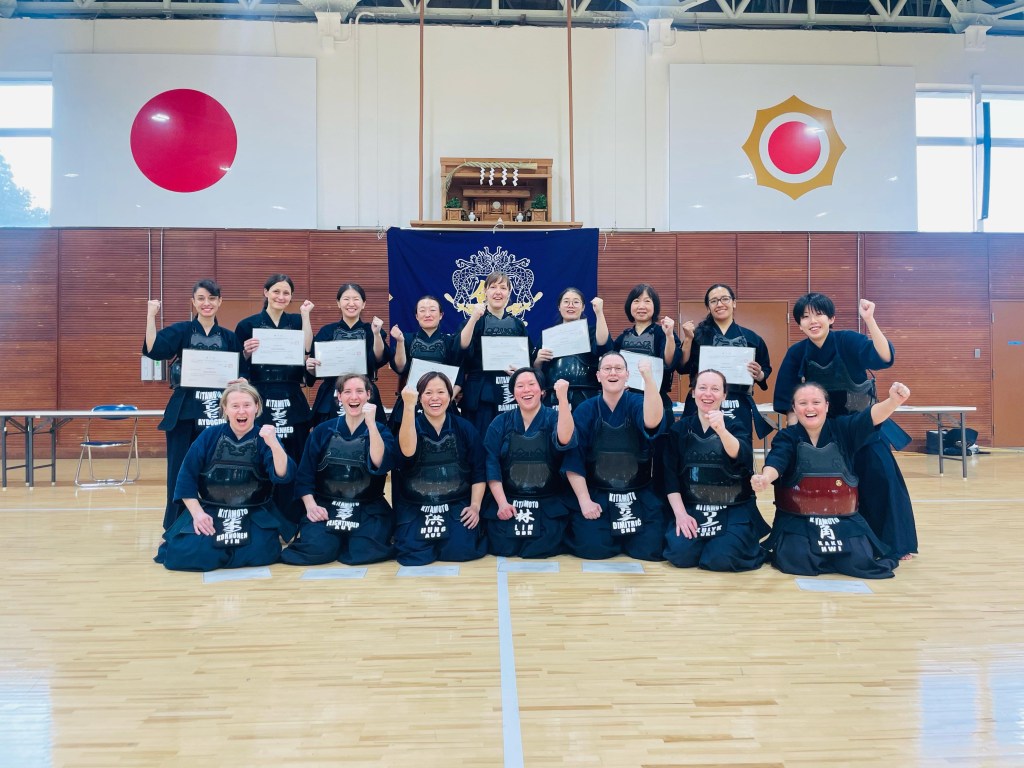
In keeping with the ‘Kitamoto’ tradition, although the seminar is now held in Katsuura, the All Japan Kendo Federation had custom made nafuda prepared for all participants, featuring ‘Kitamoto’, our surnames, and home countries upon our arrival. I thought this created a strong sense of unity from the start, and we all wore them proudly on our tares throughout the seminar.
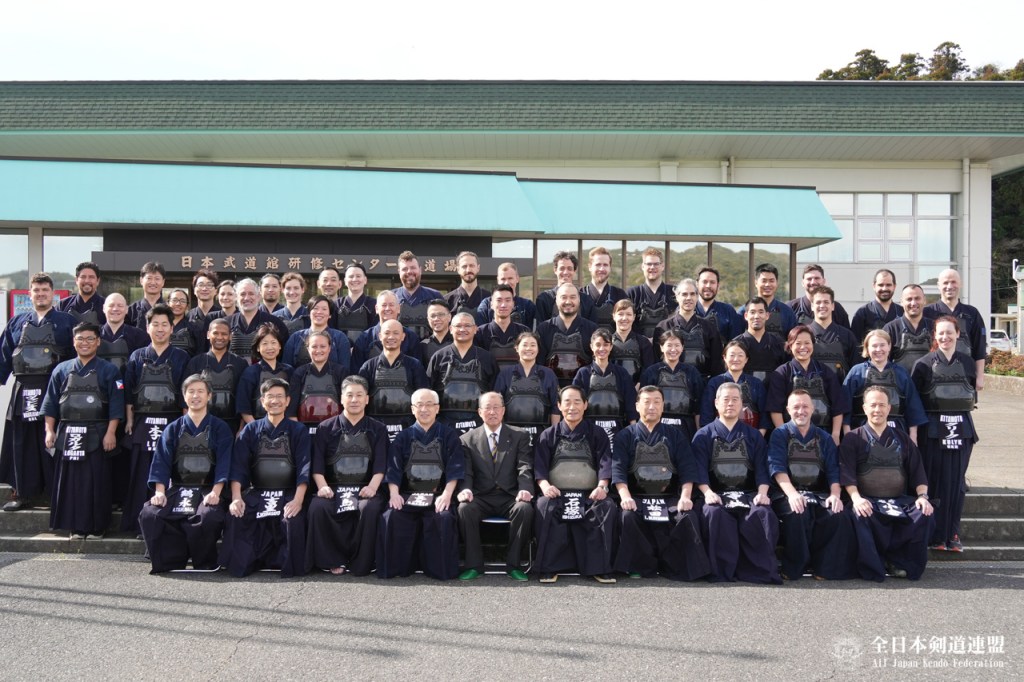
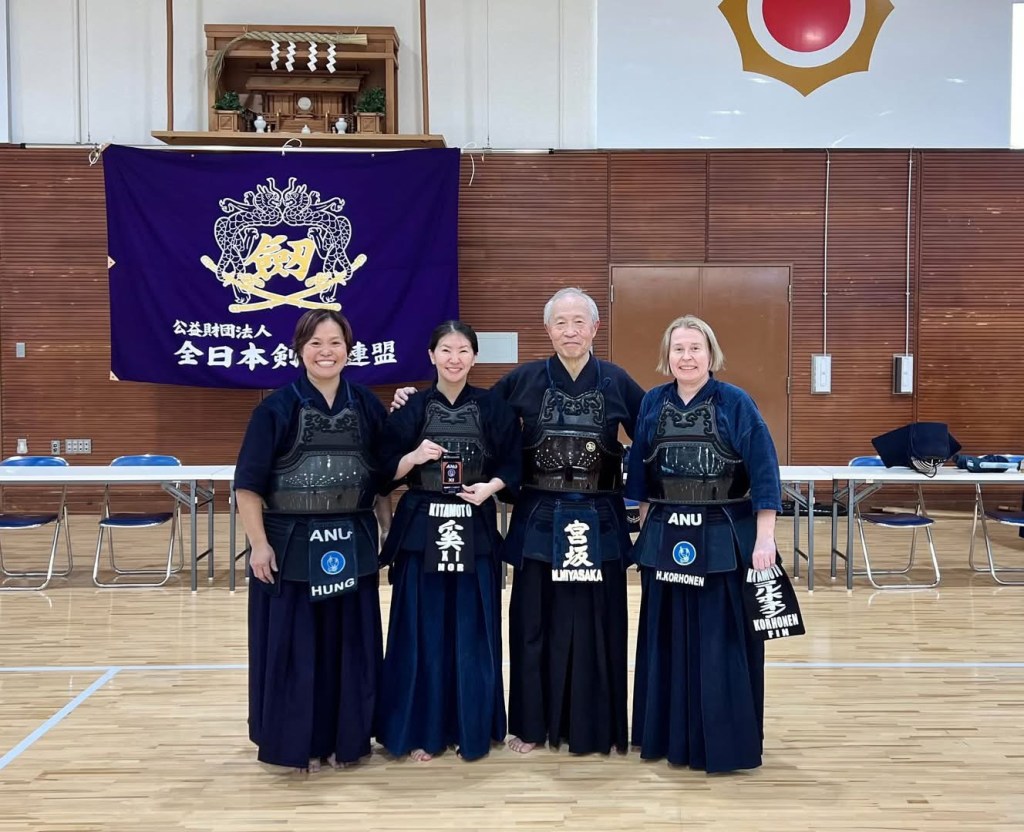
This year, there were a total of 47 participants, with 15 women making up roughly a third of the group. We were each assigned one or at most two roommates for the week. I had the pleasure of sharing a room with Tina from Hawaii, and I could not have asked for a better roommate. What made this year’s seminar even more special was meeting Jane from Australia and Heini sensei from Finland, both of whom I share a connection with through the Australian National University (ANU) Kendo Club, where I first began my kendo journey. Our impromptu alumni gathering became even more memorable when Miyasaka sensei, the founder of ANU Kendo, was among the visiting senseis for the seminar.
The seminar itself was led by an impressive lineup of top-level instructors, including Ishizuka sensei, Matsuda sensei, Terachi sensei, and Ijima sensei, with Bennett sensei and Ogura sensei providing translation support throughout the week. We were also joined by visiting senseis such as Hamasaki sensei, Yoshisato sensei, Tsurunaga sensei, and Isshiki sensei, along with Ooishi sensei and Oda sensei, two of the few female visiting senseis who offered valuable opportunities for keiko and learning.
The seminar curriculum covered a wide range of practical and theoretical topics, balancing hands-on training, refereeing practice and lectures. Mornings began with voluntary asa-keiko at 6 a.m., followed by Bokuto ni Yoru Kendo Kihon Waza Keiko Ho, Nippon Kendo Kata, kihon and waza drills, covering both shikake and oji-wazas. From day one, there was a strong emphasis on basics, etiquette, kamae, maai, datotsu, and the proper handling of shinai and bokuto. Each kata was broken down in great details, highlighting the depth kata carries and the difference between true comprehension and simply going through the motions.
Afternoons focused on refereeing and shiai practice, followed by mawari- and shido-keiko. I particularly appreciated the daily refereeing sessions, an area where I feel least experienced. A major focus was placed on key elements of Shinpan-ho: (1) understanding yuko-datotsu, (2) identifying hansoku, (3) correct tsubazeria, and (4) teamwork, coordination, and positioning among shinpan. Practical exercises followed, including handling the shinpan-ki and practicing gestures and commands. We then had structured referee training rotating through roles as shiai-sha (competitor), shinpan-in (referee), and kakari-in (assistant), receiving real-time feedback and guidance from the senseis.
On the fourth day, students from the International Budo University (IBU) joined us. This gave a more realistic setting for team match refereeing practice. Then, on the fifth day, we held team shiai amongst ourselves, divided into two teams and facing off against our roommates while rotating as shinpan. Unlike earlier practices, senseis let the matches run uninterrupted, with no corrections, just like in an official competition.
Throughout the week, we also had three evening lectures: the history of kendo by Nagao Sensei, the International Kendo Federation (FIK) by Takamori sensei, and anti-doping in kendo by Miyasaka sensei. I found it particularly interesting to learn that while Japan and Korea account for about 97% of the global kendo population, China, now the third largest kendo nation, has seen rapid growth, expanding from 2,500 practitioners in 2010 to 23,000 in 2022, even as many other countries face declining numbers.
Finding my rhythm – my week at the seminar
With the schedule set, each day settled into its own rhythm as the week progressed. The seminar kicked off under a sunny sky. Physically, the first two days were quite manageable. Though my body wasn’t moving the way I wanted, and my mind lagged behind. As the senseis walked among us, correcting posture, kamae, and datotsu, I felt nervous, trying to show the best kendo I could. The first keiko was rough. I felt clumsy and disconnected. Later, talking with others, it seemed many of us were still shaking off some rust. It helped to know I wasn’t alone. A hot soak in the bathtub after training helped wash away the heaviness.
On the third day, I woke early to join asa-keiko. The hall was packed, it was reassuring to see so many faces, all sharing the same quiet determination. Training, eating, sweating, showering, and waking up early together, there’s a magic in these shared routines that creates a bond between people almost instantly. That day, I had two shiais, one against Eric from Hong Kong in jodan, the other against Pedro from Spain in chudan. I lost points in both, but it didn’t matter. I had fun and also received positive feedback on my refereeing, despite my nerves.
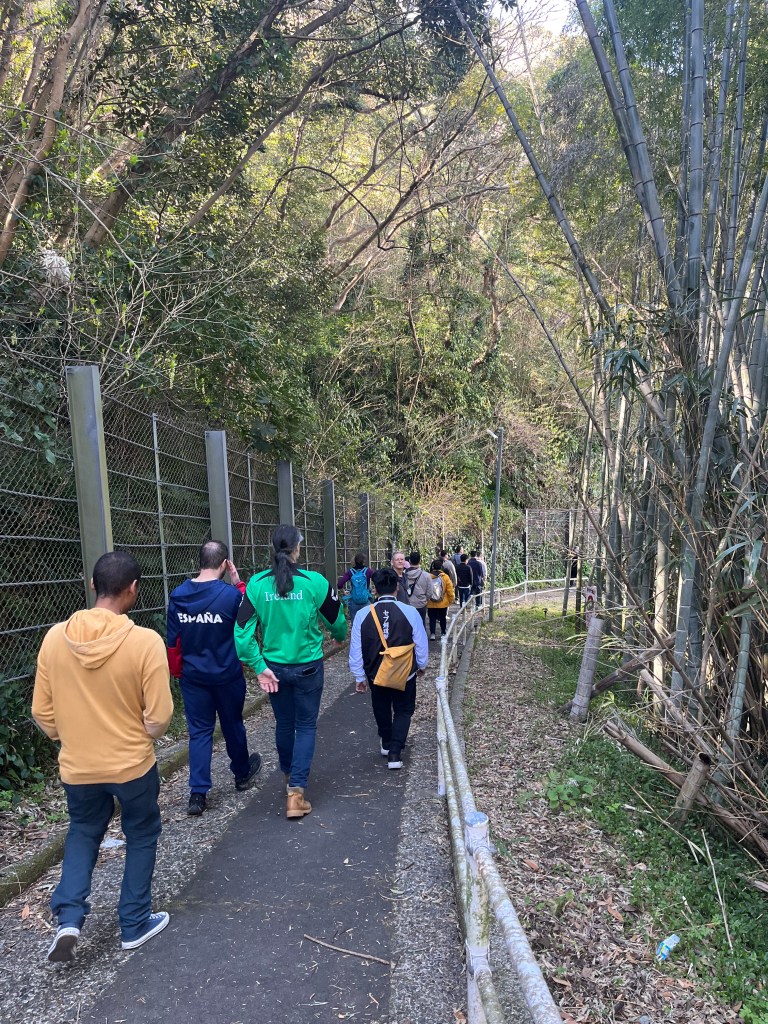
Friday gave us a brief breather, with no official program before lunch. Still, many of us, myself included, joined asa-keiko. The cold that morning was piercing. I can still feel the freezing wooden floor under my feet. Later, we went for a walk with Ijima Sensei and visited a local bogu shop. Before heading back, some of us detoured to the sunny Katsuura beach.
Maybe I had overestimated my endurance. During mawari-keiko that afternoon, I was knocked down hard and couldn’t get up immediately. I had to sit out and missed shido-keiko with the senseis. Many participants came by during the break to check on me, and Jun from China kindly offered me ice gel to start treatment right away. Later that evening, my left ankle had swollen, though it remained painless. Alarmed, my roommate Tina urged me to apply RICE immediately, which I did. Realizing I needed to listen to my body, I made the difficult but responsible decision to skip asa-keiko for the rest of the seminar.
Saturday turned out to be the first time all week that I felt connected to my kendo. Facing off against our roommates made the team match all the more special. Although I didn’t score a clean point, my opponent said I made her work hard, and that meant a lot to me. Reflecting that night, I realized how important it was to listen to my body and pace myself. Even though the swelling returned after training, I felt no pain, adrenaline must have carried me through.
By Sunday, the fatigue ran deep. Even eating felt like an effort. The final major event was the mock shinsa, where all examinees went through simulation matches and received feedback from the senseis. I was nervous but determined. In my two jitsugis, I faced Jun from China and Eric from Hong Kong. Somehow, I pulled it together. When the three senseis judging my jitsugis all passed me and encouraged me to carry that spirit into the real exam, it felt like quiet affirmation. Now, I just had to do it again.
The shinsa
Prior to the seminar, I had challenged 5-dan three times within a span of seven months, all without success. It felt like a chase. Until my last attempt in Milan after the 19th WKC, my mind had been completely fixated on shinsa. I treated almost every jigeiko as if it were a jitsugi, self-evaluating every strike and movement, judging whether it would be “good enough” to pass.
Looking back, I see how unhealthy that mindset was. I constantly criticized and beat myself up, and not seeing my number on the result sheet after jitsugi only reinforced the negative cycle. I felt like I was never enough.
Realizing how beaten up I was after the last attempt in Milan, I decided that I needed to be patient with myself and take the time I needed. For a long time, I wasn’t enjoying training, there was too much noise in my head.
Despite the positive feedback from the mock shinsa the day before, I was quite nervous on the actual shinsa day. I tried my best to stay calm and approach this attempt with heijōshin, but the nerves still got to me. Understandably so, given the emotional weight from my previous attempts, which had left me distraught and deepened my self-doubt.
After exchanging a few final words of encouragement with the other examinees, it was time to men-tsuke. Right from sonkyo in the first jitsugi, I could feel the tension in my body, especially in my patched-up left leg. As I kicked off for the first men, I felt a sharp strain in my left calf. Not now. Realising I might have pulled it, I pushed fear aside, adjusted and pressed on. By the second jitsugi, I had regained some calm. And then, just like that, it was over.
As I walked back to the waiting area, a wave of sadness washed over me, sadness that the long, grueling journey might have ended in disappointment once again. When the result was announced and I realized I had passed, I could hardly believe it.
I also received feedback from others watching the shinsa that I hadn’t shown any signs of the incident with my calf. As I slowly settled into the reality that I had passed, I realized it meant much more.
This journey had taught me how to be patient with myself, how to reclaim trust in myself, and how to face the feeling that I was never enough. Having also concluded a week of seminar, I feel humbled, knowing that I still have so much to work on and improve in my kendo. Passing 5-dan simply marks the beginning, a reminder of the continuous process of improvement and growth.

Closing thoughts
Looking back, the seminar wasn’t just about technical training or checking off curriculum boxes. It was about breaking down, adjusting, getting back up, and finding a new version of myself on the other side. More so, it was about connecting with fellow kenshis through sweat, laughter, care and support. And for that, I am deeply grateful.
About Linda Xi
Linda Xi is an instructor and current president of the University of Oslo Kendo Club. She began practicing kendo in 2008 while studying at the Australian National University. After completing her bachelor’s degrees, she returned to Norway and continued her kendo journey in Bergen. She has been a member of the Norwegian national team since 2014 and represented Norway in 3 World Kendo Championships and 4 European Kendo Championships. As both a competitor and instructor, Linda is dedicated to fostering kendo’s growth in Norway and supporting the next generation of practitioners by sharing her knowledge and experience. Off the dojo floor, she also has a growing collection of academic degrees and plays a musical instrument.
 Kate Sylvester Perspectives
One response to “Guest Essay: ‘The 49th International Kendo Leaders’ Seminar 2025′ by Linda Xi (Norway).”
Thank you for sharing. Your story picked me up at many points and encourages me to keep going on, especially at those times when self doubt seems to conquer all the precious experiences gained during the kendo journey. Ganbarimashou!
LikeLike