
Foreword by Kate Sylvester.
The first All Japan Women’s Kendo 7 dan Tournament took place at the Kose Sports Park in Yamanashi prefecture on December 15 in 2024. It was the very first time that a women’s 7 dan competition had been held in Japan. Thirty of the best 7 dan women from around Japan and two from overseas were invited to the prestigious competition.
The competition commemorated the 70th anniversary of the establishment of the Yamanashi Kendo Federation. It was a significant event considering the few competitive opportunities there are for 7 dan women kenshi in Japan. Especially considering that as of 2023, there were 877 women 7 dan in Japan—a momentous increase from 2008 where there were only 14 women who held the rank in Japan.
One could say, it was overdue to hold such a prestigious event for women considering the number of 7 dan women in Japan and that male equivalent competitions, the All Japan 8 Dan Tournament and the All Japan Invitational Kendo 7th Dan Championship have been running for 22-years and 11-years respectively. Although selected 7 dan kendo women have opportunities to compete in the All Japan Interprefecture Ladies Kendo Championship and the All Japan Tozai-Taiko (East V West Japan) Kendo Takai, undoubtedly this prestigious individual tournament provided an important opportunity in terms of status and competitiveness.
The performances of the women at All Japan Women’s Kendo 7 dan Championships were technically impressive and powerful. Most of the competitors based in Japan have been members of the Japanese national team and have remained highly engaged in kendo post national team retirement regularly practicing and competing whilst working as company employees or within the police or education system. Many of the competitors also instruct kendo.
LINK to competition result, video and other details.
It is anticipated that women’s kendo will develop rapidly now that there appears to be an intentional effort to support the growth of women’s kendo in terms of status and opportunity in recent years. For example, the All Japan Women’s Kendo Tournament was also televised and held at the Nippon Budokan on November 3 in 2024. Furthermore, for the first time in the history of World Kendo Championships, women were allocated equal time and women’s referees were invited. In addition, two women have passed the first round of the 8 dan exam in recent years. Also, the highest level of women’s competition are now refereed by women.
This progress is striking and promising for the future of women’s kendo. These developments and new opportunities challenge how women are viewed and positioned in kendo—in ways that destabilise assumptions and stereotypes about women’s kendo aspirations and ability. This tournament in particular is also important because it bridges a gap between Japan and the international women’s kendo community. This bridge is much needed considering that current level of women’s international kendo is markedly lagging behind Japan.
A remarkable aspect of the event was that two overseas-based 7 dan women were invited to the tournament. Yukiko Miura sensei (Kyoshi 7 dan) based in California (USA), is an accomplished kenshi who was selected to referee at the 19th World Kendo Championships (WKC) and also the tournament’s women’s team final. The other woman, Dance Yokoo sensei (Kyoshi 7 dan) based in Munich (Germany), has achieved great success as a national team member of Team Germany and also won the first women’s 7 dan competition at the Aki Takai in France in 2023.
Dance Yokoo sensei was interviewed for this blog site ksperspectives.com in 2023 and the article received close to 2,000 views. Needless to say, to be invited to this prestigious tournament as an overseas-based kendo practitioner is impressive and a great honour. It is an honour that both of these women have earned. Although one may be curious as to the selection process and as to why no Korean-based women sensei competed. Like the selection process for women referees at the WKC, perhaps some processes in kendo have a special way of taking their own course.
In the following passages, Dance Yokoo sensei shares her experience participating in the first All Japan Women’s Kendo 7 dan Tournament. It is an inspiring read for all kendo practitioners.
Grateful
First of all, I feel thankful for all the cheerful support and also very heartwarming cheerful words after the championship. It touched me very much and gave me strength to follow the path further. I am sincerely grateful to the German Kendo Federation and the European Kendo community for all your efforts over the years to promote Kendo.
Since moving to Germany with my family 34-years ago at the age of 13, I have had incredible opportunities to practice and develop my kendo skills with so many amazing sensei, teammates, and kendo friends. Thanks to this support, I was able to be selected as a participant for this year’s first-ever historic women’s kendo event, organized by the All Japan Kendo Federation to commemorate the 70th anniversary of the Yamanashi Kendo Federation. I believe my selection is a reflection of the outstanding development work of German kendo and the European kendo community as a whole.
The Selection
At the end of August, when I attended Tani Katsuhiko sensei’s seminar in Ravenna, Italy, Tani sensei asked me if I had heard anything about an invitation to attend the first ever women’s 7 dan tournament, which was to be held this year in 2024. I had no idea that I would later receive an official invitation from the Yamanashi Kendo Federation via the German Kendo Federation—and for real! It was probably the first time I felt so excited while reading an email.
I couldn’t believe it. A totally unknown kendoka like me, with no particular experience in the Japanese kendo world, had been selected for such an important and historic Kendo event!
Previously, I had experienced something similar with the World Combat Games in Riyadh, Saudi Arabia, in 2023, which had to be abandoned for political reasons. Kazuko Kumpf Sensei and I were invited as both fighters and shinpan for the event. I felt deeply honoured, but for me, it was more important to take a principled stance and demonstrate my political position to the outside world, the DKenB (German Kendo Federation), and the European Kendo Federation.
But this time, it was different! An even more incredible offer and opportunity. One I absolutely had to seize!
I started kendo at the age of 12, and I had been a member of the German national team for 10-years.
I’ve certainly had my fair share of shiai experience. Still, there are many kendokas who have been active competitors for much longer than I have, with far greater success and experience. That’s why I truly thought my selection was a miracle.
After the Miracle
I had originally planned a two-week trip to Japan to see the All Japan Championships. It was the first time in kendo history that the men’s and women’s tournaments were to be held simultaneously at the Nippon Budokan on November 3.
However, since I had no remaining holidays, I quickly adjusted my plan to a one-week trip so that I could compete in the December tournament.
After completing the registration form, submitting my photo, and sending everything back to the Yamanashi Kendo federation, I was left wondering what to do next.
Now I had confirmed my participation, but I couldn’t help asking myself if it was really okay for someone like me to take part?!
Out of 32 competitors, only two were from abroad, and I was one of them, selected from the European Zone.
It was, without a doubt, an incredible and deeply honorable opportunity.
On top of that, I was actually the only true Japanese participant from abroad with no experience practicing kendo at a Japanese high school or university.
Yukiko Miura sensei from the USA had lived in Japan until she was 29, before moving to USA for work 15-years ago.
But at the same time, I couldn’t stop thinking, am I really worthy of participating in such a prestigious event? Suddenly, doubts started to creep in.
Doubts and Many Thoughts
Not only did I have doubt that I was actually good enough for such an event, but I also had to consider the fact that Japanese women’s kendo is very fast-paced, with very aggressive and stirring types of seme and attacks and a variety of techniques, which is not my favourite type of kendo.
I started reflecting a lot on my kendo and my approach to shiai.
At the 2nd Aki itaikai in Paris earlier this year, I found myself overthinking and trying too hard to showcase great content, form, and style. In hindsight, that was completely foolish.
True greatness comes naturally as a result of giving your absolute all in the shiai moment. The only thing that truly matters is focusing entirely on your opponent—nothing else.
The Preparation
Luckily, my husband, Sasha Yokoo, former coach of the German National Team offered to be my coach. Thank God!
He told me that I needed to have the strength to push forward with seme rather than retreat, and to develop the power to apply seme against my opponent’s pressure. He emphasized the importance of being able to withstand strong, aggressive pressure from the opponent.
Additionally, he corrected my stance, specifically the width of my footing, and helped me improve the positioning and preparation of my left foot.
So, now it was the time to get out of my sensei comfort zone!
Because of my two bad knees I can not do overly strenuous training like oikomi. Therefore, I had to practice kihon and jigeiko as well as I possibly could.
“Practice like it’s a shiai, and fight a shiai like it’s practice.”
I did jigeiko like it was a shiai. The keiko was tough, but I felt that the more seriously you focus and practice, the more enjoyable it becomes. And when things don’t go well, the frustration is definitely twice as strong also.
Gradually, through this type of practice, all the random thoughts in your mind fade away, and before long, you find yourself opening up and switching to a “nothing to lose” mindset.
Compared to all the other competitors, I’ve practiced kendo abroad all my life, without having all the advantages and opportunities.
So, I felt I had nothing to lose. I just needed to compete with “confidence”. Finally I was ready.

Preparation in Japan
If my knees were healthy, I would probably be able to handle more intense training programs, like those at the Tokyo Police or Kokushikan University. However, I needed to ensure that my knees were strong enough to kneel for sonkyo at the championship.
I thought it was important to practice as usual without overdoing it.
Fortunately, with the support of Koyama Norio sensei as always, I was able to train at my favourite dojo near my aunt’s place, Renseikaikan in Toyoda, Tokyo, where I also practiced for my 7 Dan exam preparation.
I arrived in Tokyo on the morning of the 11th and had a quick lunch with a very young, intelligent, and strong jodan woman from Waseda University, who had already visited the Munich Kendo Club twice this year. After that, I headed to my aunt’s place so I could make it in time for evening training.
Kurita Waichiro sensei had injured his shoulder, so he couldn’t practice, but he was very kind to supervise and gave me instructions on whom to do keiko with. After training, he also provided feedback on what I should focus on.
Once again, I feel very fortunate to know such a wonderful sensei like him, and many others in Japan who support me whenever I am there. Everyone at Renseikaikan is always so friendly, and I was really happy to be able to train there on the day I arrived and the day before I left for Kofu. I feel very appreciative.

The Day Before the Championship
The championship was scheduled for Sunday, the 15th, and on the afternoon of the day before, there were events such as the competitor warm-up, competitor meeting, and the open drawing.
The schedule for the 14th of December was as follows.
10:00-16:00 Competitor Warm-up
16:30 Competitor Meeting
17:00 Open drawing and Dinner
Thankfully, Tanzawa Tadaomi sensei from the Yamanashi Police, who had been the German national coach shortly before the pandemic, was of great help to me both before and during the event.
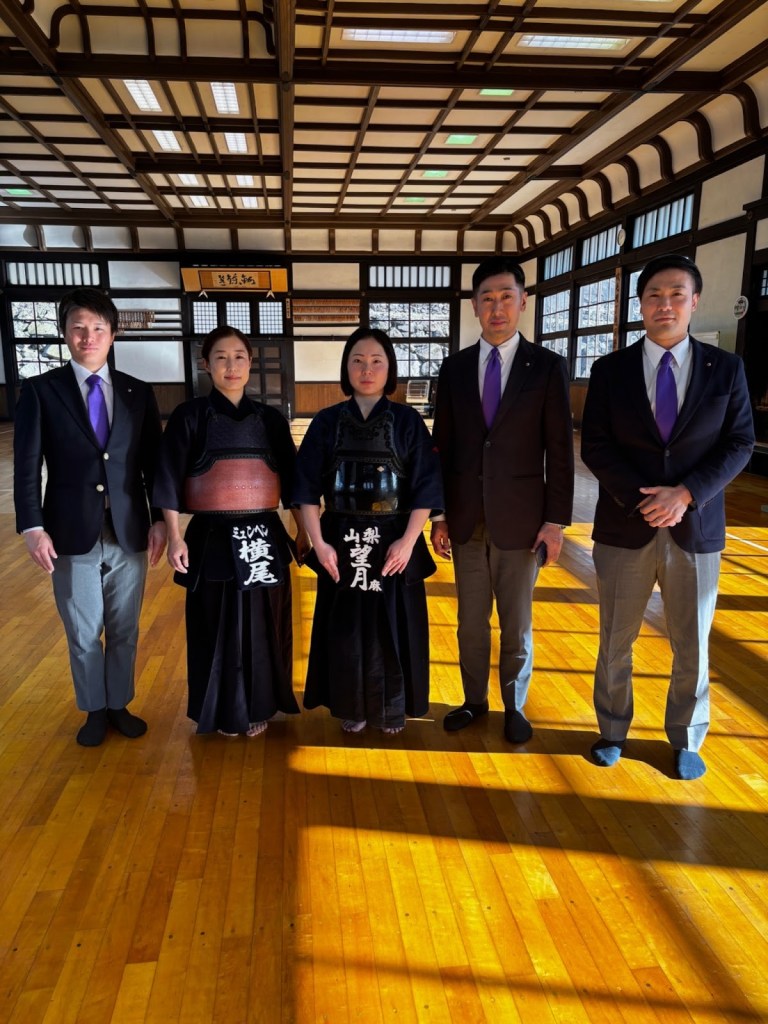
When I arrived at Kofu Station, Tanzawa sensei was already waiting for me with a young policewoman, Mochizuki san, who would be my warm-up partner at the Kofu Butokuden.
About a 10-minute walk from Kofu Station is the Kofu Butokuden, located in Maizuru Castle Park.
The Butokuden is usually divided in half for kendo and judo, with tatami mats for judo, but on that day, they removed the tatami mats and used the entire space for kendo.
Tanzawa Sensei mentioned that he often practices there.
When we arrived at the Butokuden, there were already some competitors present.
Two sensei were practicing, some had just finished their warm-up, and others were still arriving.
Some people from the Yamanashi Police tokuren (elite kendo team) were there in suits, as part of the event organization.
Everything looked very professional and well-organized.
Mochizuki san showed me our changing room, a large tatami room in the building next to Butokuden, where several trophies and other items are displayed that are probably normally used for other things.
It felt a bit (or very much) like I was being watched, but luckily I felt frighteningly calm and was able to do kihon with Mochizuki san for around 30- minutes and keiko at the end.
After my warm-up, many other sensei arrived, including Murayama Chinatsu sensei from Saitama, a legend of women’s kendo and a five-time All Japan Champion. We had once invited her to the Bavarian New Year’s keiko a few years ago, and Kondo Keiko sensei (née Baba), 2003 WKC champion, whom I had fought at the WKC in Taiwan in 2006. I was super excited to be able to say hello and give them some souvenirs from Germany.
After greeting the teachers, we went to the Castle Hotel, a five-minute walk away, still in our hakama and keikogi.
At the hotel, next to the reception, there was a large poster of the championship and a long desk with many paper bags labeled with names. Several people in dark suits and purple ties were standing to welcome all the arriving competitors.
It was quite overwhelming how everything was so professionally and thoughtfully organized. Wow!
Since I had a large bag that could fit both my shinai and bogu, as well as another bag filled with souvenirs, Tanzawa Sensei and Mochizuki san kindly accompanied me to my room. I really can’t express my appreciation enough.
The room was of course in Japanese size, but when I saw all the souvenirs, a bottle of red wine from Yamanashi (by the way, Yamanashi is apparently very famous for good wines) with the championship label on it, Shingenmochi. As well as various fruits and water bottles, it automatically made my heart beat faster!
After taking a quick bath and getting dressed up in a suit, being glad that I had asked Tanzawa sensei and Murayama sensei in advance what I should wear to this kind of event, I went down to the lobby where all the participants and shinpan were waiting to go to the open drawing event location, the Bell Classic Kofu, where weddings are usually held.
Competitor Meeting
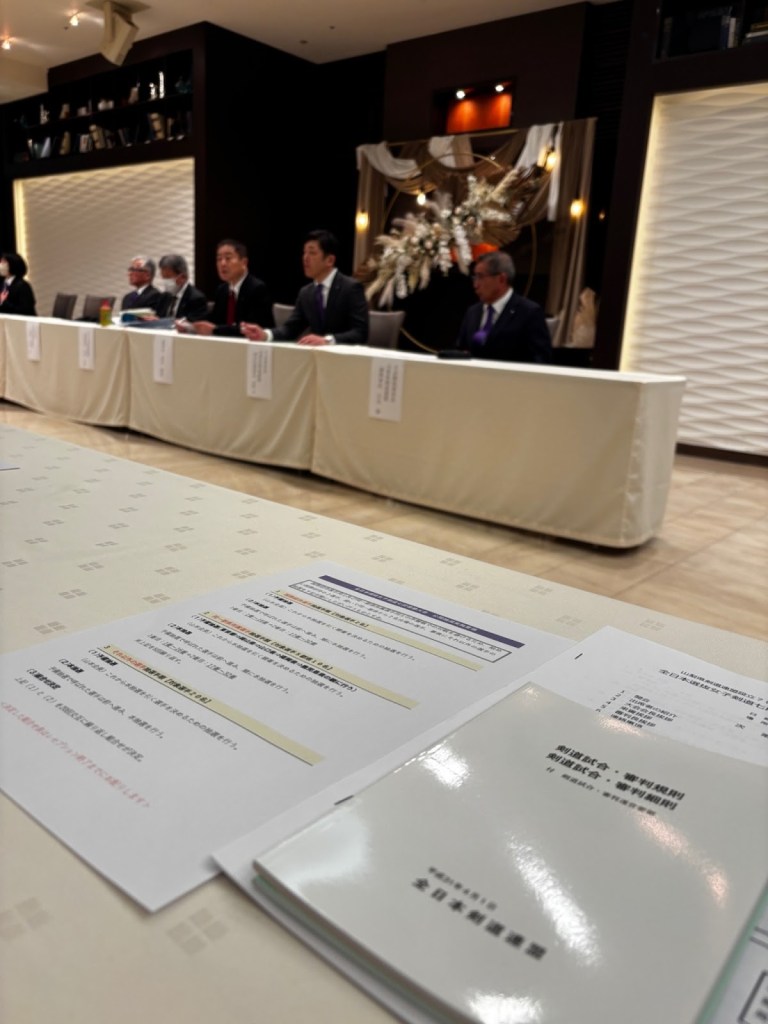
In the meeting room, there were several tables for two people, each with a championship schedule, all the related information, and competition and shinpan books.
After all the important figures from the organization introduced themselves and expressed their joy and congratulations to the selected competitors, there was a final word from the shinpan-cho, Koda Kunihide sensei.
Koda sensei explained that this championship would be comparable to an 8 dan championship.
“While winning and losing are, of course, important, what matters most is the kendo with great content.”
The Open Drawing
After our meeting, we moved to a larger room with several round tables. The seating arrangements had been made in advance, and Miura sensei (USA) and I sat next to each other, while the other sensei from Tsukuba and Chuo University appeared to have been assigned to sit together at the same table.
The other seats also seemed to be arranged so that people from the same university sat together.
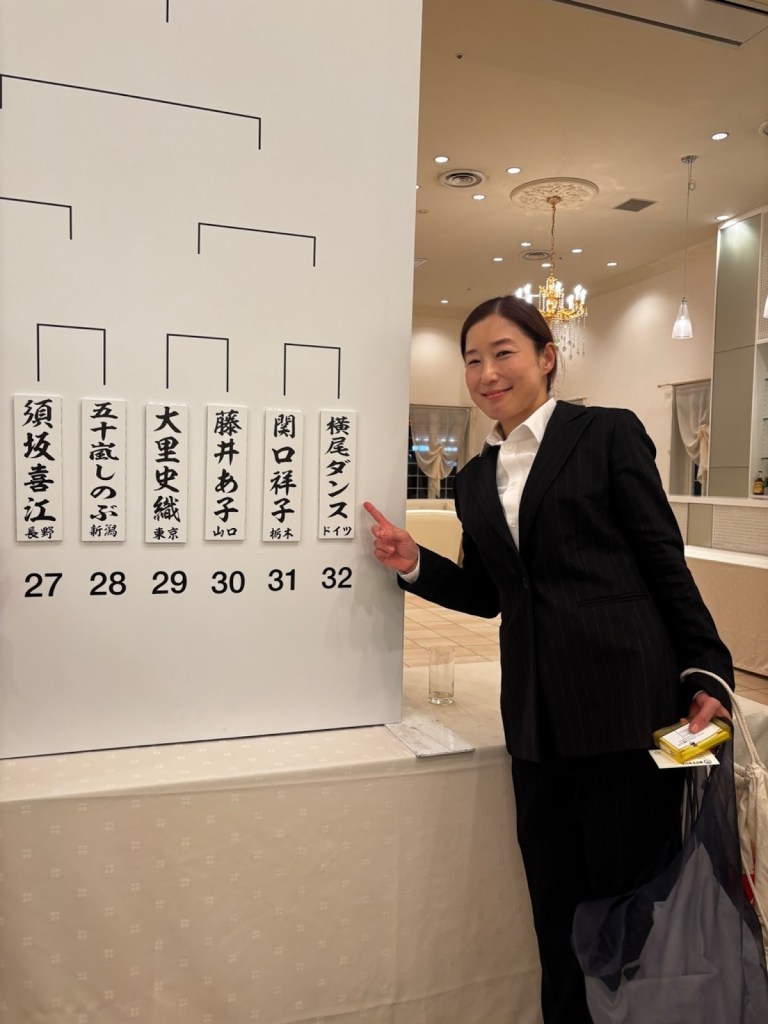
To prevent competitors from the same prefecture as the overseas group from facing each other in the first round, the open drawing began with the overseas group. Miura Sensei drew player number 6, and I drew number 32!
Toward the end of the drawing, my opponent was decided, Sekiguchi Shoko sensei from Tochigi. She was the same age as me and had competed in the All-Japan Championships and the Kokutai Championships. She was sitting at the same table as me. It was very exciting.
Finally the open drawing was over, we could start with the pleasant part of the evening, with the super delicious Japanese buffet!
And then we had the opportunity to greet all the participating sensei, shinpan, and special guests like Tani sensei.
It was a very special evening!
Day of the Championship
It was said that there was to be no shinai check since this was the highest women’s competition.
The schedule for the day was as follows.
7:40 Departure from the Hotel
8:15 Warm-up 2nd floor Dojo
9:15 Opening ceremony
10:00 1st round
The fact that there was only one shiaijo was a bit intimidating and overwhelming for many participants, especially since even the 8 dan championship is not treated with such importance with two shiaijo.
There were many incredibly exciting shiai, with several matches between former teammates of Japan. Due to injuries and other unknown reasons, two originally selected participants Shinzato Chikano sensei (Tokyo) and Miyazaki Sachie sensei (Saga) (née Shojima) could not attend.
However, two other fighters from neighbouring prefectures were quickly invited. Arai Takako sensei from Saitama and Ōsato Shiori sensei from Tokyo.
Arai Sensei made it to the Top 8, while Ōsato Sensei secured 3rd place. The world of Japanese kendo is still astonishing. There is an extraordinary number of strong athletes. I had the last fight of the first round, and around the 8th match, I was able to warm up with Ōsato sensei.
It was an incredible experience! Everyone was so kind and friendly, and I felt truly grateful.

My Fight
Surprisingly, I wasn’t nervous. But unfortunately, my match with Sekiguchi sensei was over very quickly.
I certainly didn’t expect to lose the first ippon so soon, but that’s just how it goes sometimes.
We saw, time and again, in many moments throughout the tournament, that even the most famous and strong sensei can lose.
This realization has now become my strength.

From the second and third rounds all the way to the final, there were many intense and thrilling shiai!
I was particularly impressed by Shimokawa Mika sensei’s matches.
Her first opponent was none other than Murayama Chinatsu sensei—the legend.
The last shiai I had seen from Murayama sensei was at the 62nd Tozai-Taiko match against Ogata Yuki sensei, which she won.
Shimokawa sensei’s subsequent shiai were even more intense. She faced formidable opponents such as Kozuno Yuka sensei (née Tsubota) from the Okayama Police, a former All Japan champion, national team member, and multiple winner of the Ōtsuhai (a prestigious women’s championship in Okayama). Shimokawa sensei also fought Fukuda Misako sensei from Nagasaki, who was a 19th WKC shinpan, and winner of the All Japan Teachers’ Kendo Championship, and placed third in the All Japan Championship. Shimokawa sensei progressed on to fight Ōsato sensei, a prison officer from Tokyo who has achieved third place in the All Japan Prefectural Championship and is a three-time winner of the National Correctional Officer Martial Arts and Kendo Championship.
The final fight between Shimokawa sensei and Ogata sensei was all the more astonishing.
I probably would have expected a different result, I must admit, but the pressure from Ogata sensei was immense and I guess Shimokawa sensei had something else in mind and was a bit surprised from the beginning by this kind of agitating, strong pressure and was more or less overrun til the end.
The fun and challenge of shiai.
The content must be good.
But if you don’t win, people won’t listen or follow you.
The semi-finals and final were outstanding. All were truly invaluable learning experiences in so many ways. It was simply fantastic.
As for me, I am deeply grateful for this once-in-a-lifetime experience at such a wonderful and unforgettable event. From now on, I’m ready to work hard once again.

Last but not Least
I would also like to thank all the sensei, even those I have not been in contact with for a very long time, who congratulated me on being selected for the championship. It was truly heartwarming.
A special thanks to Yamaguchi Tamiko sensei, who went as far as to ask her colleagues to bring me a congratulatory gift. Her colleagues mentioned that Tamiko Sensei turned 80 this year and that she was so happy to hear that I had achieved 7 dan and had been selected for the championship.
I believe that the younger generation now has more opportunities, with better communication and stronger connections within the global kendo community. This provides a foundation for even greater personal development.
I see a bright future ahead for the German and European kendo community.
So, come on, everyone, let’s do our best!

Results
1st Ogata Yuki (KUMAMOTO)
2nd Shimokawa Mika (KAGOSHIMA)
3rd Kondo Keiko (OSAKA) and Ōsato Shiori (TOKYO)


