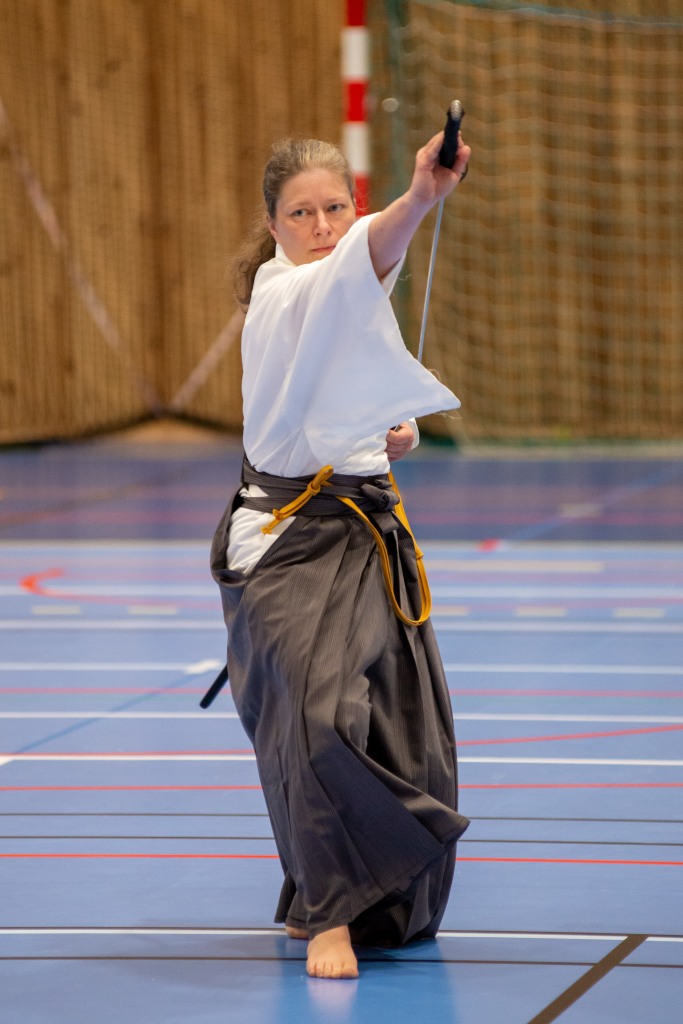
In February 2024, the fourth installment of the “Women in Iaido” seminar series was held in Utrecht, The Netherlands. This seminar series receives official support from the European Kendo Federation as part of their highlighted development areas “junior practitioners, female practitioners and lifelong kendo”. Despite having been interested in this seminar series for a long time, this was my first-time taking part and so I cannot comment on the seminar series as a whole but thought I would share some impressions and reflections for those interested in this type of seminar setup.
The “Women in Iaido” seminars have all been conducted under the leadership of Kinomoto Miyuki-sensei, iaido kyoshi 8 dan and a practitioner of Shinkage ryu. This year unfortunately, we all learned at the last minute that Kinomoto-sensei would not be able to attend in person due to an eye condition requiring urgent medical care. I’m sure we were all (including Kinomoto-sensei herself) disappointed to hear this, but the sensei still managed to prepare and conduct a successful training seminar more or less as planned. The seminar was set up so that Kinomoto-sensei led the morning session over a video connection, with Kanto Yuki-sensei (iaido renshi 7 dan, Muso Jikiden Eishin ryu, Belgium) translating and Danielle Borra-sensei (iaido kyoshi 7 dan, Muso Shinden ryu, Italy) and Elaine van Ommen-Kloeke-sensei (iaido 6 dan, Shinkage ryu, Netherlands) assisting in various ways.
This year’s seminar followed the same general setup as the previous seminars with the Saturday being a women-only event, and the Sunday being open to all interested participants, but with a special invite extended to male teachers who want to get better at teaching female students. Because of the remote teaching taking place this year, the morning sessions ended up being mostly listening and observing Kinomoto-sensei, and then practicing the various exercises and techniques she had been explaining later in the day.
Despite the last-minute change of plans and only having access to Kinomoto-sensei over video, it was immediately clear that the sensei group had planned the event in detail and was very coordinated. For example, when Kinomoto-sensei wanted to talk about strength using the imagery of a Japanese fan, Kanto-sensei quickly picked a fan out of her bag. Small details like this were very nicely executed, and really helped give the feeling that Kinomoto-sensei was indeed part of the seminar, albeit not physically attending. The sensei present all made an effort to make sure that the Saturday seminar felt like a safe space for everyone present, to make sure that topics that may otherwise feel awkward or taboo to bring up could be breached. Kinomoto-sensei also covered topics such as good cutting technique (from the perspective of “you don’t have to cut like a man to be good at cutting”), zanshin and proper kitsuke (dressing).
The last topic may seem unexpected to some but has been a recurring theme during the seminar series as many women practitioners reported that they did not have a senior woman who could show them the tips and tricks of getting the clothes to fit (and stay put!) in their dojo. This time, the kitsuke part focused especially on wearing the montsuki, but more fundamental topics such as correct placement of the zekken (nafuda) on curvy body types and how to go the bathroom while wearing a hakama were also covered. In case anyone thinks the last part is a bit overly mundane, it has been my experience that every time this is discussed, there is at least one woman present who wasn’t previously aware that she did not need to remove the hakama at every bathroom break, and the “Women in Iaido” seminar was no exception.
On Sunday morning, with the mixed gender group present, Borra-sensei presented the results of a small survey she had performed among female iaido practitioners and their male teachers in Italy. While the women fortunately reported that they had not experienced overt gender discrimination in iaido, they reported feeling that they had a harder time progressing to higher levels and the responses from some of the teachers also identified that they struggled to support female students in progressing beyond the basics. It was also pointed out that women have a harder time getting recognition as teachers, which was supported by data on how many female iaidoka (in Italy) have acquired the necessary teaching diploma vs how many actively teach in their dojo (6 out of 16).
Kinomoto-sensei addressed these issues by again talking about how strength in iaido does not just rely on muscle power, and so there should be no important physiological difference in men’s and women’s ability to cut well. Several technical points that women had brought up as problematic (typically points where the sword blade is brought close to or in direct contact with the chest) were also explained by Kinomoto-sensei during the second day, so that male teachers in the audience would also hear the answers. If I can summarize the essence of Kinomoto-senseis replies according to my own understanding, it was that when the technique is correctly executed (including correct posture and taisabaki) these issues should no longer arise. And so, while the issues themselves may only or predominantly arise for female practitioners, they can still be resolved by understanding the correct form. And so the take-home message in a sense, was that there is no “male” or “female” iaido – only a correct form with some slight individual variations in presentation.
So, why then do we even have a “Women in Iaido” seminar one might wonder? According to statistics from the European Kendo Federation (EKF) grade database that Borra-sensei presenting, only around 17% of European iaidoka are women and it was quite clear from Borra-sensei’s presentation that while iaido itself is not gender-dependent, the training environment may be quite different. Just the opportunity to be taught by high-level women is an unusual one for most iaidoka and serves as an important chance to find female role models. This need was further highlighted by questions raised about how many women have passed iaido 8 dan, and Kinomoto-sensei listed the names of all eight who have done so to date. Personally, I think the opportunity for men to attend on the second day is also highly important because from my own viewpoint it seems that many of the things male teachers reported they struggled to teach women could be addressed by them seeing more high-level iaido performed by women. And so, if I could change one thing about the “Women in Iaido” seminar it would be to make it an event with only female teachers. So far, the seminars have been adding the support of some high-level male teachers on the second (open) day of the seminar, and I can understand that there are several reasons for this. Despite that, I would hope that in the future this could be an event that showcases female teachers even more.
All in all, I think the “Women in Iaido” seminar is a valuable platform for female iaido practitioners to meet, connect, find role models and breech topics that may feel more comfortable to bring up in this setting. I also think it can be an important platform for showcasing female iaido to iaido practitioners regardless of gender. This is important not because women’s iaido is different – as Kinomoto-sensei was making very clear, there is no such thing as “women’s iaido” – but because if there is unequal representation in what types of bodies we see doing high-level iaido we will eventually find it difficult to imagine how technical correctness will look for other body types.
Finally, I am sure some have been worried that seminars like this may lead to more gender separation taking place in iaido. As it is, I think most of us highly value the lack of importance assigned to gender in All Japan Kendo Federation (ZNKR) iaido. (Or as Donatella Castelli-sensei jokingly remarked during the opening of the seminar “you have a special responsibility to be great, because you have the chance to beat the men in competition”). Fortunately, I think the same is true of all the female (and male) sensei involved in organizing these seminars, and despite the first day being a women-only event, the overall theme and vibe of the seminar was really to improve the inclusion of women rather than any form of separatism.
 Kate Sylvester Perspectives
One response to “ ‘Women in Iaido Seminar – Netherlands’ by Caroline Lindholm (Sweden).”
thanks so much for this summary! You’ve captured the topics, atmosphere and essence of the seminar really well. It has been great meeting you and hope to see you for the next seminar.
LikeLike