Women’s voices and achievements are under-represented across kendo-related media and literary channels. Guest essays published on this website share personal experiences, perspectives, and reflections on kendo that are written by women.
Guest Essay: Bunbu Ryodo in Latin American Women Kendoka: Underneath the Iceberg of the WKC and Academic Life by Tanya Saga and Karen Pullupaxi (Ecuador).
Tanya Saga (née Gomez) 5 dan and Karen Pullupaxi 3 dan, are both members of the Eduador national kendo team. They have joined the Kendo World Championships facing an academic and professional context developed in a country outside of their hometown.
Tanya Saga is a researcher, educator and translator. She graduated from Kanoya Sports University and the University of Tsukuba. Since she started kendo in junior high school, she has visited Japan several times for training with elite instructors. Tanya is the founder of Butokukai Dojo in Ecuador and cooperated with Rotary in Kanoya to make a donation of kendo equipment to Ecuador. Currently, Tanya is the director of Active Life, an organization for the exchange between the international and local community. She develops programs in sports and language education for integration. Her research analyzes cases from the cultural perspectives.

Karen Pullupaxi is an architect from Ecuador who is currently enrolled as graduate student of the Olympic program at the University of Tsukuba. Her research is in the reconstruction of cities through sports. Also, she works in the fields of education and integration of the community.
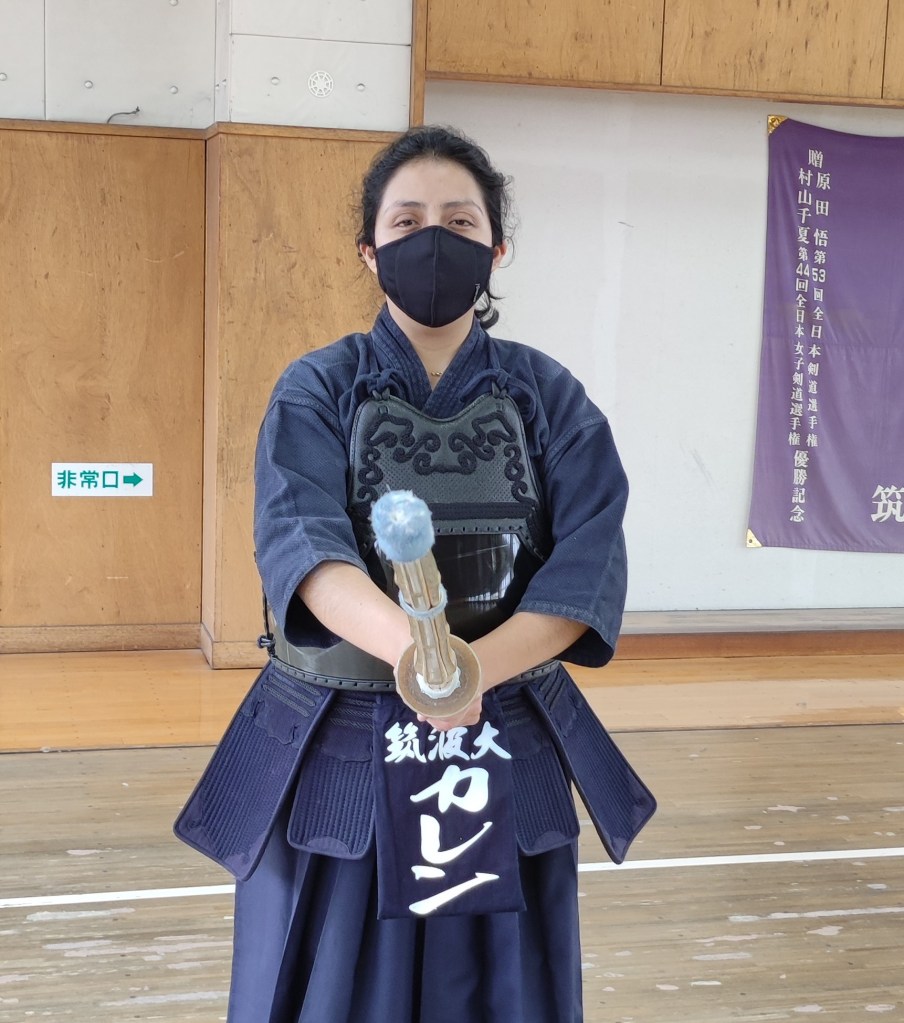
Bunbu Ryodo in Latin American Women Kendoka: Underneath the Iceberg of the WKC and Academic Life
It is always challenging to be a national team member and especially when it is not a full time career that implies having other life responsibilities. Some players around the globe have faced a lifestyle between kendo, professional and academic life. There are many national players that do not receive any sponsorship, public or private, to represent their own country in international competitions. Therefore making a career in kendo can be a challenge.
Many players are students, employees, have families and train at the same time. From male and female players this article is limited to describe players who fulfill the 2 following characteristics:
-An academic career in a graduate degree level
-Be national player at the kendo world championships
Underneath the iceberg of championships includes adjusting education schedules to join the training at several dojos and high performance training sessions. Plus, the academic side of lessons, internships, assistance to professors, and part time jobs. For Tanya and Karen this has also been possible thanks to their families constant support and the guidance of their mentors.
Underneath the Iceberg: Tanya Saga
Tanya extended a year at her university career in Multilingual Business and International Relationships to train for the National Team since 2010. She obtained the sports scholarship and took part in the Latin American Championships obtaining the second and third positions in the teams that joined. Plus, she participated in the 16th and 17th World Championships. Tanya adjusted her schedule to study, for training and for doing part time jobs to participate in international training events and seminars not only in the LA region but also America, Taiwan and several times to Japan. Other players around used to say “I cannot do it because of my economical condition” or “you’re lucky” but Tanya can assure that “luck” comes with effort and organization.
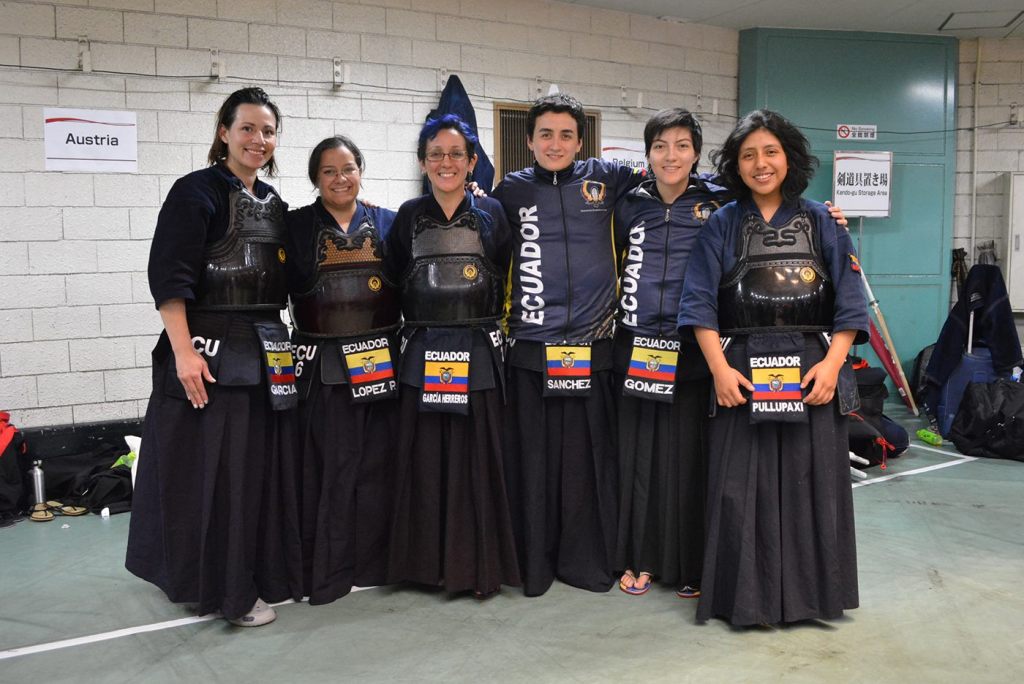
Photo: Team Ecuador at the 16th WKC in Japan
In 2017, Tanya decided to take her major to the next level in a strong university of kendo, National University of Sports in Kanoya. Then, she joined the Master course in International Development through Sports. During this period, academic conferences, part time jobs related to education, training every day at the club of kendo, and doing an internship in kendo coaching were the lifestyle connected to the key word “organization” to enjoy the experience to the fullest and not to give up. The challenge was the 17th WKC in South Korea where she was the only female member that represented Ecuador. After graduating she continued her research at Tsukuba University. As a result, she obtained the 5 Dan rank and started working in education and launching her own project for development.
Bunbu Ryodo: Karen Pullupaxi
Karen was a high school student when she accepted the challenge to be part of the Kendo Female National Team and participate in the 16th World Kendo Championship. She was in her senior year and at the beginning she struggled to balance her school duties with the new training schedule. Her mother, the whole team, and coaches supported her. She became the youngest Ecuadorian player who joined a World Kendo Championship. The training preparation included monthly sessions of national team training plus night training at local dojos. Finally, in Japan the training for the WKC included a training camp in Oita Prefecture and the visit of various sensei that have taken care of the Ecuadorian Team through Jica.
Years after, the youngest player, Karen became an architect and during her university career joined the regional competition the Latin American Championship obtaining the 3rd position in teams. After graduating from the university, Karen obtained 3 Dan rank. Then, the next challenge came. Karen, recommended by Tanya, joined the University of Tsukuba in the master of Olympics Studies and she applied her major as an Architect to research the recovery of cities “machizukuri” after disasters through sports. This is a good opportunity to develop the academic field and at the same time continue the preparation process for the 18th WKC.
Underneath the Iceberg of Bunbu Ryodo
Following the concept of Bunbu Ryodo, Tanya and Karen obtained results giving effort in both the training and academic fields. Tanya acquired the sports scholarship during her undergraduate studies. Plus, the recognition for outstanding performance in her graduate studies, including Japanese government and private scholarships. Similarly, Karen obtained the scholarship of excellence in her undergraduate studies and a scholarship of the Japanese government for the graduate studies in recognition of her effort.
Many kenshis’ dream is to be able to train in Japan and young adults usually apply for programs of exchange focused only on kendo training. In this case, Tanya and Karen cases describe enhancing their major studies to develop a professional career in a place where they can improve kendo training with elite athletes. Currently, they have access to train in private dojos, with elite instructors and players. They train focusing on the next World Kendo Championship and additionally ascend their rank examinations that are coming soon.
We recommend taking care of the family and close people that constantly support the challenges on the path. There are many challenges underneath the iceberg. Nevertheless, we highly recommend young athletes to pursue a graduate degree abroad if they have the opportunity to choose between a short term exchange or a university degree. There are scholarships available and tuition fee exemption for students with outstanding performance. The key is organization to be able to fulfill the academic duties as the ones as athletes following the idea of Bunbu Ryodo.
All photographs in this article were supplied by Tanya Saga and Karen Pullupaxi.
 Kate Sylvester Perspectives
One response to “Guest Essay: ‘Bunbu Ryodo in Latin American Women Kendoka: Underneath the Iceberg of the WKC and Academic Life’ by Tanya Saga and Karen Pullupaxi (Ecuador).”
Thank you both for this article. Continuing to develop our World Kendo Family I got to know Tanya via various Kendo Events and World Champs. I nearly took a female delegation to South America prior to Covid as I was so impressed with their development of Kendo in various countries and particularly Ecuador. I would love to do that one day. I think it is young people like this who can be our future Sensei and guardians of our Budo and I am so thrilled to hear the stories of these wonderful young kenshi (ken-she)
LikeLike