Women’s voices and achievements are under-represented across kendo-related media and literary channels. Guest essays published on this website share personal experiences, perspectives, and reflections on kendo that are written by women.
Guest Essay: Doing Seme Work in Kendo and Daily Life in Preparation for the 6 Dan Exam by Kaori Dimovski (Australia).
Kaori Dimovski (née Miki), 5th dan is the current Australian Kendo Champion and an instructor at Monash University Kendo Club. She started kendo when she was 9-years-old in Fukuoka, Japan. At 14-years of age, she left her family to do kendo at Kumamoto’s Keiryo Junior High School and boarded with the kendo teacher Kurokawa sensei and his family. She went on to Aso High School and learnt kendo from Izumi sensei. Thereafter she attended Fukuoka University of Education and was taught kendo by Sumi sensei. Her brother (6 dan renshi) and father (7 dan kyoshi) are both important kendo inspirations in her life. After graduating she moved to the UK to study English and practiced kendo on occasion. Kaori now lives in Melbourne, Australia with her 3 children and husband and runs Festive Flowers, a flower arrangement business that specialises in weddings.

Doing Seme Work in Kendo and Daily Life in Preparation for the 6 Dan Exam
I am in the situation to challenge my 6 dan grading in the near future and have been trying to focus on seme in my kendo keiko. Objectively speaking, kendo that cannot be felt to be seme is said to be poorly evaluated. To strike, there has to be seme. However, it is only seme if the opponent reacts against my seme or if it causes the four precepts (the four precepts of kendo – surprise, fear, doubt, and confusion or hesitation) for the opponent.
My current situation is that my seme is monotonous or too simple, and when I try to attack, I get hit or after I step in as seme and when my body stops. Although it is generally said that we have to break the centre and also kill the kensen of the opponent, I am not breaking the opponent’s feeling, but rather, after I take a step, various thoughts come to my mind. I stop my footwork and look at my opponent’s movement too much. In addition, my current fault is that my opponent is hitting me with debana waza. I think about kendo a lot recently and I feel it is like life, especially in regards to the seme part. Therefore, I would like to understand seme deeply and make it my own by referring to the opinions of various sensei and pieces of advice from my father, who is ranked 7dan kyoshi and teaches kendo in Japan. He often sends kendo materials to me in Australia.
My Thoughts on Seme
First, in the examination, the process from seme to striking is observed by sensei who are judges on the grading panel. It is said that the most essential part is the seme part and getting the shodachi (the first strike). How do I seme to create opportunities to get the strike? Do I seme them in small increments or in a big, aggressive way? The purpose of seme is to create opportunities to strike, so I cannot attack in a selfish, one-way way. Always sensei said that we must seme based on the principles of kendo. We must seme with the sword, with the ki, and with the body (including footwork).
Every basic training is wholly essential. It means to do seme with whole spirit from the distance of the “shokujin no ma-ai” (touching blade distance) using my footwork, and make seme first before the opponent to create a chance then, strike with sutemi (not holding back or attacking with abandonment) – if there is an opportunity to go. If the opponent strikes forcibly, I must respond with a technique like oji-waza. To have a body that is ready to move at a moment’s notice, it is fundamental that the body must learn to react quickly through regular practice (including kirikaeshi, uchikomi-geiko, and kakari-geiko) so that the techniques are remembered in the body – or become intuitive and intrinsic.
All sensei said that we should not just strike whenever we want because we feel like it, but we should seme with our opponent communicating through the shinai. If the opponent does not feel anything in response to my seme, it means I am not making seme enough. Seme is to make the opponent’s feel insecure. When the distance between the two is far, the mind can relax a little, but as the space gets closer, there is a very tense pause where the mind becomes anxious, wanting to strike, not wanting to be hit, and not wanting to be defeated. (I consider this a tricky point, where you are a little closer than “Issoku-Itto” interval, which is already striking distance). This is seen as the essential point of seme, and we are told how we deal with it is crucial.
It is not good to avoid this most critical interval and strike from a too-far distance or mess around by getting in too-tight space with each other. In this tensest of intervals, I have to be patient then win in seme and go strike with sutemi, or will the opponent seme back to me, I raise my left hand and to a self-guarding and pointless dodging stance (which means I lost in seme), or I go backwards with fear, or I seme back again with strong feelings and execute my techniques? I think this is holding back for a moment before striking is what is often referred to as “tame” in kendo.
The other day, I watched the grading examination for shodan to sandan in Melbourne. When I watched all the matches, some didn’t have any seme before the striking and either waited then did kaeshi-waza when the opponent came or just waited and struck when the opponent came. Those who are doing this in the grading, I thought they would not pass, and yes, they didn’t. Also, those who did seme and tame and then struck made a beautiful ippon which gave some satisfaction to the people watching the process of seme to strike. This was an excellent opportunity to watch the successful process of seme, especially while writing an essay about seme in kendo.
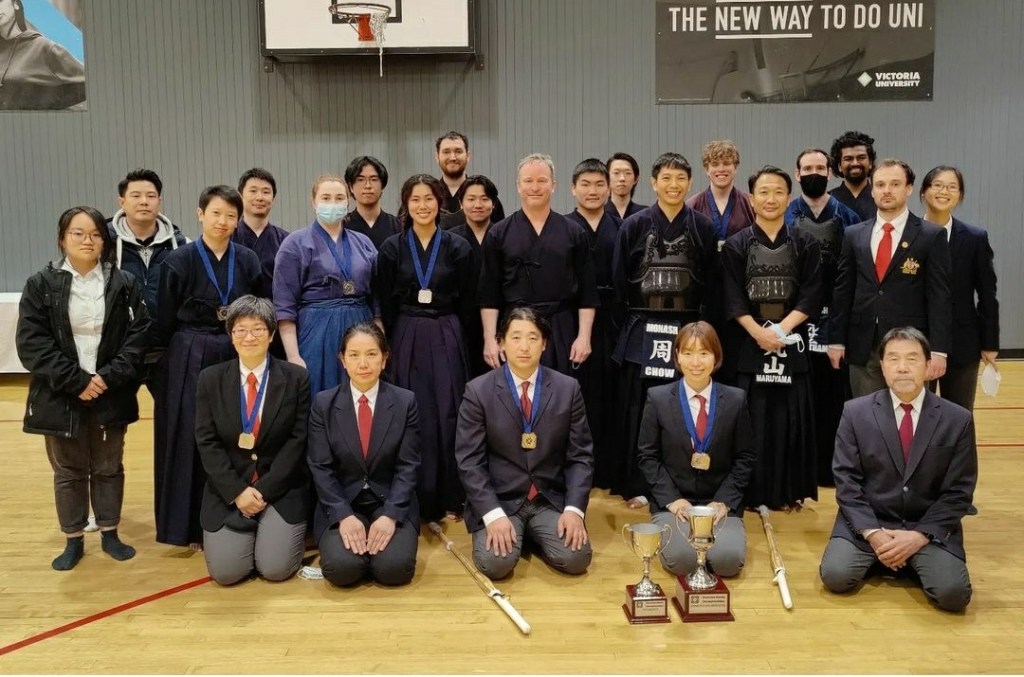
Photo: Monash University Kendo Club (Australia)
At this point in seme, it is more of a battle against oneself than against the opponent. I think it is crucial to have this mentality called “kokki” or 克己 the spirit of self-discipline (also the motto Monash University Kendo Club), as it is here that I must defeat myself if I show a weak heart. I have to win against myself first. If I overthink at this “ma-ai” (distance), my footwork will stop, and I will look at my opponent too much. I will be struck there with some of the four kendo concepts coming to my mind when I get hit.
We must never forget why we seme and going into the ma-ai not just step in without any thinking. Even If I get seme by an opponent here, I have to have the mental strength to endure the situation and be patient, not going backwards and seme back with a strong spirit. The guts to seme, be one step ahead than my opponent, and have the courage to strike with sutemi. I want to keep this in mind when I practice every time.
When I was a student, I was so focused on winning and losing in the kendo matches that my mood would rise and fall depending on whether I was hit or not. Now, as I am challenging for the 6 dan, I have become more conscious of kendo seme, and I have come to think about things in the context of my own life.
Working on Seme in Daily Life
This is often applicable in everyday life to me, work and child-rearing especially. I always think I have to react to my children’s acts that they make one after another. I should deal with it without disturbing mine and their emotions, just as I have to calmly and patiently endure a seme from an opponent in kendo without reacting (but in reality, this is not the case as I tend to respond to their attitude. In fact it not really so easy and it is always challenging for me. It is the same thing I can say to the relationship with my husband too, or even at work).
Sometimes it isn’t easy to take action because I overthink. Also, when I want to try something new, either in terms of work or in my daily life, I sometimes think, “What if I fail?” or “What will people think of me if I do this?” or “Will I lose something?” Even when things don’t go my way, I must have the strength to persevere and seme back. This is where kendo seme comes alive, and kendo’s overcoming spirit is nurtured. It is the effort to overcome one’s weakness and the courage to go on the seme and go with sutemi.

In kendo, I think it is only this moment and just continuous of ”right in this moment”. Even though I got hit just a minute ago by my opponent, I could not keep thinking about that in the match, and it causes stop my body movement. I have to glance a moment quickly. In life, we can say the same thing, some mistake we made in the past or a word someone said to us which made us so down, but we can not keep thinking about it because that makes us stop challenging things in life. I want to aim to live my kendo so that I can live my life, and I want to work on my daily training so that my life can positively reflect my kendo.
All photographs in this article were supplied by Kaori Dimovski.


2 responses to “Guest Essay: ‘Doing Seme Work in Kendo and Daily Life in Preparation for the 6 Dan Exam’ by Kaori Dimovski (Australia).”
A very well written essay, “Doing Seme..” by Kaori. Every aspect about Seme was well explained. However, in my opinion, I disagree with the notion that “Seme” is the most essential part during a high rank promotional exam. By all means, I don’t mean to discredit Kaori’s notion on Seme. Seme plays a huge role in the art of Kendo and I wish I had more time to explain my view. I am currently a 5 dan in kendo and have been practicing Kendo for 31 years in the US. I will be testing for 6 dan in the next promotional exam. I have done extensive research and reviewed many past high- ranking promotional exams. I came to the conclusion that in order to pass the exam, one must show a clean “men” strike while exhibiting good “kamae”, with or without “Seme.” This is just my opinion. Thank you
LikeLiked by 1 person
I like this article because I can identify my concerns and thoughts with Kaoris’. When I express my questions and thoughts about such similar subjects in dojo, my trainer tells me that “i think too much”. He doesn’t imply that thinking about or analyzing kendo techniques is wrong but thinking might slow down or impede our practice. I also believe that he advertises learning by doing, trying to realize and learn the sensation of good movements, good seme or a good hit in the moment and try to relive it next time. I believe that there are different types of learners and I too belong to the “analyzer” group. I don’t think that other ways of learning are wrong or inefficient but simply not applicable for everybody. I like to analyze and break down and am happy to see that Kaori sees it in a similar way. She spoke from my heart.
LikeLiked by 1 person