Women’s voices and achievements are under-represented across kendo-related media and literary channels. Guest essays published on this website share personal experiences, perspectives, and reflections on kendo that are written by women.
Guest Essay: Voyages by Manuela Hoflehner (Austria).
Manuela Hoflehner is currently 5th Dan and has been practicing kendo since 2007. She was part of the Austrian National Team for 10-years, participating in 3 World Kendo Championships and 7 European Kendo Championship, leading the women’s team for five years.
As part of her competitive development, she has put a focus on mental training, regularly attending congresses on sports mental training from 2014 on. In the course of this, she taught kendo to student teachers at the University of Education Upper Austria for two years, integrating kendo and mental training for their pedagogical purposes.
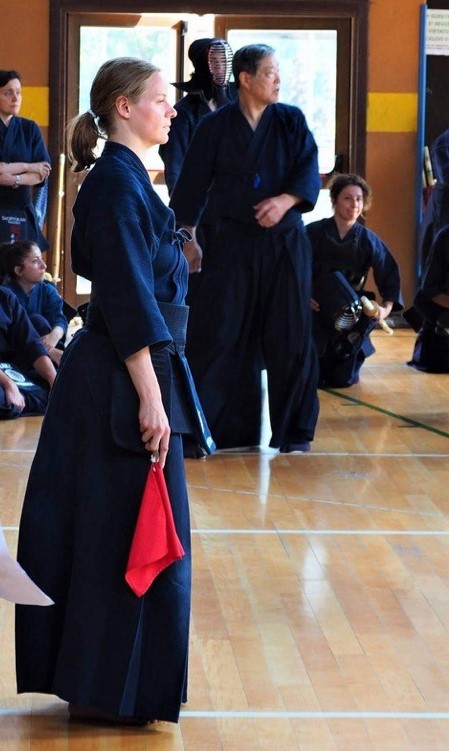
Voyages
I had been practicing kendo for barely one year when I went on my first seminar abroad. We drove seven hours to Germany for a 5-day-gasshuku in the Black Forest. It was the start of my international kendo travels.
The seminar was an intense experience, and not just because of the three trainings per day. The training even continued in the breaks: We were all accommodated in the same cottage, a house just for us kendo people. Those of us who did not sleep during the lunch break spent the time in front of the entrance, showing each other exercises on tenouchi and talking. I learned as much during these breaks as during the trainings, not the least thanks to a sensei from Switzerland who always joined our talks.
Some weeks later I was on a train to Switzerland. Said sensei had invited me to visit, and in the spur of the moment, I followed. Objectively, it was a crazy trip: 16 hours in a train for a 3-hour-training. But it was worth it. Not for the training itself, but for the weekend spent together talking. There is nothing that has been as formative for my kendo as these two days.
At the time, I was struggling to find access to one teacher in Austria. Even though I was trying, it felt like there was an invisible wall there, the size of Grand Canyon, and it was bothering me.
But I was a beginner. Who was I to criticize those up high in the hierarchy? Still, after strolling through a forest with the Swiss sensei for a few hours, talking, I took the courage and spoke my feelings.
I got a reply that stayed with me for years: “It is not your job as a student to find access to the sensei. It is the job of the sensei to find access to you.”
It felt like I had been carrying a stone in the backpack of my kendo journey from the beginning on, and with this short, on-the-point remark, the Swiss sensei managed to remove it instantly. Whenever the going got tough the following years, I remembered his quote. It eased my journey.
Expanding horizons
KendoLinz, my dojo, was built on going out and bringing knowledge in. We never had a teacher on location and relied on higher graded people from outside visiting us as well as us using every possible chance to exchange with other people. So that is what we did.
Living in Austria, being a small country in the heart of Europe, enabled us to relatively easily and quickly travel to neighbouring countries like Czech Republic, Hungary, Italy, Slovenia and Germany. This allowed us not only to bring knowledge in, but to experience different cultures of kendo. To see that there is not the one truth, but many perspectives and ways to live kendo: How you organize everyday training, which – and whose – goals you strive towards, what shape you give the word “sensei.”
Over the years, traveling has thus become one of the foundation pillars of my kendo. If you want to build on something, for it to hold up, it needs to have a good foundation. For me, those are several pillars that enable me to keep the fire burning or to get up again after I have hit a wall. Because in its essence, kendo comprises a lot of repetition and also continuous frustration. Not every day is good and you are constantly confronted with your own limits. If you don’t find a way to handle this frustration, the fire isn’t going to last.
My way of handling this frustration is to have enough variety to switch focus when I need to. Like I need to have a Work-Life-Kendo-Balance, I also need a balance within kendo itself.
One of these pillars is traveling. Since that first seminar, it has become an integral part of my kendo journey. When I get bored by the repetition in the weekly trainings, I go on a kendo weekend. Meeting people whose fire for kendo burns so bright is immensely stimulating. They help me to let my own fire burn brighter again. And I get input to work on, which helps make my regular training in Linz more interesting and enjoyable again.
And reversely, when a kendo-weekend wasn’t satisfying, I return to the dojo. Coming to the dojo always feels a bit like coming home. A safe space where I can work in my own tempo and with great people on my and our improvement.
Mix and match
Similarly, when I’m in our children’s training, whatever bothers me about my own kendo becomes irrelevant and the focus changes completely for that training day.
Kendo is such a broad field and has so many niches. Occupying some of them and switching between them has helped me ship around the bad weather zones that undeniably come up over time. It’s a constant altering and adapting – your kendo to your body, your life, your changing interests and responsibilities in life as well as temporal and financial capabilities. Over the years I figured out how many trainings per week are good for me and how many are too much. Balancing how many travel weekends per month are good for me is still a struggle between having fantastic experiences with other people and wishing for a quiet weekend on my couch with a book.
Finding this balance is essential for keeping going on without burning out – as well as creating an environment for yourself that lets you thrive. Most of us are not in the ideal learning spaces – lack of teachers, lack of training partners, lack of training time. Coming to the dojo doesn’t feel like coming home for everyone. Maybe we have to deal with people who follow a different direction and put stones in our way.
But our energy is limited, and the more we have to deal with freeing up the path, the less time there is for what actually brings us forward – the practice. Your energy goes where your attention is.
Some people are energy vampires, some people want to see you fail. Staying on the road is often hard enough in kendo, even without such distractors. Because even without others: 80% of our self-talk is negative. We are excellent at talking us down ourselves. We don’t need somebody else to do it for us, too.
And this is also part of what makes international travel so valuable for me. To seek out people with a passion for kendo. To talk about the essence: the practice. And to focus on that which made me fall in love with it in the first place: the joy of the movement and the intricacy of the interaction.
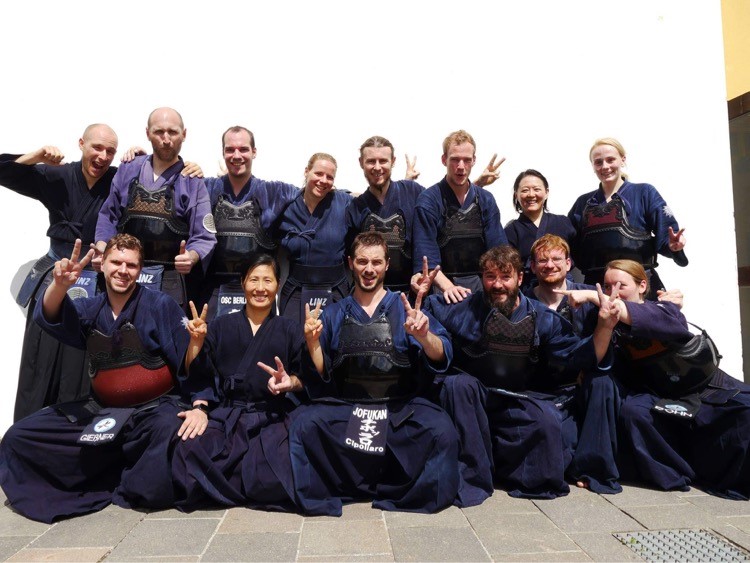
Photo: Tani-sensei seminar in Italy 2015
Traveling lets you see different perspectives, when maybe you are stuck with your own or your environment’s. It shows you different ways that are offered, but not forced on you.
And if you find people who join you on these travels, even better. As the saying goes: “If you want to go fast, go alone; if you want to go far, go together.”
Kendo travels have brought me to places that I would never have visited otherwise – Japan, South Korea, Israel, Poland, South Africa and Macedonia, to name just a few. Kendo travels have made the world smaller for me and have given me an understanding of other cultures that I could have never gained otherwise.
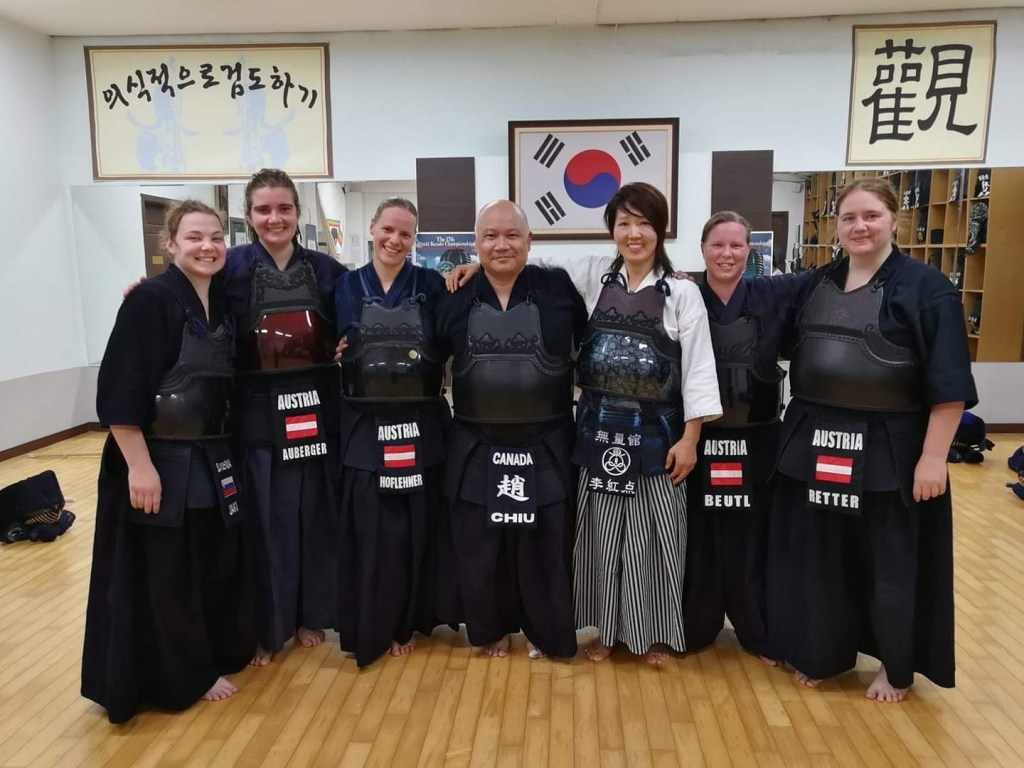
Photo: Kendo training in South Korea in 2018
Kendo is often said to be a way. For me, more than a way it’s a voyage. If you go down a way, you usually know where you will end up and with whom you go. You follow the path.
If you start a voyage, you are open for where it will take you. You follow your feelings and maybe change direction and destination if the current route does not fit you anymore. A voyage leads you to places and encounters that you would not have accounted for when you set out in the beginning. It lets you leave the path that somebody else has made. And it lets people become your travel companions who have set out from a completely different starting point. Joining you for a smaller or longer part of the voyage. And enriching it in completely unpredictable ways.
All photographs in this article were provided by Manuela Hoflehner.


One response to “Guest Essay: ‘Voyages’ by Manuela Hoflehner (Austria).”
I’ve enjoyed to read it, felt something similar stories in my budo life, how we are ger into Budo deeply. Especially struggling to keep the balance between Budo and life. I often think what I’m doing that I giving
up all my weekend life and friendships.
And… the questions, “am I doing Right?”, “why my Kendo do not improve than before?”, “am I too old for this?”
Nevertheless of all these, my decision is the keeping my Budo in my own way.
Thank you for sharing the story, and showing us the way you went to. Yes, I’m saying you, 先生, who were born before, and went the way earlier than us, and show the way where you found it right. Guiding us, teaching us. That’s the Sensei, not only the high grade reached.
LikeLike