This platform centres the voices and visibility of women (both trans and cis) and non‑binary practitioners within martial arts and combat sports (MACS). Contributions celebrate those featured while also challenging the dominant norms and mythmaking that sustain inequality and compromise practitioner physical and psychological safety in MACS. The site advocates for more just, inclusive, and accountable MACS communities.

Kate Sylvester
Author | Researcher | Coach | Kendoka
Events
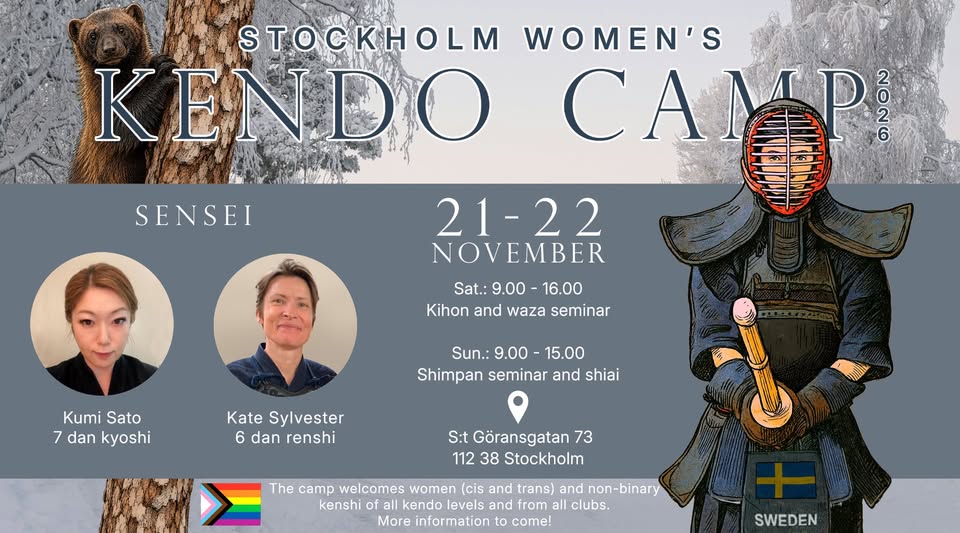
Stockholm Women’s Kendo Camp (November 21-22)
The Stockholm Women’s Kendo Camp 2026 will take place on 21–22 November, and registration is now open. The venue, S:t Göransgatan 73, is located just 3 km from central Stockholm and a short walk from Fridhemsplan station, airport buses, hotels, restaurants, and shops.
This year’s instructors are Kumi Sato sensei (7 dan kyoshi) and Kate Sylvester sensei (6 dan renshi), who bring extensive experience, international perspective, and a strong commitment to supporting women and gender‑diverse kendoka.
The camp is designed for women (cis and trans) and non‑binary practitioners, people often underrepresented in kendo. Registration is open to 4 kyu and above, preferably in full bogu. Participants of all genders are welcome, provided they support the camp’s focus on creating an inclusive and empowering environment for self‑identifying women and non‑binary kendoka. The event aims to offer a safe, inclusive, and joyful space for learning, growth, and challenge through kendo.
The program:
- Saturday (9.00-16.00): kihon, waza, an optional dance workshop to support movement and connection, and a session on harassment and bullying to promote safer training spaces.
- Sunday (9.00-15.00): refereeing and competition practice to build confidence in both judging and competing.
The participation fee is 400 SEK / 40 EUR, including the full seminar and Swedish fika on both days. Payment details are provided in the registration form.
Registration closes 31 October 2026. Questions can be directed to Kate Sylvester: kate.anne.sylvester@gmail.com
New Publications
Book Chapter
Sylvester, K. (2026). Women student-athletes’ perceptions on life skills and careers through higher-education sport in Japan. In H. Pielichaty, P. Velija, C. Phipps, & N. Dickerson (Eds.), Sport, higher education and critical pedagogies (pp. 169–180). Routledge.
This chapter examines how university sport shapes the identities, aspirations, and future opportunities of women student-athletes in Japan. Based on fieldwork and a survey of 240 athletes within 7 clubs (kendo, judo, dance, basketball, handball, softball, and cheerleading) at a leading sport university in Japan, the study shows that women view university club sport as important for developing leadership, teamwork, confidence, social networks, and career-related life skills. However, ambitions and capabilities women develop through university sport are not always fully supported by the broader social and institutional systems that remain somewhat gendered.
Journal Article
Sylvester, K. (2023). Resilience building pedagogies and women’s university club sport in Japan. Asian Journal of Sport History & Culture, 2(3), 296–317.
Abstract: Anglophone studies on school club sport (undō bukatsudō 運動部活動) in Japan commonly consider sport as cultural fields that reproduce hegemonic masculinity and ‘traditional’ notions of femininity. This study suggests that school club sport for women in Japan is more diverse and complex than what the dominant symbolic level gender ideological frameworks imply. This article is based on a broader embodied ethnographic project that examines how university club kendo contributes to the construction of women’s identity via member relationships and sport’s cultural learning.
Book
Sylvester, K. (2023). Women and Martial Art in Japan. ASAA Women in Asia Series, Routledge.
This book, based on extensive original research, examines the practice by women in a university sport setting of kendo, the Japanese martial art. The book illustrates an unexplored example of identity construction in Japan, one which legitimises women’s sport experiences within a male-centric physical culture, unpacks the notion of “tradition” in kendo.

Latest Posts
-
#9 One Step Closer: Does 7‑dan Demonstrate a Performance Standard or Embodied Knowledge?
Striving towards any grade is a personal journey. Nevertheless, a grade is considered a demonstration of a certain standard of embodied kendo knowledge. Or is it? Can the standard be performed, without the knowledge or ethics being embodied? Is 7‑dan a standard you can perform well enough to pass? I have always wondered whether it…
-
“From Korea to the Global Stage: A Brief Overview of Women and Kumdo in Korea” by Kate Sylvester (she/her)
From Korea to the Global Stage: A Brief Overview of Women and Kumdo in Korea by Kate Sylvester. Published in Fine Ladies Kendo Worldwide magazine (Volume 8, 2026). Behind Korea’s fierce international rivalry with Japan and the remarkable success of its women’s national team lies a vibrant community of women and girls practicing kumdo in…
-
Guest Essay: “Relics” by Rosie Ogle (she/her) Wales.
We found ourselves in a cramped room, the air heavy with frankincense. The relics of St. Basil were shrouded, oiled, and watched over by an Orthodox monk who took one look at me and my husband and knew we were out of place. ‘You speak Serbian?’ he asked sternly. ‘No,’ I said, with the usual…
Subscribe to receive the latest post to your inbox.

