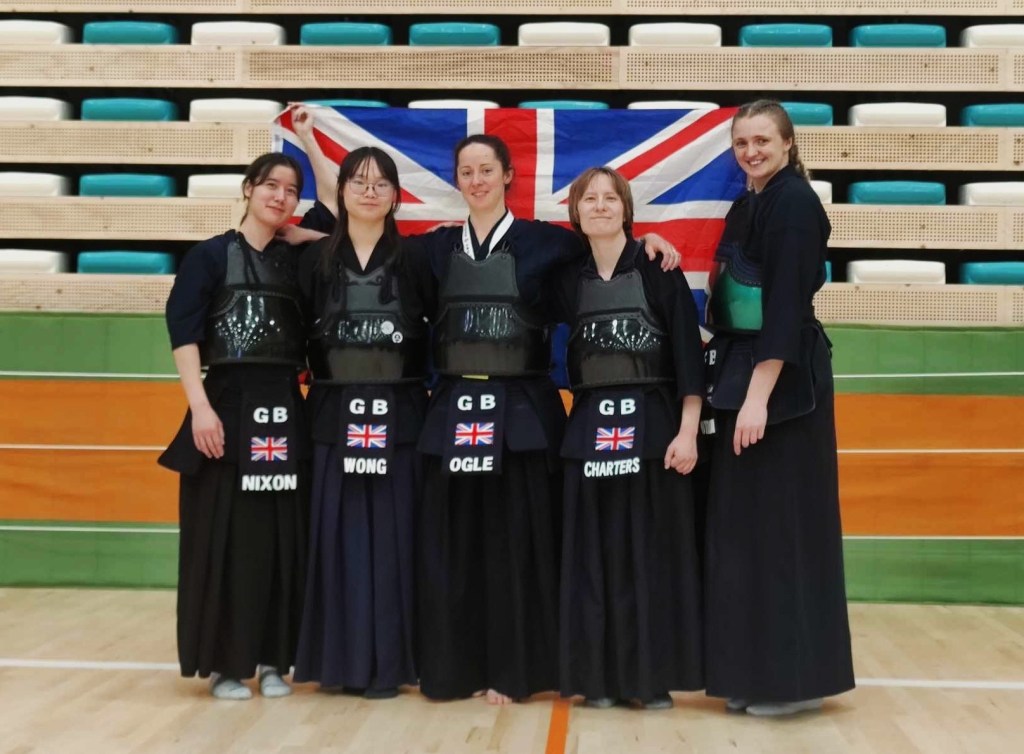
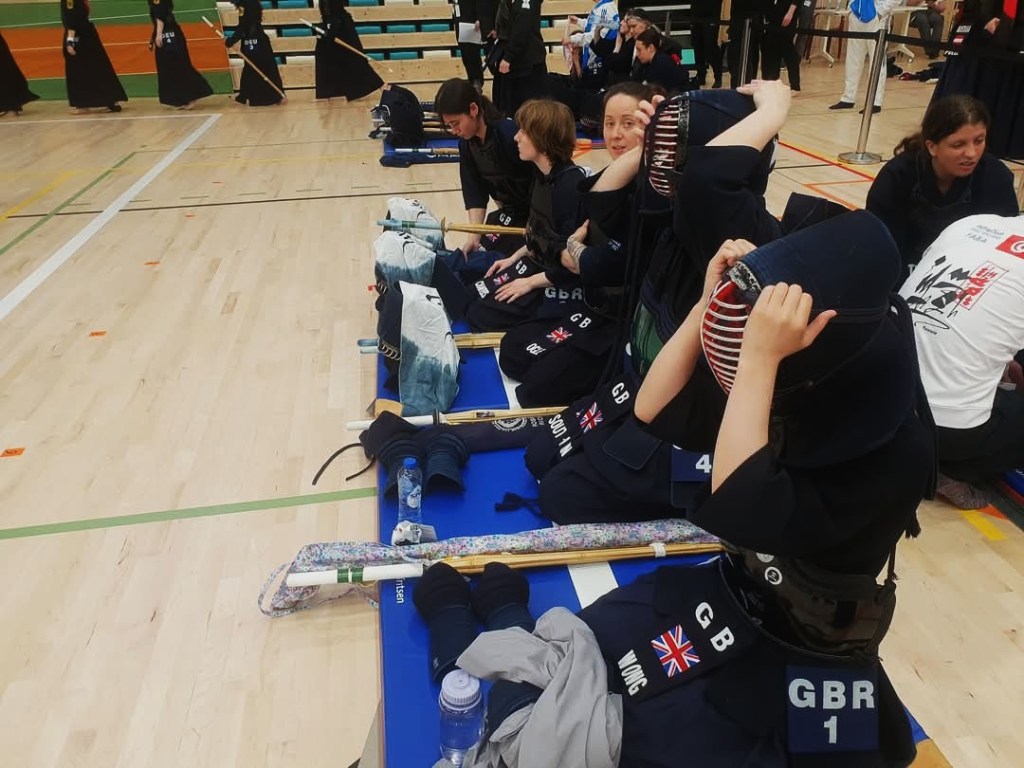
‘I’m sorry,’ I said surrounded by an explosion of bogu-bags, half-empty water-bottles, and the curled flattened tubes of energy gels in the kit room of the thirty-third European Kendo Championships (EKC). ‘I let you down.’ My eyes were still full of tears from when we came off after not getting through our pool. The team stood haphazard around me at a slight distance, perhaps unused to my negative demeanour after a year of being on my best behaviour.
‘We’re a team,’ said one of the women in her usual positive tone. ‘It’s not one person’s fault.’
‘That’s what I get to say to you lot,’ I said, ‘I’m supposed to be the experienced one. You don’t get to say that to me.’
‘Well we’re not taking that,’ another said.
There were a few smiles and I huffed in mock annoyance. I knew they were right. I’d attempted to show them what I thought was the best mindset to take into the championships since they each started with the GB squad and now I was going back on that because I’d lost.
The first European Championship I attended was in 2014. To begin with the team was very new and we went to the events not knowing what to expect. This was hard on all of us. Later there came a time when I thought I wanted to be captain and then that urge left when I decided it was easier to only look after myself. I’m extremely competitive by nature. When my older brother started school and learnt to tie his shoes, I aggressively tried to learn too so I wouldn’t be bested by him. I thought it suited me to look after myself. I could focus on my matches and on my kendo. Perhaps I didn’t entirely believe kendo could be a real team sport.
Then in the run up to this EKC, after a difficult year in the squad where a lot of people had left, I realised I was the only woman who had attended an international taikai before and was almost ten years older than the next oldest team member. I knew it would probably come down to me to be captain and I most likely couldn’t get away from that. Fortunately for the team, I’d spent many of my more recent years of competing bringing ideas of sport psychology into my practice so I had an idea of the captain I wanted to be.
Last year I’d listened to a podcast where a professional athlete described the attitudes of his wife who was an Olympic long-distance runner. In a nut-shell she told him that when she ran she ran with her competitors, not against them. A quicker time, even if it wasn’t hers, pushed the sport forwards and improved the field on a whole and because of that everyone was pushed forwards and improved. At first he thought she was utterly mad until she medalled and he could see how this worked. Now, I thought, if long-distance running, the sport of renowned loneliness, could be a team activity then kendo had a shoe-in. I’m almost embarrassed to admit how much easier things felt when my mind switched in this straightforward way.
‘Lionesses hunt together,’ I put in our group chat.
It might have sounded like it belonged on a motivational poster but there was honesty behind it. I knew it would be difficult to achieve wins as a brand-new team but that didn’t seem important. All I wanted for the women was to be able to go to the EKC and perform in a way that was close to how they performed at home. To end the last day on a high not with the migraine and regret I had spent years experiencing. The feeling that for so many years made me wonder why I kept doing what I was doing.
After every fight we had as a team at national training I told them what I thought. I was honest with myself and with them and I found that I was nothing but impressed each month with how they’d improved. I was often able to tell them how well they worked as a team even if we didn’t win. I gave them all the knowledge I had about the nuts-and-bolts of international taikai. I wanted them to feel as prepared as possible. I didn’t want to be someone above them. I wanted us to be one unit. I wanted them to feel they could come to me with any problems, questions, or worries they had. I wanted them to finish the weekend pleased with themselves in some way and when they went home would want to compete on the international stage again. I wanted them to feel supported.
I just needed to draw my match with Austria for us to go through the pools. The other women had fought their socks off to make that happen. I lost two-nil.
‘We wouldn’t have done as well as we did without you as captain,’ one of the women told me. ‘You were never disappointed in us.’
‘Why would I ever be disappointed in you?’ I said.
Even if they stood there frozen in complete terror I couldn’t be disappointed. I know how hard it is. After eleven years it’s still hard. I didn’t feel like I’d done much for them. Simply treated them with the respect they deserved. I think they would’ve done fine without me. They are a great group and naturally more optimistic than I had ever been.
I got to the quarter finals in the individuals and lost two-nil very quickly. They were there at the side when I came off to say how proud they were of me. When I got home I waited for the usual self-loathing and embarrassment to kick-in. Got past the first week and waited some more, I know you’re in there somewhere, I thought. But it didn’t come. Yeah, it would’ve been nice to do better but I don’t feel so bad. I supported the other women as honestly and in the best way I knew how. They supported me more than I thought possible and showed me what is achievable.
When I explored this mindset more it was clearer to me why respect going both directions is entirely essential. Those who started training before us are pulling us up behind them but those who start after us are always improving and pushing us forwards. They’re the engine. We all move forwards as a unit. In our clubs, in our national teams, in our regions, and in the world. No one can progress as an individual. Our successes belong to everyone and the successes of everyone belong to us.
Author Biography
Rosanna Ogle lives in Cardiff, Wales where she moved in her mid-twenties from The Forest of Dean in England. She trains with both Denshinkan and Akai Ryuu Kendo clubs in the city and has competed in seven European Kendo Championships and three World Championships with the GB team. She works as a professional gardener and writes novels in her spare time.
 Kate Sylvester Perspectives