Introduction by Kate Sylvester.
This article features Marie-France Mercy sensei, the head organiser of the Ko Jika International Spring Tournament. It shares the significant role that kendo has played in Marie-France’s life and specifically focuses on the highly successful Ko Jika International Spring Tournament.
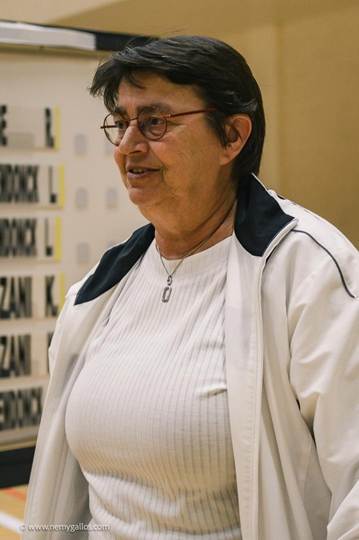
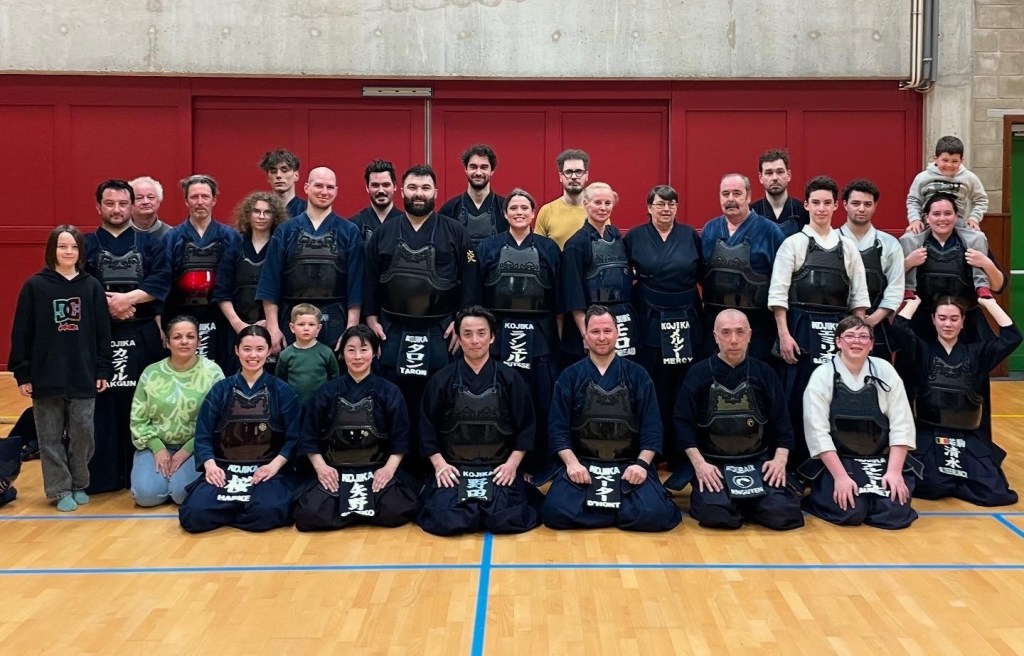
The first Ko Jika International Spring Tournament was first held in 1993. It has grown into a special event that has been participated in by many of today’s senior European kendo talent. Demonstrating the event’s growth, in 2024 the tournament hosted approximately 200 participants from 13 countries.
The tournament is a major event for the development of youth kendo in Europe. One of tournament’s main purposes is to support kendo youth to foster friendships from all over Europe and beyond. The kendo friendships that evolve from these opportunities are valuable as they are often long-lasting and help to sustain our dedicated engagement in kendo. The tournament also focuses on giving young kenshi the opportunity to develop their skills in an event that is specifically organised for youth participation.
I had the opportunity to visit Ko Jika Kendo Club in 2022 through Lisa van Laecken, another prominent figure in the Belgian kendo community. I was very impressed by the quality of the leadership, style of kendo, and the spirit of the members of the Ko Jika Kendo Club. Marie-France’s passion dedication to kendo were particularly evident.
After keiko, I had the pleasure of spending the evening talking to Marie-France about her kendo philosophy and experiences. I felt very inspired being in her presence and was moved by her genuine love for kendo and her commitment to supporting the development of others. I recall pondering that if there were more kendo leaders with this type of kendo authenticity and generosity people’s engagement in kendo could be even greater. The support and encouragement she provides to her students and her family in kendo is immense. This sentiment was also shared by her daughter Freija D’hont, the 2022 EKC Champion who also featured in an article on this website.
About Marie-France Mercy
At 63-years of age, Marie-France has had over 50-years of kendo experience and is the dojo leader of Ko Jika Kendo Club. In the past, she has worked in several jobs, but 28-years-ago decided to quit working and become a housewife to focus on her family and on kendo. Marie-France is married and has four children, all of which have practiced kendo. Three are currently still active in the kendo world.
Marie-France is understandably very proud of her family members engagement and achievements in kendo. Her eldest son, Wesley Haeke won the European Junior Championships once and finished second place in the European Championships in 2002. Her other son, Peter D’hont is currently the coach of the Belgian national team. In 2022, her daughter, Freija D’hont won the European Championship in the women’s category.

Her husband, Dirk and some of her grandchildren are also practicing kendo. Marie-France’s eldest granddaughter, Sakura Haeke is currently the captain of the Belgian women’s team. Her daughter-in-law, Chieko Yano was one of the first females to shinpan at the 2024 World Championships in Italy. It is clear that her family and kendo are both the most important things in her life and they are entangled in many ways.
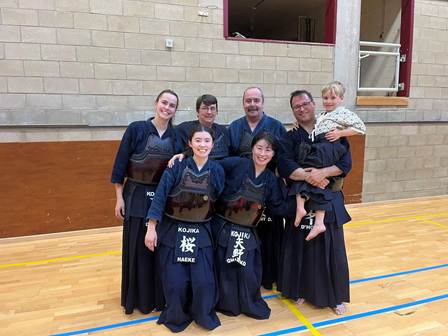
Cheiko and Sakura. Photo by Freija D’hont
Marie-France’s dedication and contribution to kendo through her long-standing leadership is inspiring and highly commendable. The following text shares responses to a series of questions answered in Marie-France’s own words.
How and why did you start kendo?
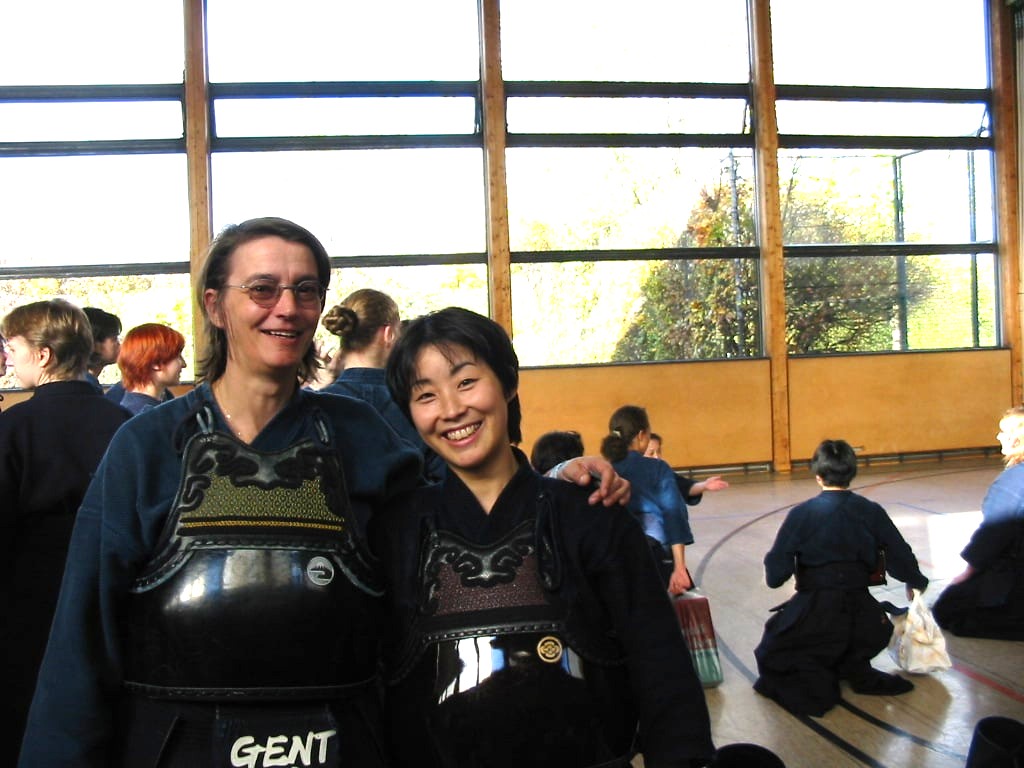
I started kendo when I was 13-years-old, which means that I have been practicing kendo for 50-years. The reason why I started is because I fell in love with kendo the first time I experienced it. This was during a kendo training that took place near where I lived back then. It attracted me in a kind of way that is hard to describe. After several weeks of just watching, I took my first lesson, directly with bogu on. It was hard, but I managed to continue till the very end. And that’s when my kendo life began.
What have been your roles and achievements in kendo?
In 1987, I founded a dojo with a good friend of mine, because my oldest son had turned 5-years-old (the age when you can start kendo), but there were only grown-up men in the original dojo. The perspective of this new dojo was to be able to share kendo experience with children. That has been my motive ever since. Currently, I still assist the beginners and juniors in our club whenever I can. Besides the dojo, I have been a member of the national team, but back in the days there was no separate category for women. That’s why I have participated in the team matches where both men and women could join. Only starting from 1989, women had a separate category, in which I fought a couple of times. In 2000, I stopped to join as a player because of medical reasons.
What inspires you to continue kendo?
Kendo is such a big part of my life. Although I am already a certain age, I cannot imagine a life without kendo. This budo brings our family closer together and I wouldn’t want to change it for anything. Seeing my children and grandchildren continuing what I have started, and seeing them succeed feels like a blessing to me. Kendo holds my interest, because I can admire the people that grow stronger through my assistance. That’s what keeps me going.
What do you love about kendo and what do you find challenging?
There are quite some challenging things about being a dojo leader. For example, the question how I can promote our club to grow in number, even during hard periods, like the covid pandemic, is a difficult one. What I love the most about kendo is to see how kendoka from our club grow stronger and make progress. I love sharing this passion with others, and to see them improving, is what fills my heart with joy.

What have you learnt from kendo and applied to your life outside of kendo?
Respect is an important aspect of kendo that I also try to apply in my life outside of kendo. I try to think of kendo as budo and as a sport that is open for everyone, but if someone doesn’t take importance in respect, then I think that kendo might not be the sport that fits them.
How did the Ko Jika International Spring Tournament come about?
Thirty-one years ago, Ko Jika kendo club was invited to a tournament in Amstelveen, in the Netherlands. There were only three clubs that participated; Düsseldorf, Amstelveen Renshinjuku and Ko Jika. After that the same three clubs did the same thing, but this time in Düsseldorf. That’s why I thought about doing the same to return the favour to them. We started doing this every year and with each time more clubs started joining the tournaments. That’s how, after 31-years, we have grown to such a big number.
What is the purpose of the tournament? What do you hope the participants gain from attending?
The main purpose of the tournament is to build friendships from all over Europe and beyond. I love to see how the kids are focused on winning on Saturday, during the tournament, but in the evening, when we all gather for a dinner party, they grow closer to each other and become friends. Even though language can be a barrier, I see the youngest communicating with their smiles, a football and kendo language. Besides this point, the purpose during the actual tournament is to let the children do at least two shiai a day with children from different countries. That’s why we work with a pool system. The tournament is a way of spreading my love and passion for kendo. We see many clubs rejoining the tournament every year, so I think that we get that message across.
How is the tournament organised?
Last year, we had around 200 participants from 13 different countries (Germany, France, Romania, The Netherlands, Lithuania, Czech Republic, Poland, Luxembourg, Finland, Great Britain, Ireland, Hungary and Belgium). The tournament is a 2-day long tournament, with individual competitions in seven different categories on Saturday and the team division on Sunday. Three categories are without bogu, where competitors are required to do a menkirikaeshi and uchikomi. Four categories are with bogu, which are divided by age; 5-9, 10-12, 13-15 and 16-18-years of age. We do not separate girls and boys or kyusha and yudansha.
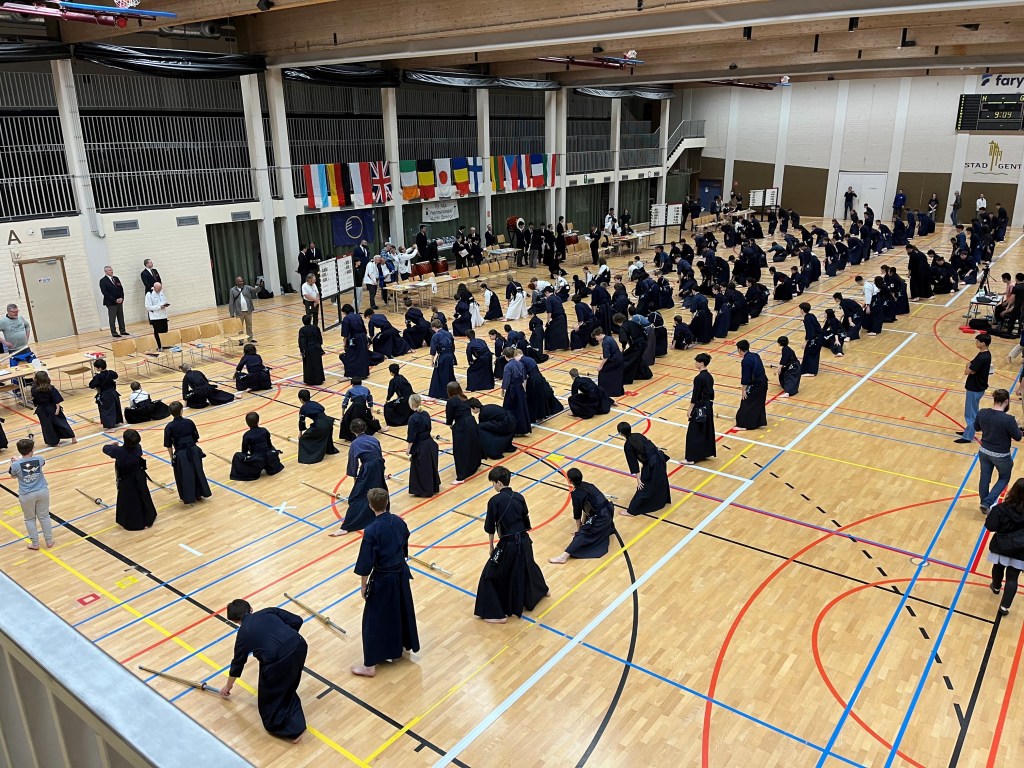
On the Sunday, we hold the team tournament, which consists of teams of five, starting with the youngest ones as sempo. The oldest competitors are positioned as taisho. All shiai are 3-minutes, except for the semi-finals and finals. On Saturday, before we start the individual competition, the kids all warm-up together led by a member of Ko Jika, which is an impressive moment to witness. As mentioned before, we hold a dinner party on Saturday evening, which is next to the sportshall where we let participants and others sleep. In this way, everyone can get to know each other and eat, drink, play and have fun together. This is one of the best moments of the whole event for me.
What are the challenges of organising the tournament?
Because I have been organising this event for over 30-years, I don’t find it so challenging anymore. This is of course thanks to the help of motivated people around me, especially family and kendo friends. I cannot mention every single one of them, because we are with so many, but I want to name the three without whom this tournament wouldn’t exist; my husband Dirk D’hont, our previous club president José De Sager and our IT-specialist Tom Decabooter. They have always had my back and they have helped me throughout this journey.
The only thing that makes me unsure in organising such a big event is to not have the control over the amount of participants that will join each edition. Every year, dojo’s seem to wait until the very last moment to register their participants, that’s why we sometimes jump from 100 participants to 170 or so in one day. Every year again, this makes me anxious about how the tournament will turn out. Until the number of participants is set, we can’t decide on the schedule, food orders, tournament grinds, etc. I think that’s the most challenging part.
What do you think is special about the tournament?
With this tournament we are able to help build a kendo network between clubs and between children from all over Europe and beyond. Because our tournament focuses on young kenshi, we are able to give them a stage to show what they are made of, which most of them cannot yet do during the European Championships. Our tournament can also be seen as a good preparation for the juniors participating in the European Championships. A thing you should know is that a lot of past and current top players from Europe have once joined our tournament and this shows that we are doing a great job, I think.

_______________________________________________________________________
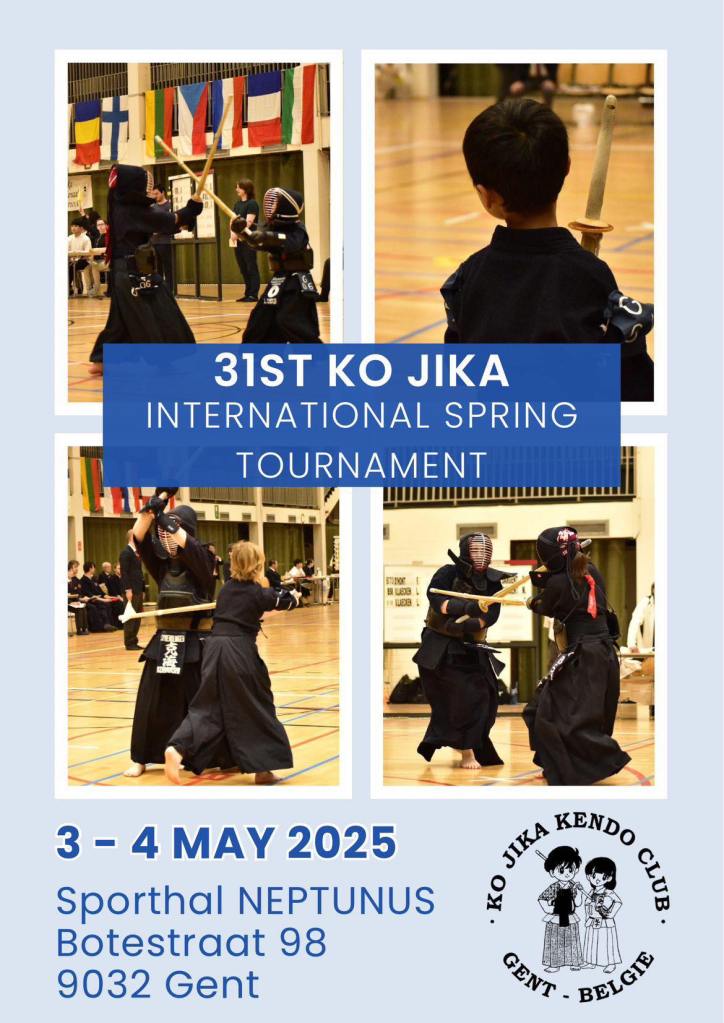
The next Ko Jika International Spring Tournament will be held in Ghent, Belgium over the weekend of 3-4 May, 2025. This event is set to be another resounding success, driving the growth and development of youth kendo across Europe.
 Kate Sylvester Perspectives