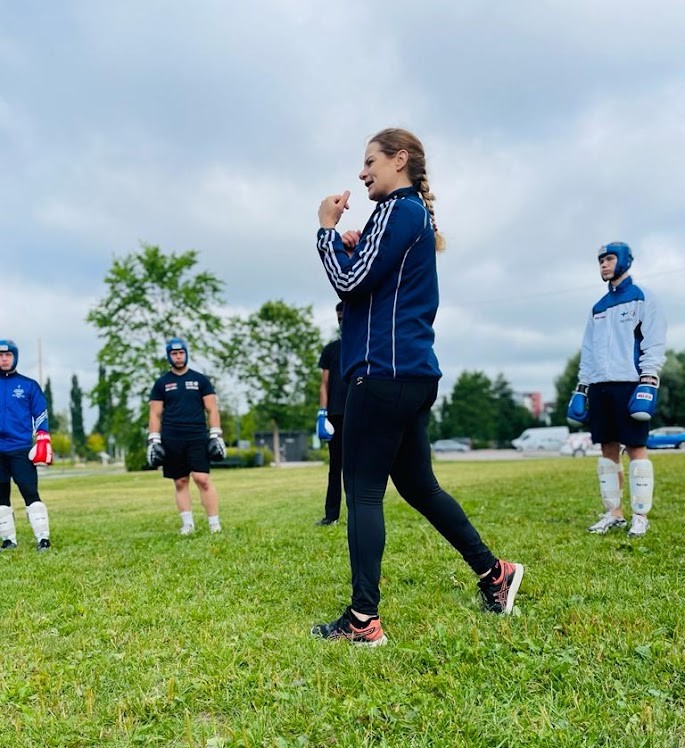
Navigating Time, Gender and Coaching in Sports by Sanna Erdoğan (Finland).
This paper examines the intersections of time, gender, and structural norms within sports, focusing on how these elements shape personal and academic perspectives. First, I will start with my experiences in sports in Finland and scaffold my understanding of gendered structures within sports contexts. I continue to consider whether these structures support or hinder equal participation possibilities within sports contexts. Furthermore, I reflect on how time as a linear and structural environment establishes deeply ingrained norms and expectations. Although I discuss previous international research, this paper is situated within the Finnish context, specifically focusing on coaching in the sports club environment. The perspectives presented are shaped by the unique cultural, social, and organisational characteristics of Finland’s sports systems, emphasising how these elements influence coaching approaches, gender dynamics, and institutional structures. These themes offer insights into how temporal and structural factors impact participation, coaching, and the ongoing negotiation between my personal fulfilment and professional alignment in sports and academia. Finally, I discuss how research can provide a more gender-aware understanding of coaching.
Time scaffolding my perspectives
Time is an essential element in drawing my knowledge and perspectives. I consider having a chronological calendar age, a sports age, an educational and work age, and an age as a feminist scholar.
My sports age started 25-years ago when I began boxing. Suddenly, I was in a fascinating world where I could challenge myself in many ways. I develop my boxing skills and constantly measure the improvement with someone else. There is something extraordinary in individual, full-contact sport in which you and only you are responsible for the outcome. For me, boxing is primarily about developing multiple skills simultaneously, which is a perfect way to concentrate and focus on the ongoing moment. Being in a ring and responsible for your safety does not allow you to think of something else. The mind is focused only on a three-minute round at once.
I have been a coach for 20-years in the sports age. Even though my competition career was short, I continued to practice my sport-specific skills. My athletic and coaching experiences have been neglected until recently. I have followed the traditional way in combat sports, where the motivation to be a coach is related to staying in the sport. Coaching in combat sports involves daily thoughts about improving techniques, pedagogic ideas on making more reasonable training sessions, and personal exercises to test how relevant and effective various techniques and tactics are.
My educational age within sports began in 2010 when I accomplished further education in coaching and two degrees in applied sciences of social pedagogy. Together with other pedagogical degrees, I have developed a work-life identity as a coach developer. During the 15 years, I have worked in multiple sports associations in Finland, focused on building environments where people can learn from others and construct communities built with trust and drive to achieve everyone’s potential. My role as a coach developer has developed my knowledge and competence as a coach, too.
Although I have been interested in improving equity for decades, my feminist age is only four years—a short time compared to my adult life in sports. Suddenly, time as a structure changed from familiar and safe to uncertain and unpredictable. While becoming a feminist scholar, time changed irreversibly, like an arrow moving in one direction, forcing me to scrutinise multiple sports experiences relative to one another. I begin to scrutinise the significance of specific dates and eras, providing a sense of continuity and context across generations.
Foundational time and gendered sports structure
In sports, time is imagined as a straight line from the past − it has a long-lasting and ever-present history of relating to gendered traditions. At the beginning of the 1900s, competition sports were implemented in the one-sex category. Gradually, more women participated in sports, leading to arranged competitions in women’s and men’s categories. (Hargreaves, 1994.) Since then, sports have been considered a gendered, binary activity (Larsson & Auran, 2023). Scholars have suggested that gender inequality in sports appears demoralising and impossible to change because culture reproduces gendered models (Soler et al., 2022). Additionally, efforts to promote equal opportunities have had limited success in changing decision-making in sports organisations. As the majority, men can reinforce ideologies, structures, and practices that allow them to maintain their status and privilege in sports (Cunningham & Ahn, 2019).
Although, during the past decades, the number of women and girls participating in sports has increased, coaching remains male-dominated (Kane, 2016). The gendered structures inside sports include beliefs about gender differences and reproduced understandings of a coach’s performance. Gender qualities are assigned inherent belief systems, values, cultural patterns, and collectively shared knowledge structures, maintaining gender stereotypes in sports. The traditional image of a coach is associated with behaviours such as authority, strength, muscularity, and demanding character (Burton & LaVoi, 2016), leading to an image of the coach linked to men and masculinity, both physically and ideologically (Schlesinger et al., 2022). These inherited beliefs, cultural assumptions, and standard practices shape coaches’ expectations, and gendered resemblance creates year after year an environment where coaches are comparable in their knowledge of male attendance (Hovden & Tjønndal, 2022).
A metaphor ‘development path as a coach’ can be used to explain the gendered coaching domain. Previous research indicates that sports club board members prioritise people with a history of being elite athletes when recruiting coaches in high-performance team sports (Blackett, 2021). Champions are highly valued in sports, and organisations believe in the possibility of benefiting from their knowledge. Guidelines have been developed to support career shift development from athlete to coach, retaining talent within coaching staff in national organisations (Chroni et al., 2020). Time connects coaching possibilities through cause and effect, creating a recorded and remembered narrative of ‘ideal’ ways to take responsibility in coaching. A path from athlete to coach is taken for granted, even though former athletic experience does not guarantee coaching success (Ewing, 2019). The respect for champions potentially hinders addressing or critically examining these cultural assumptions of coach competence.
Towards a critical understanding of sports discipline
During my PhD research, I realised how uncritically I had approached the sports discipline before. The newfound critical feminist awareness brought a mix of confusion, shame, frustration, and ignorance. My experience as a woman felt anything but “unique,” shaped instead by entrenched patterns, structures, values, and attitudes that reinforce widely accepted norms of behaviour, emphasising conformity and belonging. My coaching and work as a coach developer unfolded in gendered sports spaces where male dominance prevails, and my perspectives were shaped by socially shared knowledge and hierarchical social interactions that ultimately restrict the production of knowledge.
To conclude, time is meaningful in intersecting ways that build an understanding of sports coaching. While sports are often seen as educational, enjoyable, and positive, I continue to raise awareness to recognise and address practices that may overlook diverse perspectives and experiences in decision-making and coaching. Embracing reflective practices that integrate marginalised voices is essential for fostering a more comprehensive understanding of social interactions within sports. The following years will hopefully bring comprehensive insights as I continue to navigate and study gender order in coaching. Adopting multiple perspectives can provide a critical lens through which dominant knowledge frameworks can be questioned, uncovering implicit biases and underlying power structures. My research agenda calls for voices to challenge dominant knowledge systems and promote an understanding of diverse coaching possibilities.
Author Biography
Sanna Erdoğan is a PhD candidate at the University of Lapland in Finland. She investigates the identification of competition-level coaches’ competence and examines what kind of know-how is required to get a qualification as a coach. The research scrutinises existing practices and collectively formed concepts that influence coaches’ pathways, such as how to become a coach and the possibilities for different positions as a coach. The study includes voluntary coaches in judo, boxing, and wrestling, referred to as combat sports. The dissertation will be a monograph in Finnish.
Sanna Erdoğan has 20-years of experience as a volunteer boxing coach and a professional career as a coach developer in various sports associations in Finland. She works as a project worker for the Finnish Coaches Association and is a trustee of the Professional Coaches Association in Finland. Now, she is looking forward to using her experience in academia.
ORCID ID:
https://orcid.org/0009-0002-4406-7162
References
Blackett, A. D. (2021). Do you have to walk to talk it? The significance of an elite athletic career in becoming a high-performance coach in men’s football and rugby union. In A. Whitehead & J. Coe (Eds.), Myths of Sport Coaching (pp. 154–166). Sequoia Books.
Burton, L. J., & LaVoi, N. M. (2016). An Ecological/Multisystem Approach to Understanding and Examining Women Coaches. In N. M. LaVoi (Ed.), Women in sports coaching (pp. 49–62). Routledge.
Cunningham, G. B., & Ahn, N. Y. (2019). The role of bias in the under-representation of women in leadership positions. In N. Lough & A. N. Geurin (Eds.), Routledge Handbook of the Business of Women’s Sport (pp. 83–94). Routledge.
Ewing, T. K. (2019). Rethinking Head Coach Credentials: Playing Experience, Tertiary Qualifications and Coaching Apprenticeships. International Sport Coaching Journal, pp. 6, 244–249. https://doi.org/https://doi.org/10.1123/iscj.2018-0092
Hargreaves, J. (1994). Sporting Females: Critical Issues in the History and Sociology of Women’s Sport. Routledge.
Hovden, J., & Tjønndal, A. (2022). “If There Were More Women Coaches Around, I Think Things Would Be Different”. Women Boxing Coaches. Struggles to Challenge and Change a Male Dominated Sport Environment. In L. Norman (Ed.), Improving Gender Equity in Sports Coaching (pp. 234–253). Routledge.
Kane, M. J. (2016). A Socio-cultural Examination of a Lack of Women Coaches in Sport Leadership Positions. In N. M. LaVoi (Ed.), Women in sports coaching (pp. 35–48). Routledge.
Larsson, H., & Auran, I. (2023). Trans inclusion and gender equality in sport and exercise – an (im)possible equation? Sport in Society, 1–16. https://doi.org/10.1080/17430437.2023.2233439
LaVoi, N. M. (2016). A framework to understand experiences of women coaches around the globe: the Ecological-Intersectional Model. In N. M. LaVoi (Ed.), Women in sports coaching (pp. 13–34). Routledge. https://www.routledge.com/Women-in-Sports-Coaching/LaVoi/p/book/9781138558755
Schlesinger, T., Ingwersen, F., & Weigelt-Schlesinger, Y. (2022). Gender Streotypes as Mechanisms of Social Exlusion of Women as Football Coaches. In L. Norman (Ed.), Improving Gender Equity in Sports Coaching (pp. 30–50). Routledge.
Soler, S., Hinojosa-Alcade, I., Serra, P., & Andrés, A. (2022). Gender Equity Policies in Sport in Practice: From Words to Action. In L. Norman (Ed.), Improving Gender Equity in Sports Coaching (pp. 121–137). Routledge.
Stiliani “Ani” Chroni, Pettersen, S., & Dieffenbach, K. (2020). Going from athlete-to-coach in Norwegian winter sports: understanding the transition journey. Sport in Society, 23(4), 751–773. https://doi.org/10.1080/17430437.2019.1631572
 Kate Sylvester Perspectives