By Kate Sylvester.
This text is part 1 of a 2-part article that focuses on women’s participation at the 19th World Kendo Championships. Part one focuses on highlights from the women’s competition at the tournament. Part two shares women’s perspectives on the WKC and will be published later this month.
After a 6-year break due to the global pandemic, the 19th WKC took place in Italy earlier this year. It was a historic event for women’s kendo, with many firsts and some restorations. Most notably, for the first time in the 54-year history of the WKC, women and men were given equal competition time and days. Female shinpan were also added to the list of referees and officiated alongside men in the pool and tournament matches of both sexes. As the history of the women’s participation the WKC shows, equal opportunity was not an objective of the tournament previously.
There was also a significant increase in the number of female competitors and teams, as well as a number of experienced female coaches, managers and administrators. Of note, the CIK (Conferderazione Italiana Kendo) tournament director Laura Imperiale effectively selected, trained and managed approximately 150 volunteers to deliver a top-class international sporting event.
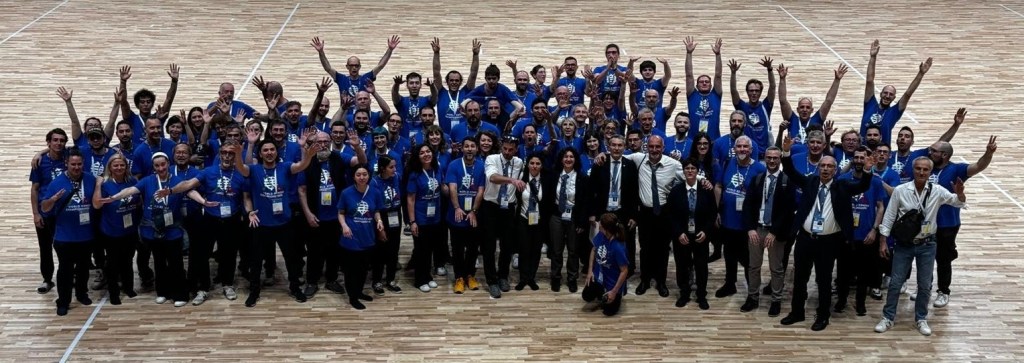
Photo credit: Confederazione Italiana Kendo
There were other more novel changes, such as emblematic Team Korea’s black striped white hakama and white gi were exchanged for standard dark blue kendo apparel. Notably, Team Korea’s appointed their first woman’s team head coach, Youn Jung Park.
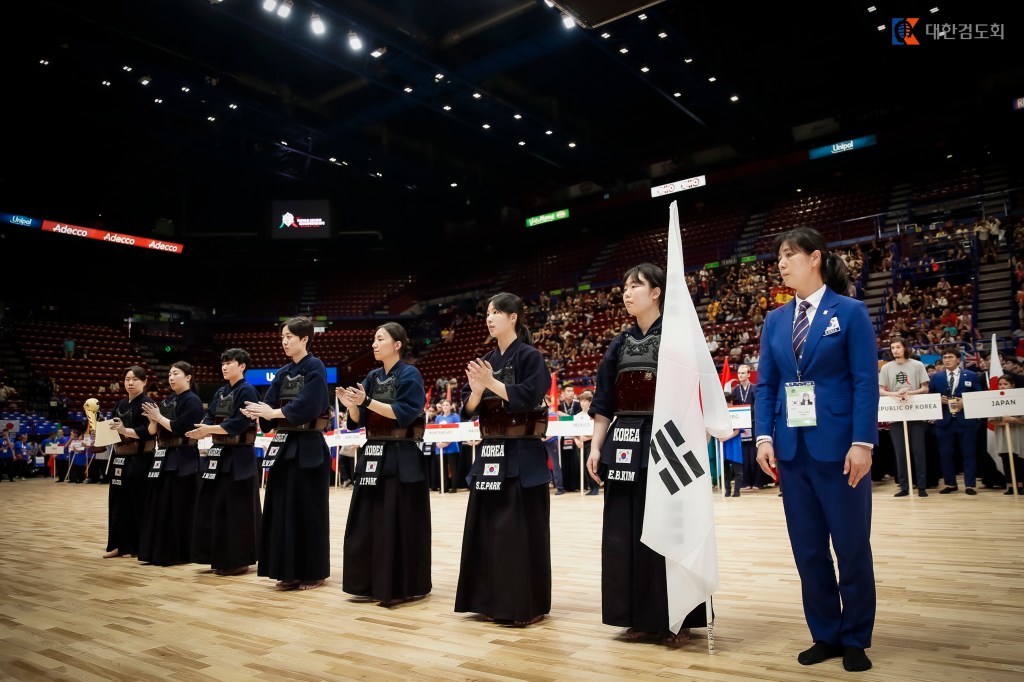
Photo credit: Korea Kumdo Association
In terms of reparation, woman team captains were once again invited to collect their team trophies at this WKC. Coincidentally, the last time the WKC was held in Italy in 2012, a trend had started where male coaches had oddly begun to collect trophies on behalf of their women’s teams.
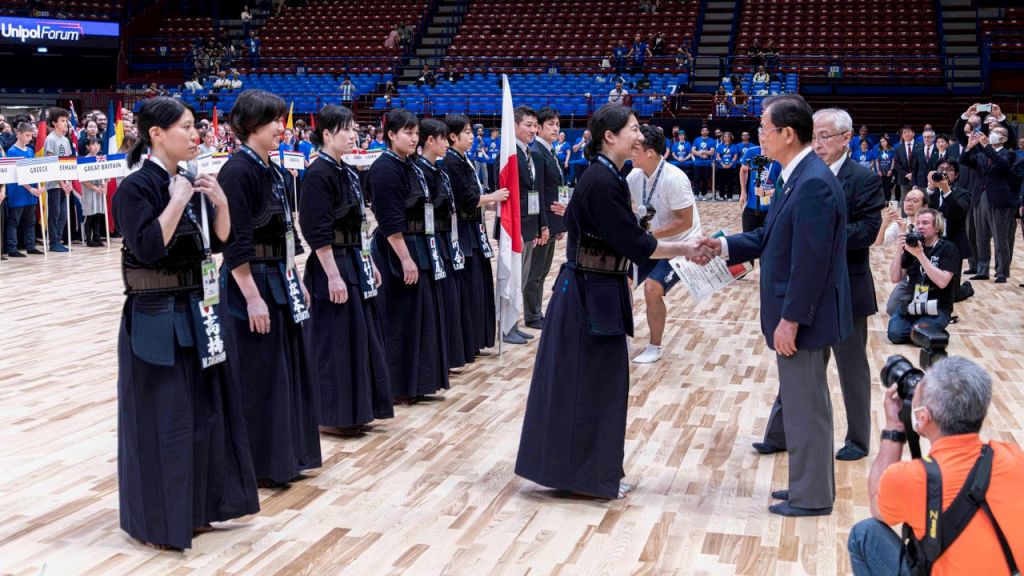
Photo credit: Chris Barbé @ chris-barbe.com
This article provides an overview of the 19th WKC―beyond the results and the usual male-centred and cultural hierarchising that takes place in reporting. It focuses on the performances of women WKC participants from around the world. Importantly, women are named, their performances and contributions are acknowledged.
For the most part, this article is based on my perspectives, experiences, and knowledge which derive from my participation in the last 8 WKC spanning over 24-years as a national team competitor and coach. At the 2018 WKC, I was the coach of the Australian National Kendo Team when the women’s team won bronze for the first time. On this occasion, I was the coach of the Swedish National Women’s Kendo Team. I also write this article from the standpoint of an academic researcher of women’s kendo and sport.
Day 1 – Women’s Individual Event Highlights
Two hundred three women were registered to fight in the individual category on the first day of tournament. An increase of 32-women from the 2018 WKC. This is a result of the higher number of women on national teams and countries participating for the first time.
Scanning the 6-shiaijo, it was noticeable that the athlete’s fundamentals, strategy, and variety of techniques had developed, with many competitors confidently throwing their conditioned physiques into their attacks. It was impressive. There was seemingly new generation of female competitors and a majority of these WKC first-timers were skilled teenagers and young adults that competed with poise and determination.
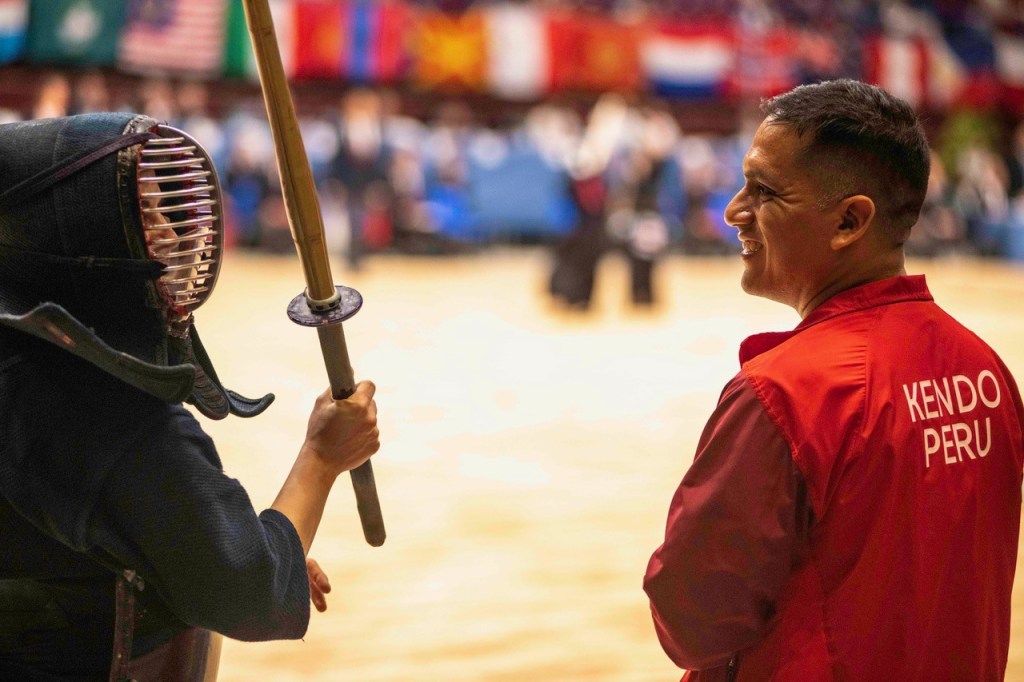
“We were able to witness a lot of fearless [women] players with technical skills and strong fighting spirits.”
Competitor Sofia Niba (Italy)
It was also moving to observe the performances of the 9-women athletes and coaches that had been interviewed in the months prior to this WKC. Especially knowing that this experience would be an important part of their kendo journey.
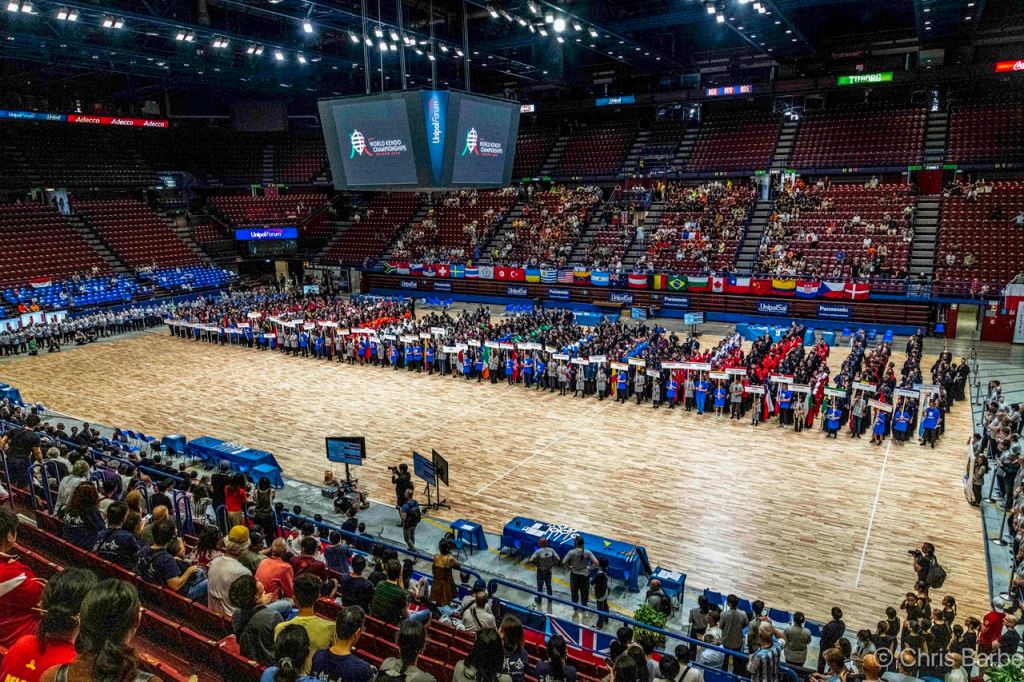
Photo credit: Chris Barbé @ chris-barbe.com
The participation of women shinpan was less novel than expected. Some competitors commented that some women shinpan were at least on par with, or more experienced than, some of the male shinpan. It certainly did not seem to be the first time that women were included on the roster as shinpan as they performed with composure and confidence. There was also an obvious camaraderie between the female and male shinpan. Of note, women shinpan were selected to referee women’s finals and also men’s matches up to the semi-finals.
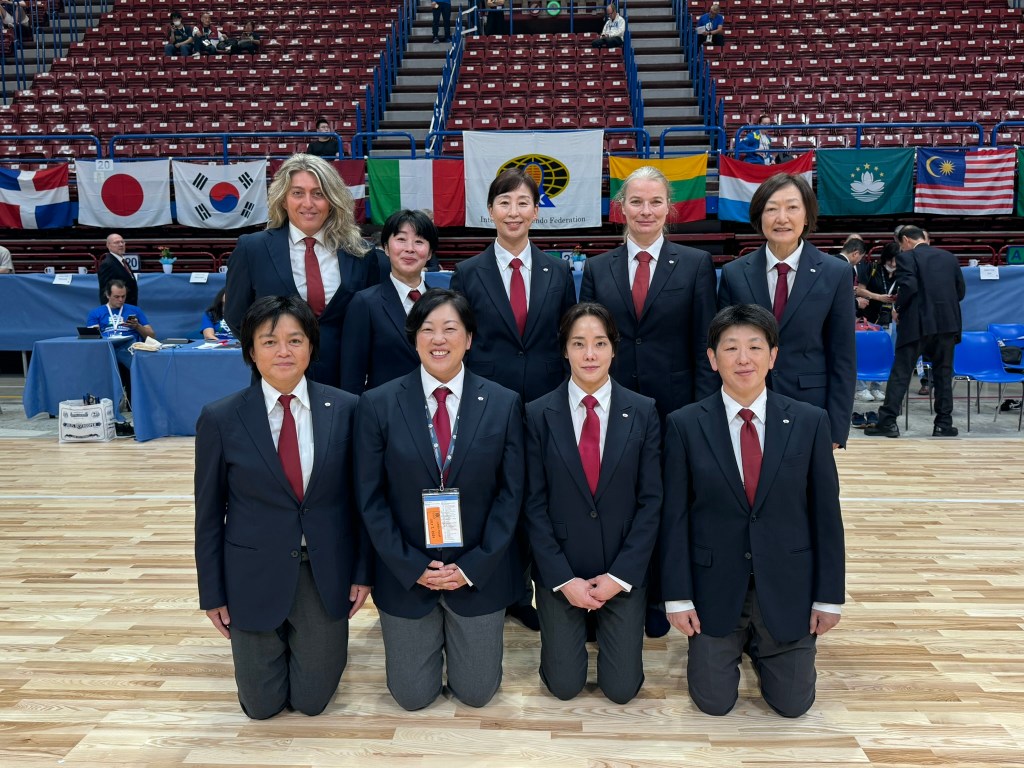
Photo credit: Toshimi Yoshida
“The WKC has entered in its adulthood, with equal opportunity for men and women. Lady shinpan were finally included and did very well, as we all expected.”
Donatella Castelli (Italy) EKF Board Member
There were many outstanding performances throughout the day and not all were awarded by results or kantosho. Many of the matches were electrifying and the spectators in the stands encouraged an atmosphere of crunching competitiveness. The women that advanced through the pools to the tournament rounds were not necessarily from the top kendo nations. The luck of the draw and good preparation also played an important role in their advancement.
Current European Champion Nikol Eichlerová (Czech Republic) displayed composure in her match against Minori Sato (Japan) with her men ippon attempts coming up just short. Some notable performances were from Team Canada’s Betty Park and Juah Paek who were both strikingly agile and fierce. Paek’s full body attacks were executed in high-speed, resonant of a kendo embodiment that I had only observed in elite players in Japan. These Canadian fighters outplayed two of Europe’s finest fighters Maria Bober (Poland) and Alina Yearwood (Poland). Park and Paek were later knocked out of the tournament by Team Japan players.
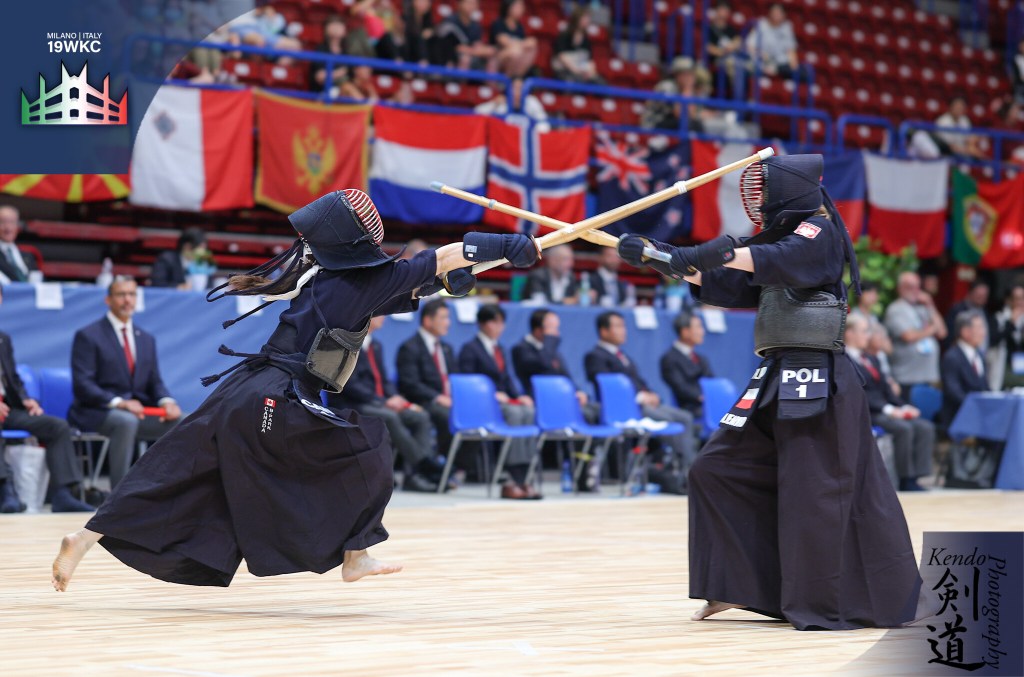
Photo credit: https://www.facebook.com/KendoPhotography

Photo credit: Chris Barbé @ chris-barbe.com
Austria’s only female representative, Mia Murakami drew out Team Japan’s star veteran Mari Suenaga (nee Yamamoto) to encho losing to Suenaga’s trademark kote. Maika Senoo (Japan) and Min Ji Kim (Korea) had the longest match of the day with several minutes of encho. Senoo’s unorthodox seme and persistence eventually scored her a decisive men ippon. Another display of grit was the match between Asteria Akila (Greece) and Caroline Ueda (Brazil). After numerous encho, Akila eventually conceded to Ueda’s men ippon.

Photo credit: https://www.facebook.com/KendoPhotography
There were some outstanding performances from players of the top team in Europe, Team France, coached by Natsuki Grossin. Kiyoko Moutarde’s (France) lioness roar created an intense atmosphere in her match against Min Ji Cha (Korea). Moutarde ran Cha outside of the shiaijo causing a scoreboard screen to crash to the ground. Cha advanced by scoring an ippon do. Such a display of competitiveness is normalised as part of men’s shiai kendo. However high-levels of competitiveness was also demonstrated in the women’s competitions. The stakes are also high in the women’s competitions.
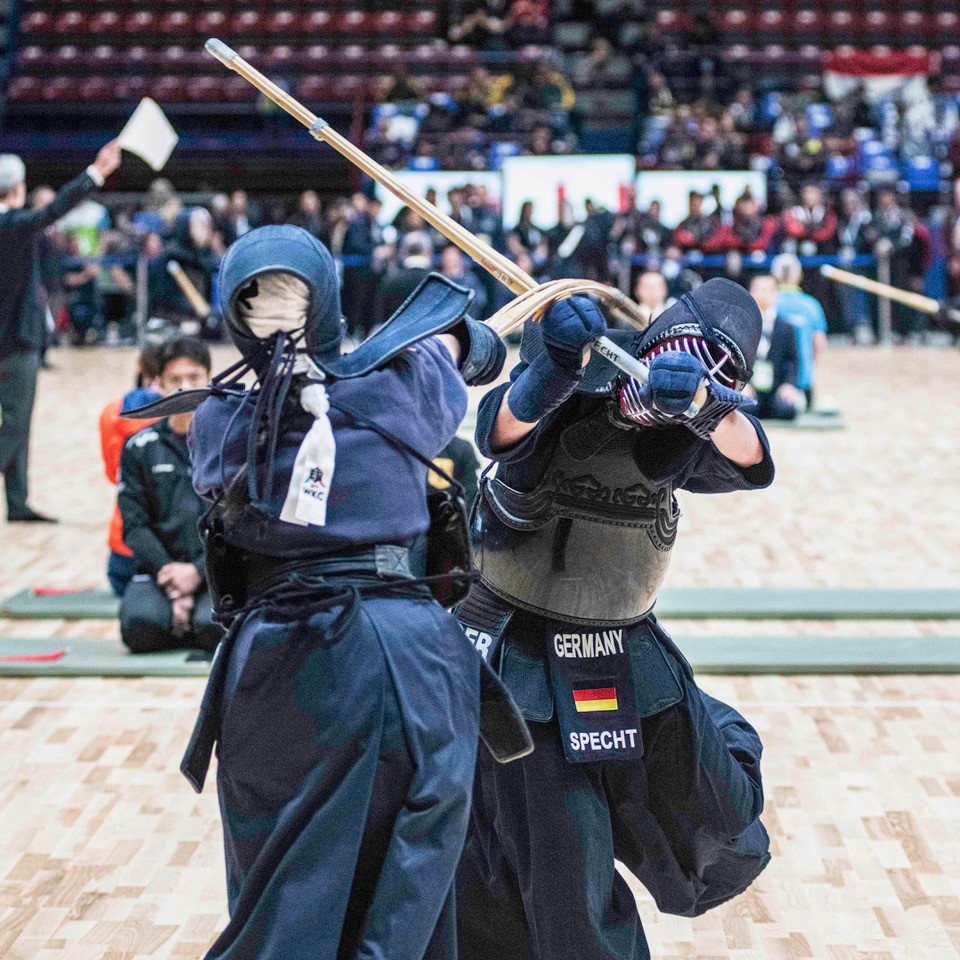
Photo credit: Chris Barbé @ chris-barbe.com
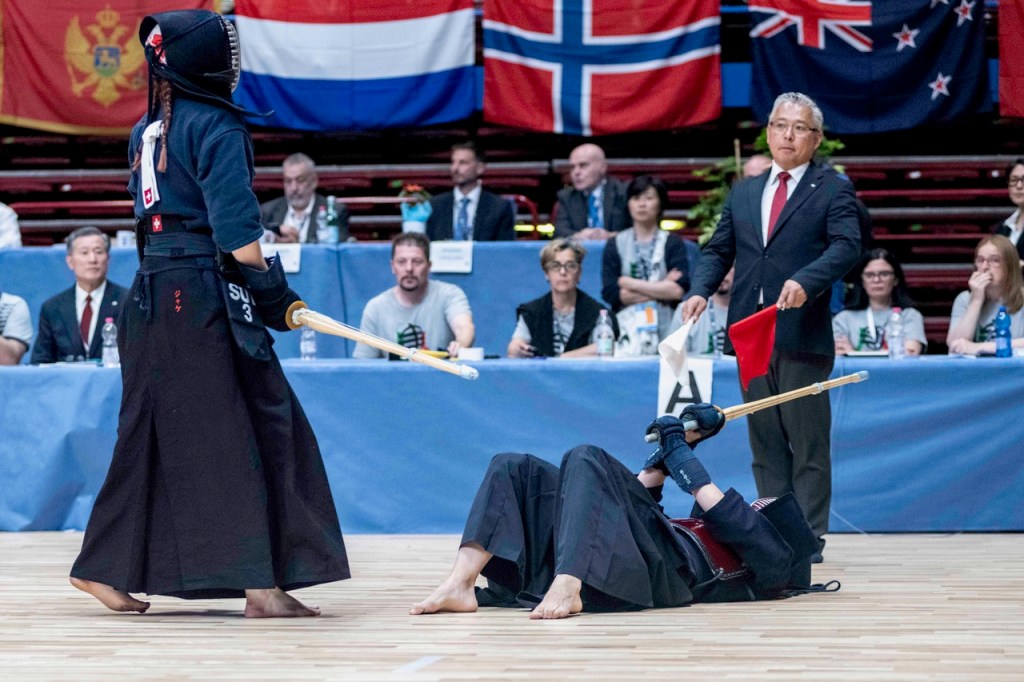
Photo credit: Chris Barbé @ chris-barbe.com
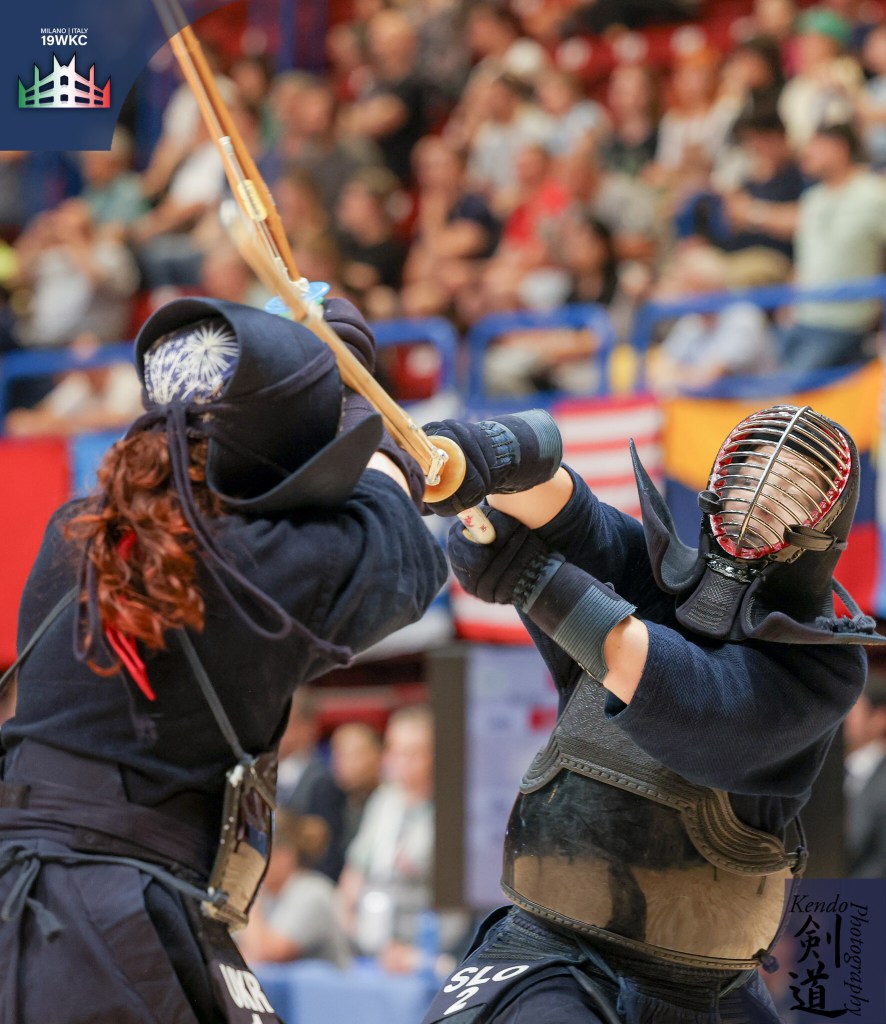
Photo credit: https://www.facebook.com/KendoPhotography
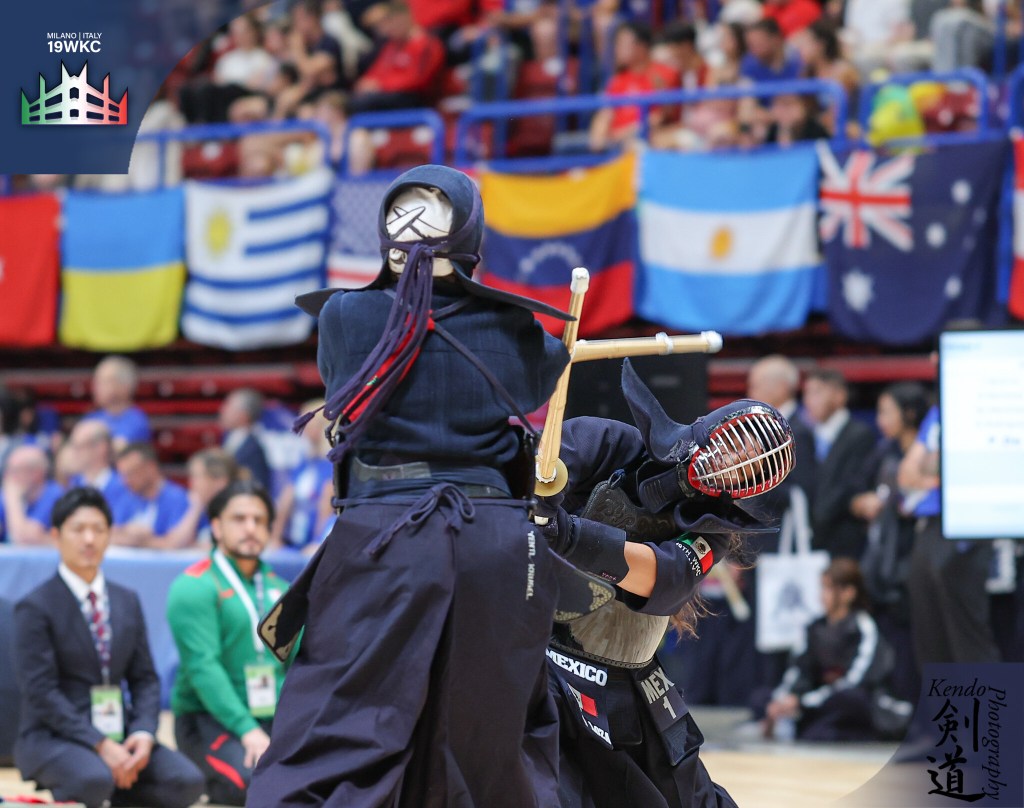
Photo credit: https://www.facebook.com/KendoPhotography
Saya Guadarrama (France) had a quality performance and presented well the kendo development she had achieved training at Tsukuba University. Guadarrama defeated Sofia Niba (Italy) and her passionate Italian support from the stands to go on to fight Ha Neul Han (Korea).
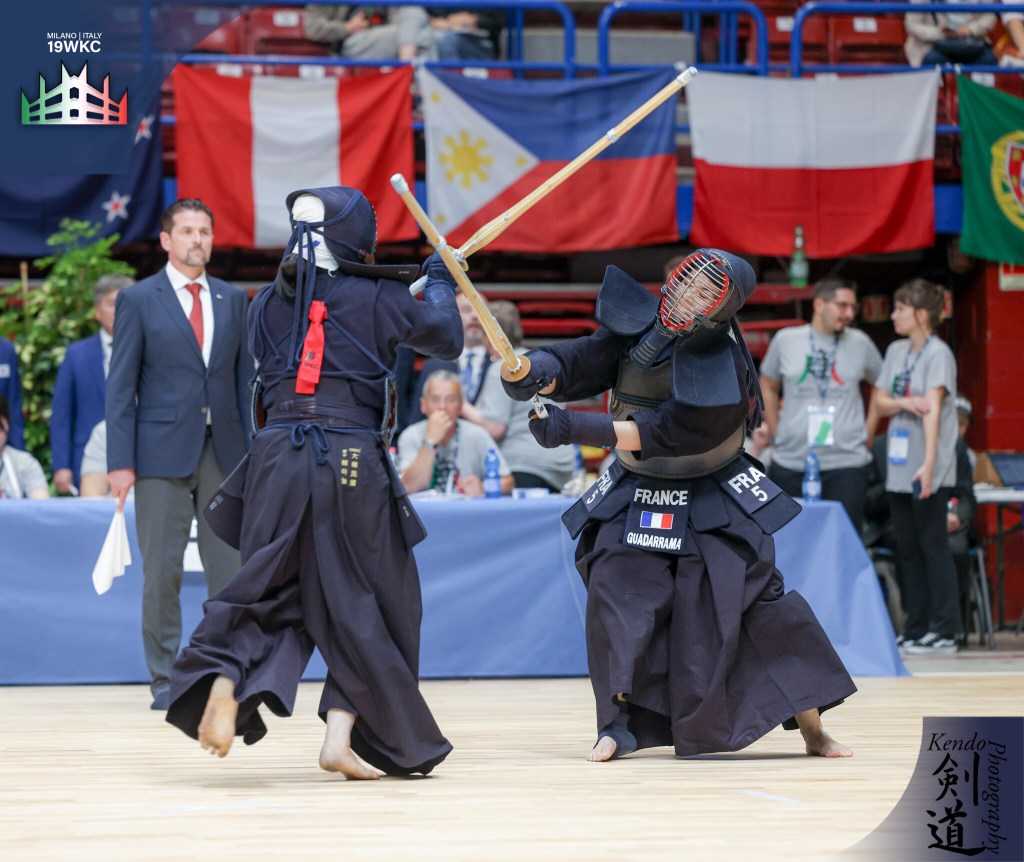
Photo credit: https://www.facebook.com/KendoPhotography
Guadarrama won and progressed to meet her next rival, 18-year-old Kelly Kishikawa (Australia), who had a superb performance for her first WKC. Kishikawa defeated Guadarrama to fight Japan’s Sato in the quarter finals. Kishikawa’s intelligent and compact style of play scored an equalising ippon against Sato and was only 1 point away from a podium finish. Showing a strength in Team Japan’s ability to capitalise on errors, Sato instantly scored a hiki-men after Kishikawa’s failed do ippon attempt. Sixteen-year-old Miyabi Fisher (Great Britain) performed exceptionally well and fought Suenaga in the quarter finals. Japan proved their invincibility once again with all 4 of their competitors finishing on the podium.

Photo credit: https://www.facebook.com/KendoPhotography
The final was set between Team Japan’s Mari Suenga and Mihiro Kondo. Suenaga had the upper hand in terms of experience as a 3-time All Japan Champion and participant in 4 previous WKC. Tokyo Metropolitan Police woman, Kondo commanded authority in the final despite it being her first WKC. The match was palpably tense and captivating. Suenaga scored the first point with her tenacious and agile footwork that pressured Kondo to open for a cracking kote. Kondo changed her game plan and switched up, pressing aggressively to equalise with a hiki-kote. Kondo’s pace and pressured control eventually broke Suenaga’s posture to score a powerful and decisive kote-men with the men strike being awarded.
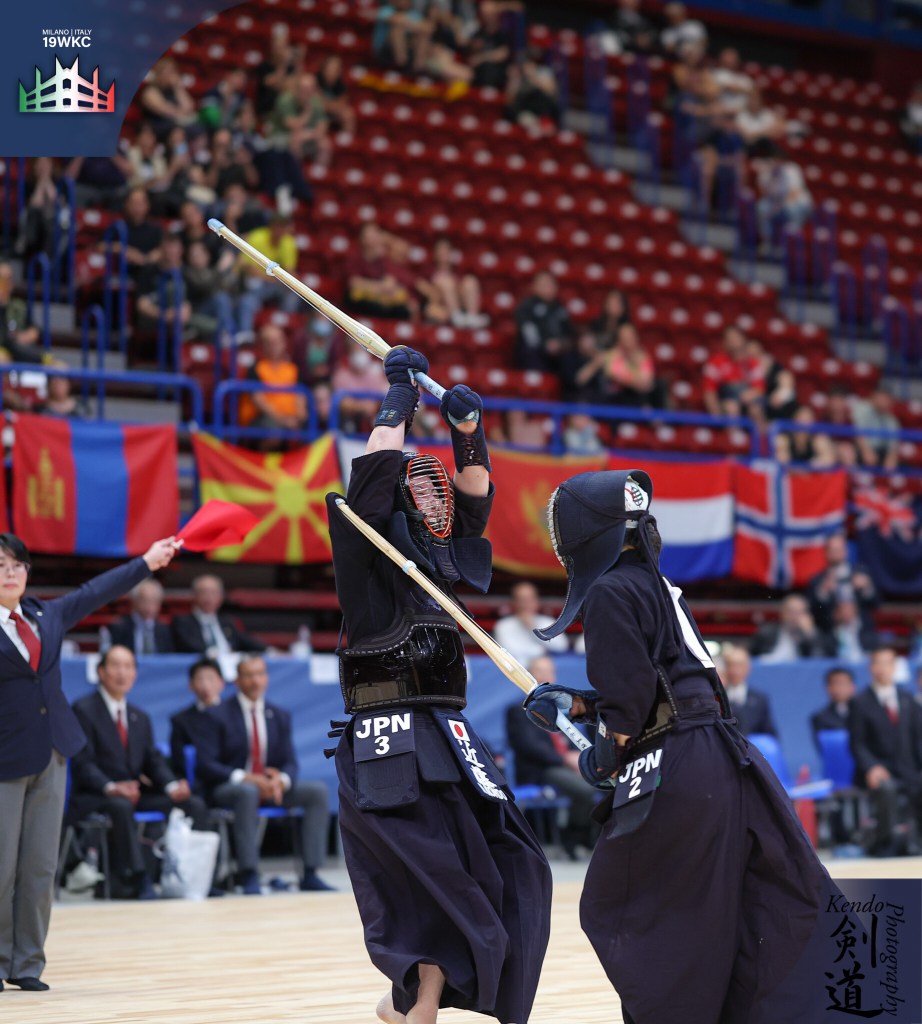
Photo credit: https://www.facebook.com/KendoPhotography
Day 2 – Women’s Team Preliminary Championship Highlights
Forty-five teams registered for in the team pool matches in the morning of day 2. An increase of 7 teams from the 2018 WKC. There were a number of countries that were participating in the team event for the first time such as South Afrika, Ukraine, Philippines, Ireland, Colombia, and Peru. Tunisia had registered to compete but were unable to attend the WKC. Some nations that had previously fielded teams such as Sweden, Austria and New Zealand were unable to on this occasion, highlighting the fragility of women’s kendo.
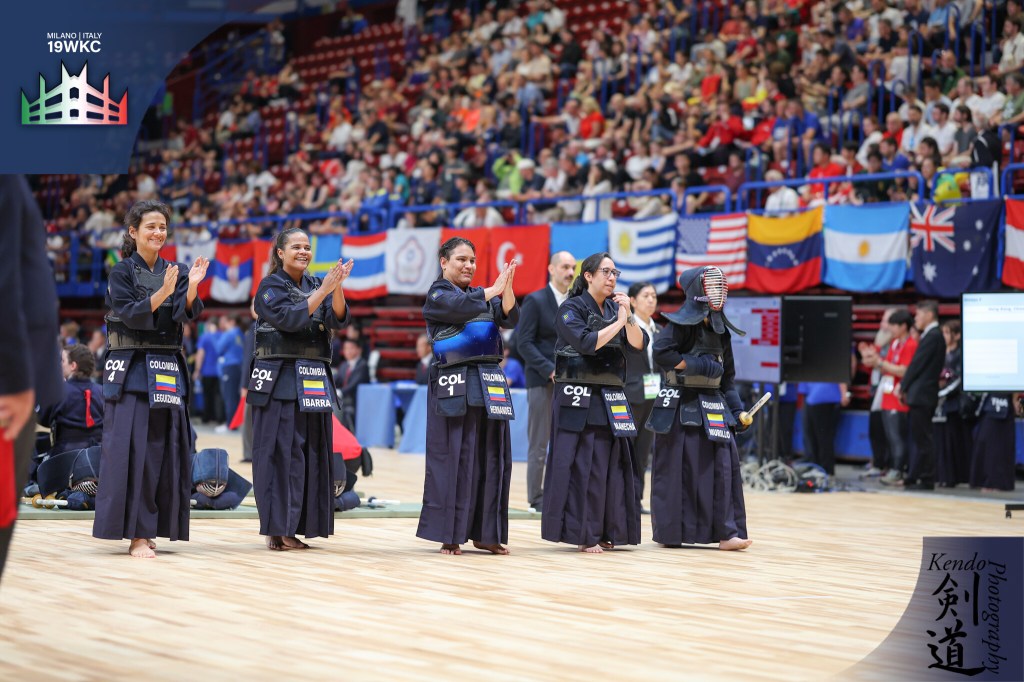
Photo credit: https://www.facebook.com/KendoPhotography
“Having two tournaments (individual and team event) in a day was a struggle [at previous WKC]. Women were given time to reset their mindset after the individuals, get rest and be fully there for the team event [at this WKC].”
Competitor Alina Yearwood (Poland)
On the morning, the atmosphere was intense and renewed. It was clear that the additional days for the women’s competitions allowed for an energised reset. It also appeared that the competitors were more invested in the team competition than the previous day. Many shared that they had performed better in individuals as they felt the stakes were higher in the teams. It was clear many teams had focused on team building and shiai strategy in their preparation.
Many people commented positively on the development within some of the national teams. It was noted that many European teams were better physically and technically than in previous WKCs. The development within the Canada, USA and Korea teams was evident. Team Korea’s kendo seemed to be more open, “cleaner” and fundamentally stronger. Team Canada showed a high level of athleticism and competitiveness. Team USA was physically solid and unwaveringly focused. It was clear that these teams in particular had pushed themselves to the limit with hard training and sacrifice in the lead up to the WKC. More than ever before, many teams had invested in cross-country training opportunities.
The luck of the draw played a salient role in which teams advanced. Brazil and Canada were unlucky in that they were placed in the same pool. Whereas Australia seeded position presented a promising opportunity to consolidate their medal placing at the 2018 WKC. Coach Asun González’s Team Spain were unfortunate to draw the staunch Team USA in their pool.
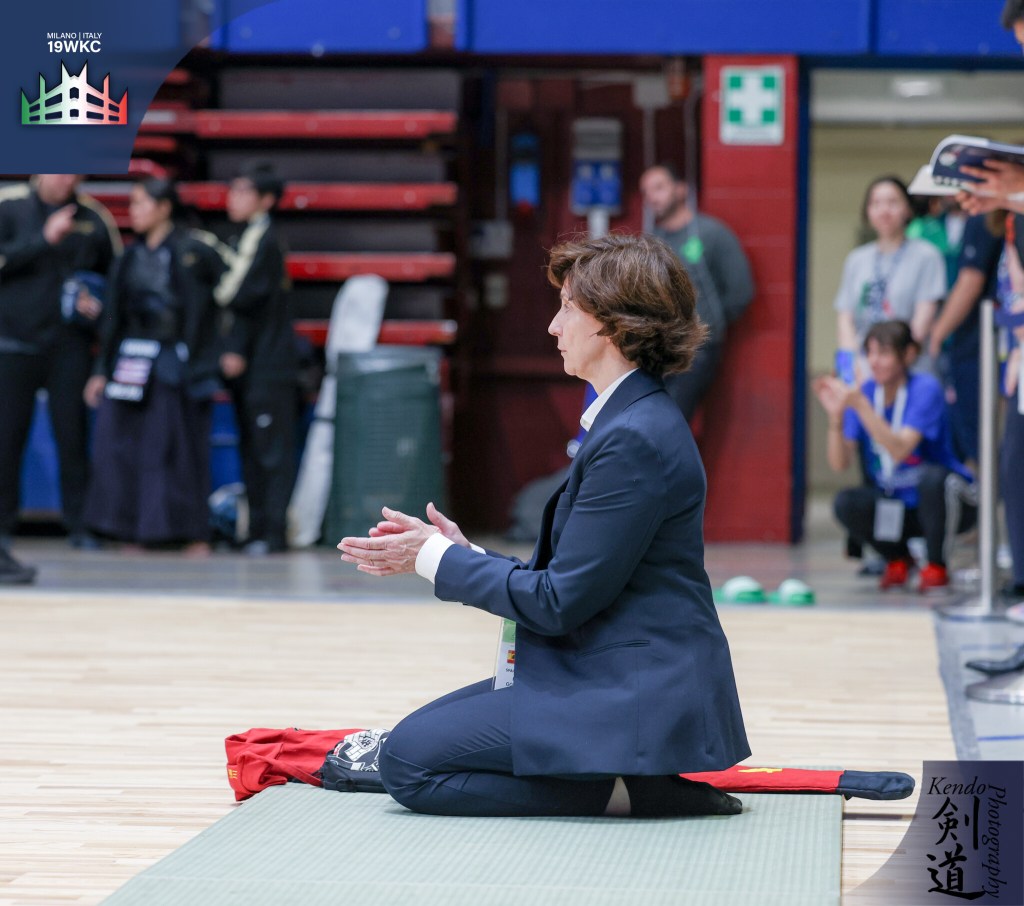
Photo credit: https://www.facebook.com/KendoPhotography
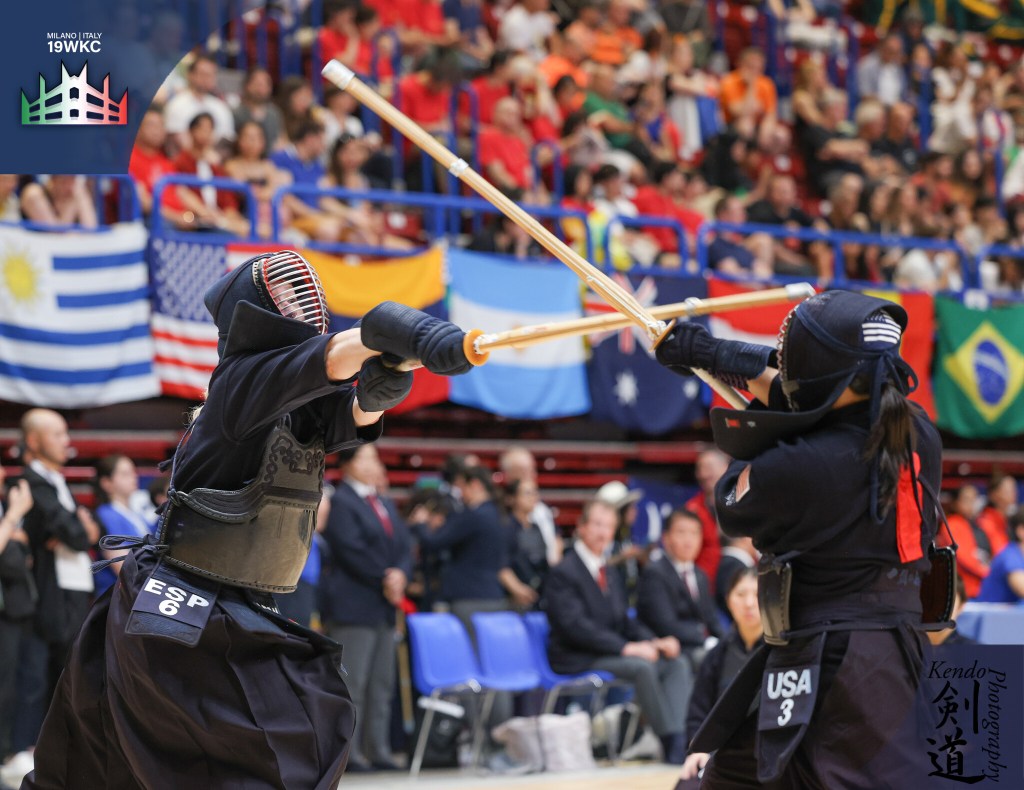
Photo credit: https://www.facebook.com/KendoPhotography
There were a number of firsts and outstanding performances throughout the day. Canada’s fighting spirit and athleticism overpowered the more experienced Team Brazil coached by Miwa Onaka.
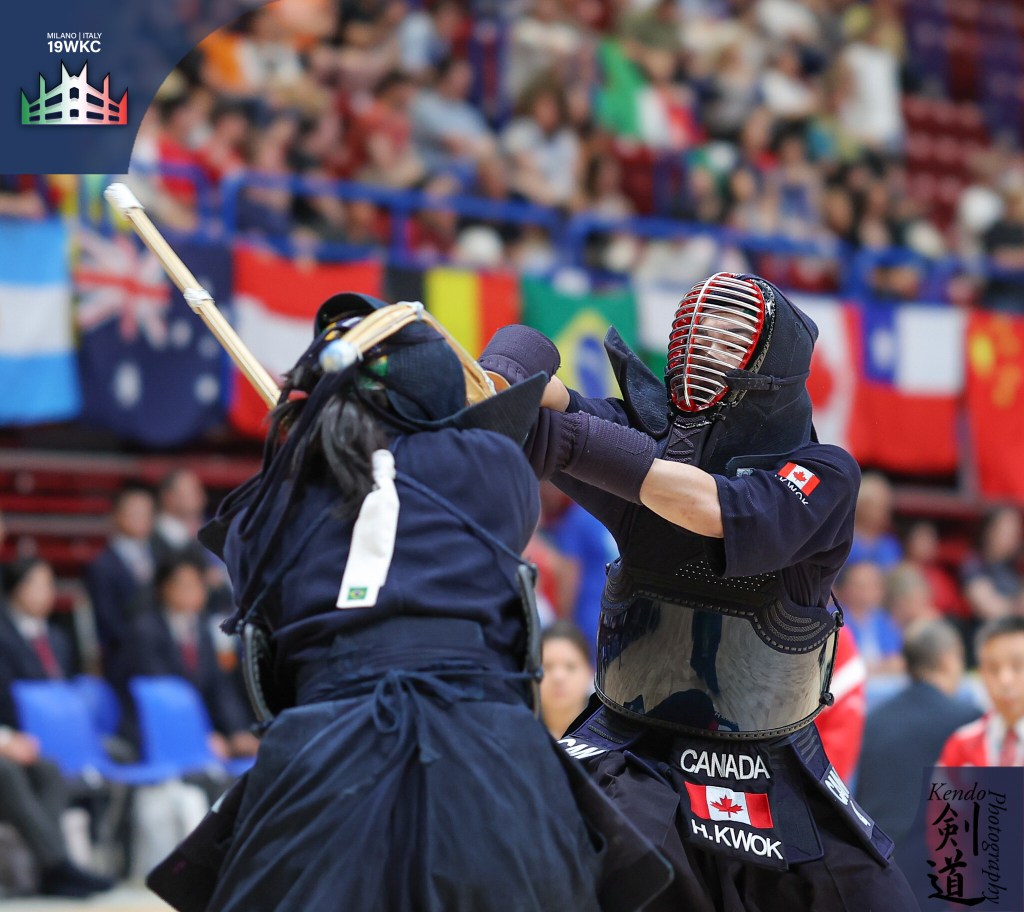
Photo credit: https://www.facebook.com/KendoPhotography
Greece coached by Antigoni Tsintza, competed soundly as a team to overtake Great Britain and Thailand to advance through the pool for the first time in their history. The Philippines fought well in their first WKC to win against Team Portugal. Showing the value of strategy, Czech Republic coached by Jana Ziegelheimová defeated Poland, the 2023 European Kendo Championship (EKC) silver medalists. Even in the absence of one of their best fighters Saadet Kök, Turkey won against Germany who had placed 3rd at the 2006 and 2012 WKCs.
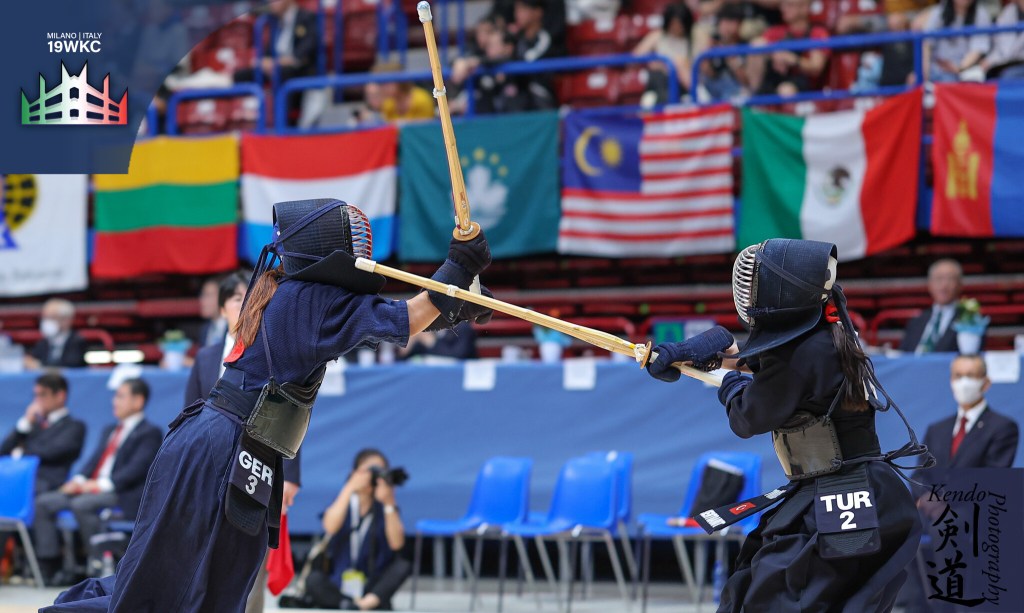
Photo credit: https://www.facebook.com/KendoPhotography
Day 3 – Women’s Team Final Championship Highlights
In the morning, the energy in the arena for the final tournament sparkled and watching the Top 16 teams warm up was in itself exhilarating. The last time Czech Republic performed in the team competition was at the 2012 WKC. They put on a strong showing against Canada, Nikol Eichlerová’s fukusho match with Kianna Darbyshire was palpably tense and a battle of lightning-fast reflexes. Eichlerová worked her way around Darbyshire’s powerful and steadfast kendo to score a men and kote ippon.
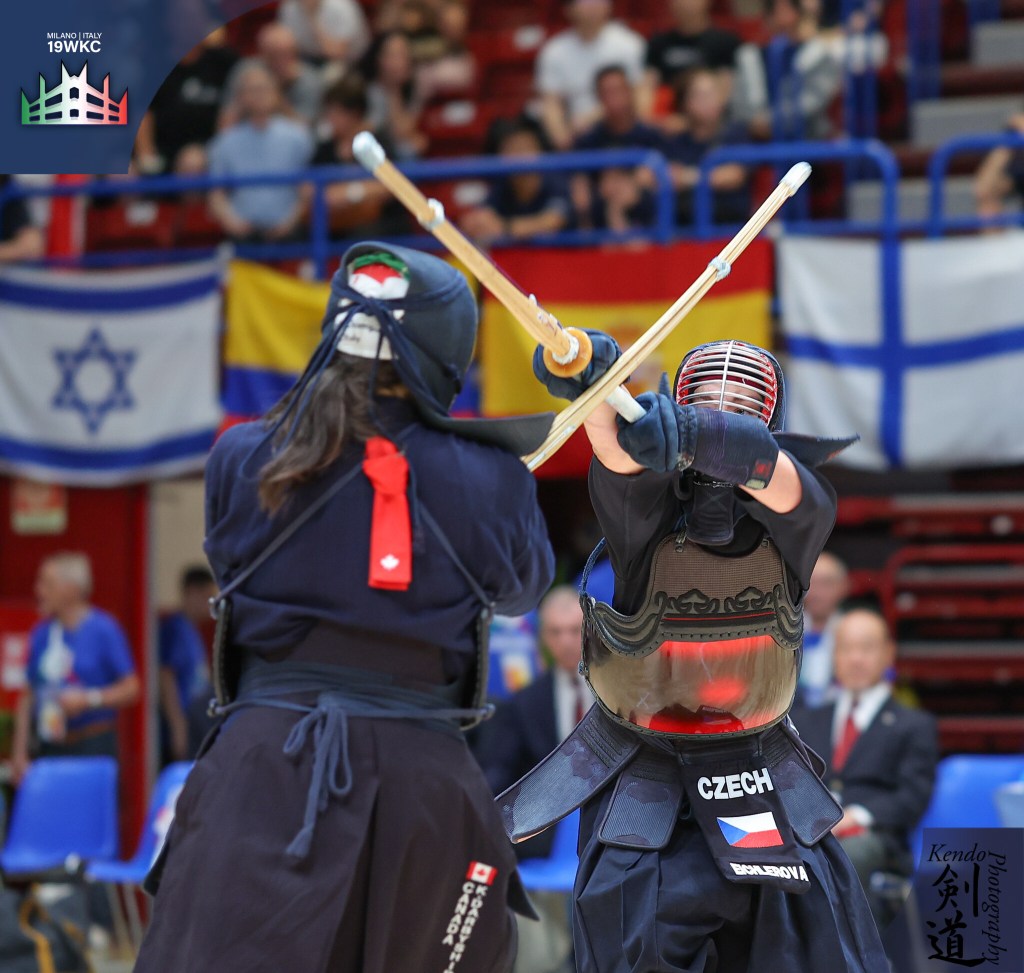
Photo credit: https://www.facebook.com/KendoPhotography
Belgium captained by Freija D’hont had a tough draw fighting against Korea first up but showed that the gap is closing between Europe and Team Korea. Belgium’s Lisa Van Laecken’s solid fundamentals awarded her a brilliant men ippon against Ju Won Choi of Korea, who later equalised with a kote ippon. The Italian support from the stands was electric in the match between Italy and Greece. This atmosphere raised the fighting spirit between the teams. Coach Yunsook Ma’s Team Italy won convincingly and advanced on the fight Japan.
“The growth of kendo in Europe is remarkable”
Shinpan Kyung Wha Back (Korea)
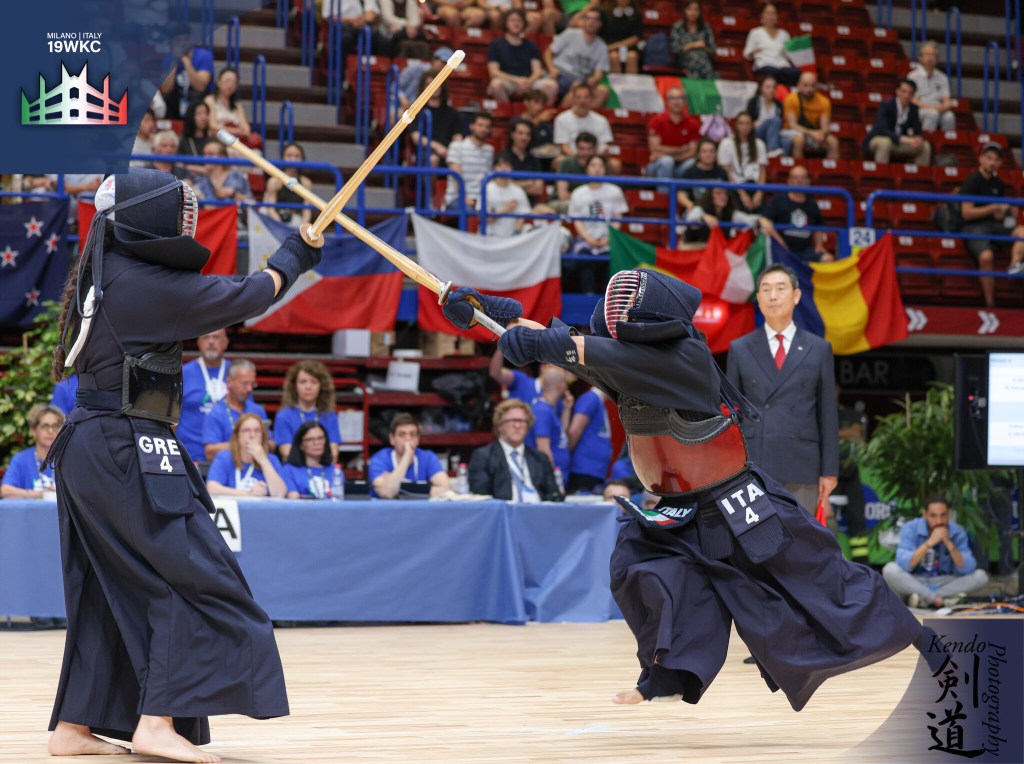
Photo credit: https://www.facebook.com/KendoPhotography
Team Australia struggled against the 2003 WKC bronze medal team Chinese Taipei. The match came down to daihyosen between Daseul Chun (Australia) and Shih-Rong Ciou (Chinese Taipei). There was faith in the stands that Chun would come through this time with the memory of being selected for the daihyosen match against Brazil’s Miwa Onaka in the quarter-finals at the previous WKC held in Italy in 2012. That time Team Australia was denied a medal placing.

Photo credit: https://www.facebook.com/KendoPhotography
Team Hong Kong showed remarkable improvement, narrowly losing 2-1 to the EKC bronze medalists Finland, who later fell just short of pushing past Australia for a medal placing.
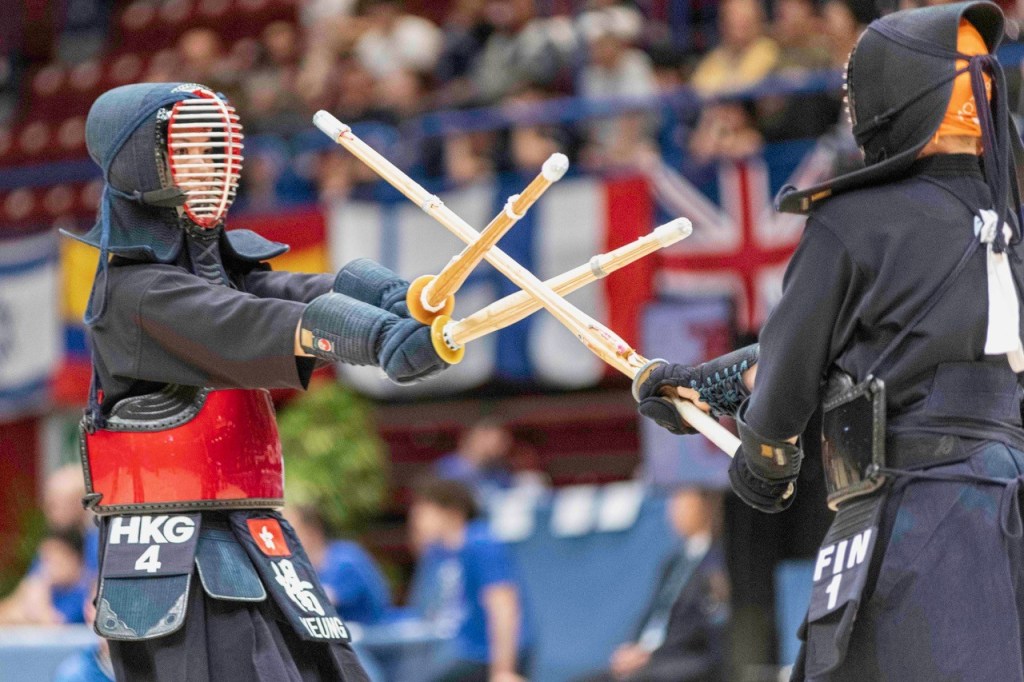
Team USA formidable style of play knocked out Team France 4-1. The hot-blooded rivalry between Team USA and Team Canada’s put more than a medal on the line in their quarter final match. Most of the members of both teams were unbelievably WKC first-timers. Team USA edged past Canada winning 2-1.
The semi-final between Korea and USA decided by daihyosen, was undoubtedly the most thrilling match of the tournament. The competitiveness was fierce. Shinai were shattered.
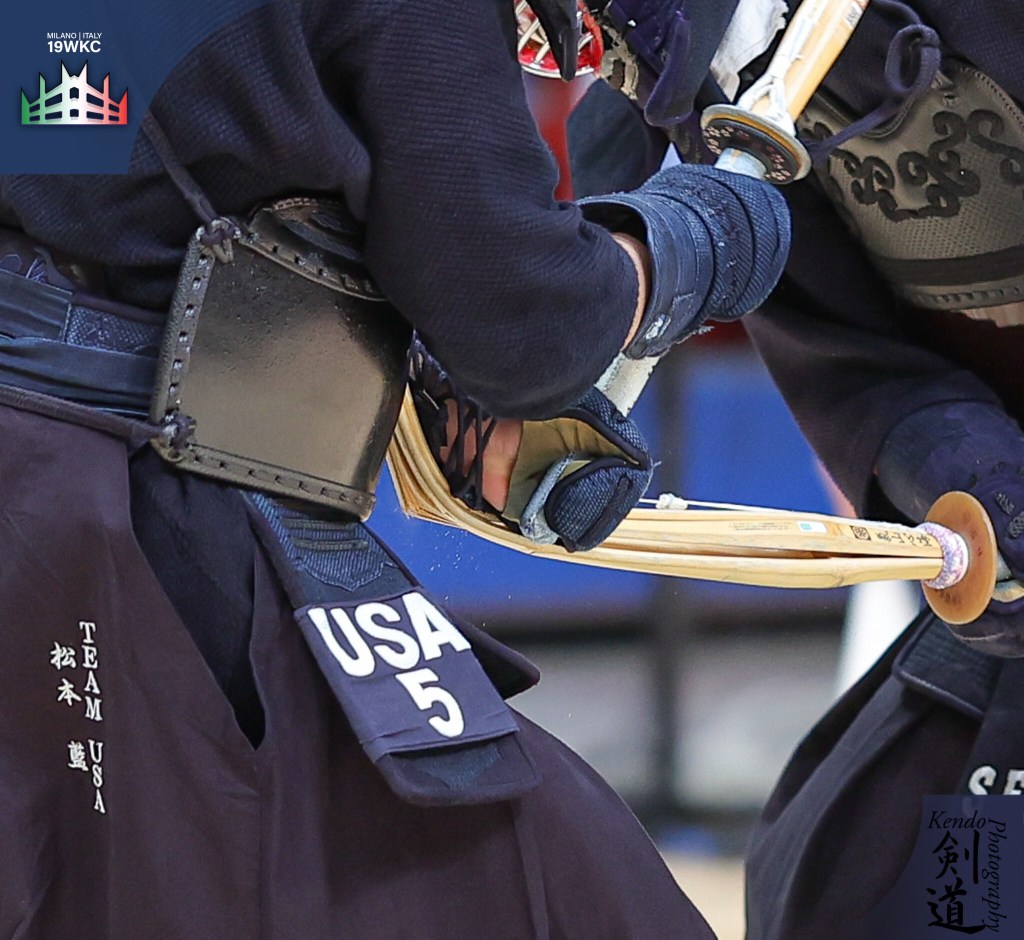
Photo credit: https://www.facebook.com/KendoPhotography
Korea held the lead until the taisho match when Zidi Allison (USA) scored a beautifully timed men that broke through Min Ji Cha (Korea) block to equalise the team score. Undeniably, Team USA’s assistant coach Song Yi Yang (previous Team Korea representative in 2000 and 2006) competitive and coaching experience played an important role in this tight team match.
Team USA strategy set to confuse Team Korea’s daihyosen selection by all members gearing up for the daihyosen demonstrated the advancement in skill and tactics in international women’s kendo.
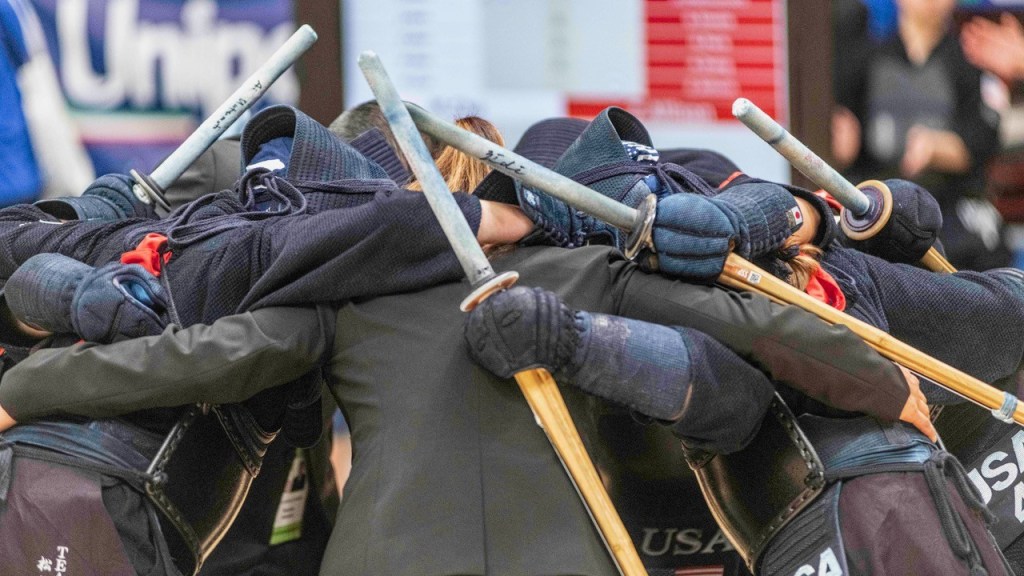
Korea’s Si Eun Park was selected to fight Allison in the one point play off. After 10-mins, Park deflected Allison’s kote to score a superb men ippon. This narrow defeat will surely be a driving force behind Team USA’s preparation for the 2027 WKC in Japan.
On the other court, Japan steamrolled through their opposing teams defeating most by 10-ippon and on average within 10-mins.
“The female players from all countries were very skilled, but I felt the level of the Japanese team was exceptionally higher.”
Shinpan Yukiko Miura (USA)

Photo credit: https://www.facebook.com/KendoPhotography
The final was set between long-term championship contenders Team Korea and Team Japan. The two teams have met in the finals since 2003 WKC. At the 2000 WKC in USA, the final was between Brazil and Japan. Team Japan had breezed through the earlier rounds, whereas Korea had to fight their way through the rounds for a chance at victory. In this sense, Team Korea had the upper hand as Team Japan had not been pushed to ‘dig deep’ as Korea had.
The first match between Chika Matsumoto and Si Eun Park was played with high pressure and focus. Park launched a men attack that was very close to being awarded but lacked the grit and explosiveness that Team Japan consistently showed. Matsumoto won the match with one first-rate men ippon raising all three flags. Moeko Takahashi set the pace from hajime in the jiho match against Ji Yoon Park and was awarded a hiki-men with her electric kiai and zanshin. Takahashi finished the match in under 2-minutes with an undisputable kote ippon. With two losses Korea was in a grim situation but Ha Neul Han managed to draw her match against Miho Takenaka. Both women fought for their teams with calculated risk and strategy.
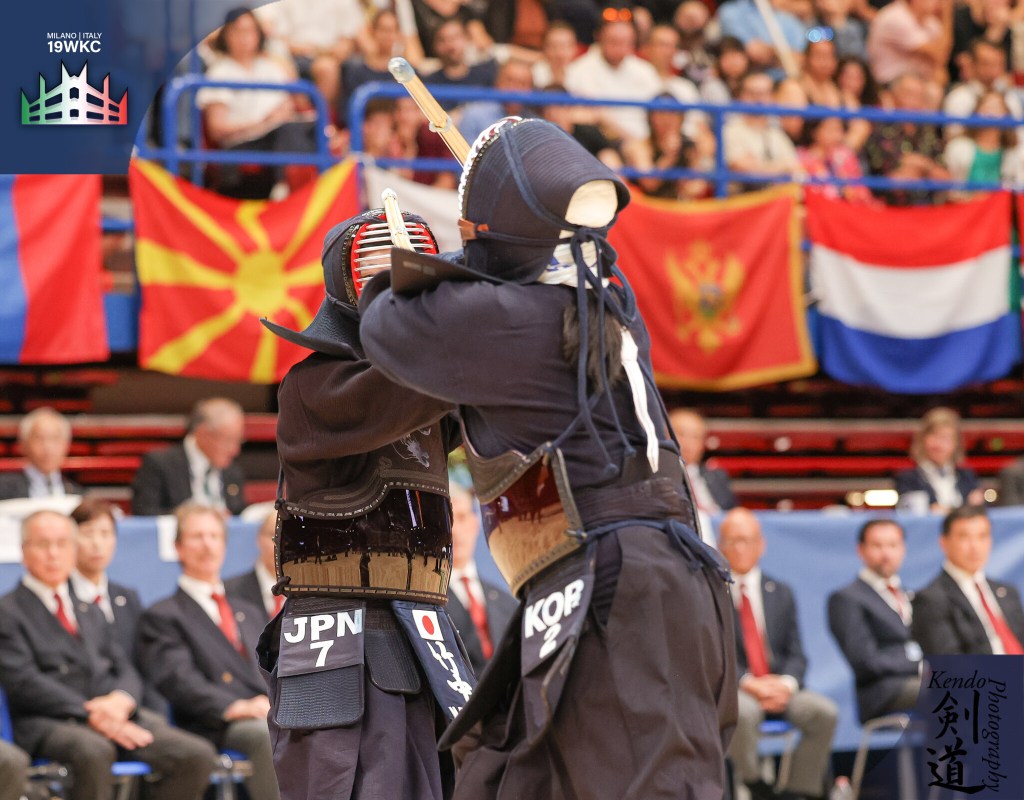
Photo credit: https://www.facebook.com/KendoPhotography
Ju Won Choi was under immense pressure to win her match against Maika Senoo in the fukusho match. Senoo’s unorthodox and powerful kendo probed Choi’s weaknesses to score a men ippon that was soon followed by a kote ippon that was set up from a strong taiatari. The final was result was decided in favour of Japan. Team Japan’s captain, Tai Watanabe (current All-Japan champion and All-Japan police champion) fought last against Min Ji Cha who had battled staunchly over the tournament. Watanabe’s resolve awarded her a kote within 10-seconds of the match that was soon consolidated with a spectacular textbook men ippon. The match was finished within a minute. The final score was 4-0 to Japan with 7-ippon scored. Korea was unable to score a point during the match.
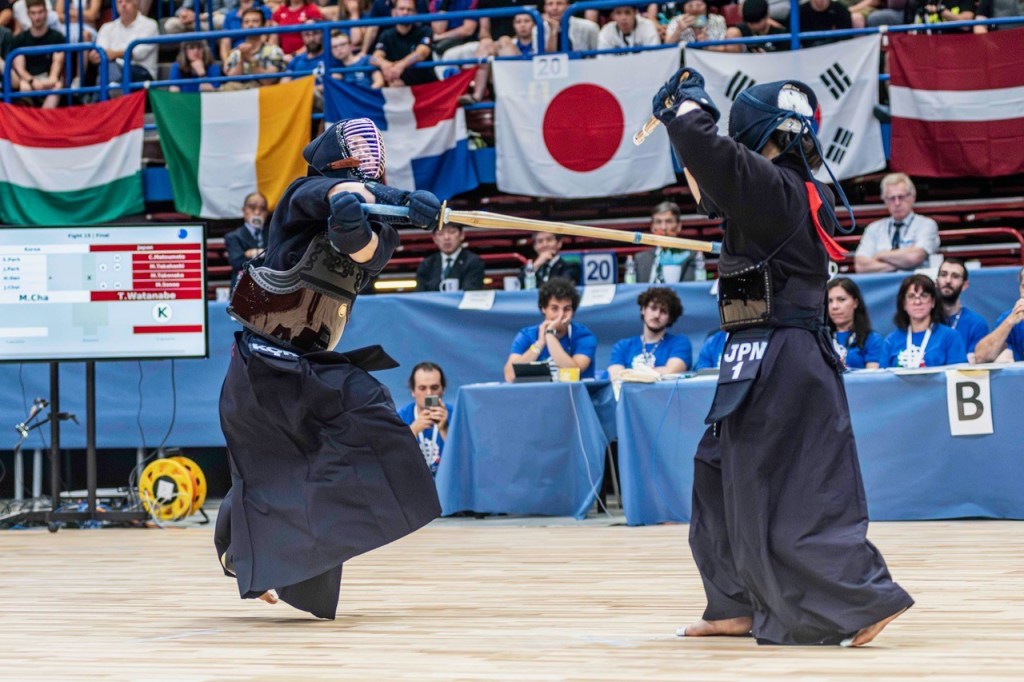
Photo credit: Chris Barbé @ chris-barbe.com
Japan’s superior level of kendo over the tournament was breathtaking. However, the score in the final does not reflect Team Korea’s performance and development. Team Korea must be commended for their prowess and composure demonstrated during the final match. Although the margin was narrower in 2018, when Japan won 2-0 and scored the only two ippon of the final, the match play by both teams in 2024 was considerably “cleaner” and more technical.
For spectators, this WKC final was a better learning experience and more enjoyable to watch. The quality of the final was partly a result of the recently implemented rules, which do not allow physical and long tsubazeriai, and that both teams showed more confidence and dexterity in their kendo than in 2018. Continuing with the developments in women’s kendo and refereeing, it is anticipated that the final will be more competitive at the 2027 WKC.
The 19th WKC was a historic event for women’s kendo that symbolised improved opportunity for women. International women’s competitive kendo has improved significantly. The marked development is outstanding considering the 6-year gap between the 17th and 19th WKC and that many of the exceptional performances were executed by teenagers and young adults who were WKC first-timers.
“Looking back at the tournament schedule, kendo still seemed to be a male-dominated art. The women’s individual competition was set for Thursday, the day with the fewest spectators.”
Assistant Coach Kazue Daigo (Great Britain)
There is still room for development in terms of women’s status in kendo and this is revealed in how the WKC is scheduled, and the number of women referees, coaches and competitors. Improvements in these areas can increase the status of women’s kendo―leading to greater engagement and skill development of women kenshi.
“The dedication and skill demonstrated [at this WKC] have shown that women’s kendo deserves the same recognition and respect [as men].”
Competitor Viktorie Eichlerová (Czech Republic)
Part 2 of this 2-part article series will be published later this month. The upcoming article centres on the perspectives of women who performed in various roles at the WKC. Both optimistic and critical reflections were shared. The perspectives highlight the positive developments in WKC kendo, as well as the pressing need to further improve certain practices. As well as suggestions to support the development of international women’s kendo. Overall, the reflections in the article convey how WKC kendo provides a deep sense of purpose and community for women.
Disclosure statement
The articles published on this website present the owner of this blog website’s perspective, based on personal experiences, unless stated otherwise. They do not represent those of people, institutions or organisations that the owner may or may not be affiliated with in a personal or professional capacity unless explicitly stated. All content in these articles are for informational purposes only. People’s perspectives that may appear as information in these articles, do not reflect the perspective of the owner or other people’s perspectives. Any views or opinions are not intended to malign any religion, ethnic group, club, organisation, company or individual. The owner of this blog makes no representations as to the accuracy or completeness on this site or found by following a link on this site. The owner will not be liable for any errors or omissions in this information nor for the availability of this information. The owner will not be liable for any loses, injuries or damages from the display or use of this website.
 Kate Sylvester Perspectives