Foreword by Kate Sylvester.
This is the last article in the series that focused on women’s perspectives and approaches to competitive kendo leading up to the World Kendo Championships (WKC) in Italy (July 4-7, 2024). The articles have featured insightful and inspiring reflections from brilliant and accomplished international level women competitors, coaches and referees. The 19th WKC taking place this week, promises to be historical event with equal match time for women and men and the inclusion of female shimpan.
The event is also symbolic of the growth of women’s kendo globally. 47-teams and 203-individuals will compete in the women’s events in spite of the 5-member minimum requirement. The number of women competitors has significantly increased from the 2018 WKC held in Korea, where 38-teams and 171-individuals competed in the women’s events. Markedly, a total of 9 female shimpan selected from Europe, Asia and the Americas will referee at this WKC.
The pressure to perform at the WKC is high for women shimpan, but all selected shimpan are highly capable of judging matches fairly and in a way that raises the level of kendo performance. Equal time and the inclusion of women shimpan at this WKC is historical, (albeit long overdue) and the level of women’s kendo and engagement can only improve with such symbolic actions of gender equality at the WKC.
This last article in the series features 3 Europe-based women that have been selected to referee at this WKC. Chieko Yano sensei, Angela Papaccio sensei and Katja Fleury sensei, in their own words share their perspectives on the new format of the WKC and what it means for them personally to be selected as shimpan at this WKC.

Cheiko Yano 7 dan kyoshi started kendo in Japan when she was 6-years-old. She moved to Belgium in 2002 and is an instructor at Ko Jika Kendo Club in Ghent, Belgium. Yano sensei considers that the philosophy of kendo teaches her that training is a path to character development. She still feels inexperienced and can improve through kendo training. She strives to work harder to become a better person through kendo.

Angela Papaccio 7 dan kyoshi has practiced kendo for 31-years. She is an instructor Koshikan Kendo, Firenze. What Papaccio sensei mostly loves and value in kendo is the entanglement between keiko and life, how to progress and succeed with hard work and dedication, whether in competition, grading or simply for the pleasure of doing keiko until (possibly) our very old age.
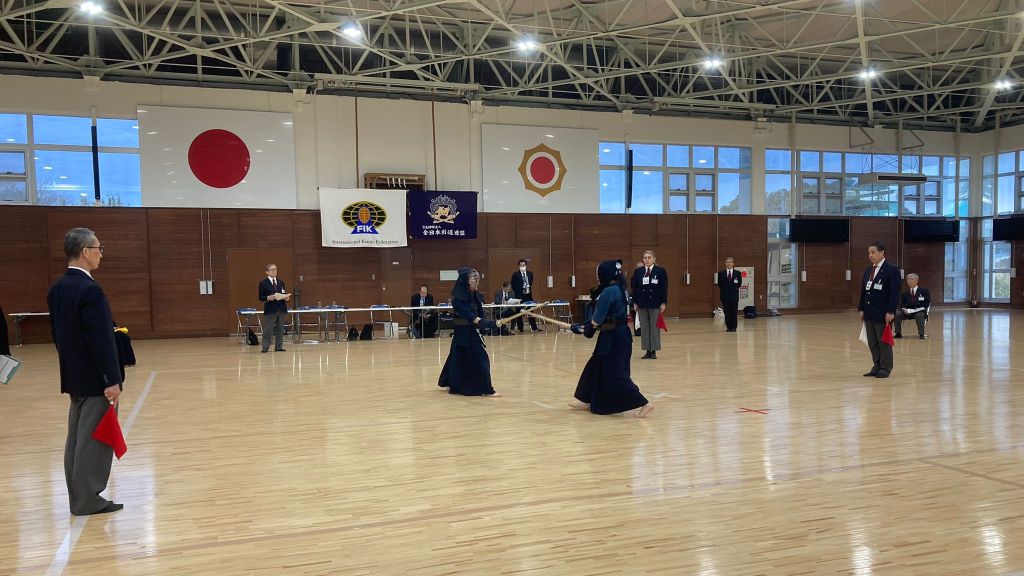
Katja Fleury 7 dan renshi, has practiced kendo for 35-years and is also 6 dan renshi in jodo. She is an instructor at Kenseikai University Sports, University of Berne, Switzerland. Fleury sensei appreciates the beauty and elegance of kendo and its movements. She feels it is important to find your own nice style to perform kendo and improve your kendo by dedicating yourself to keiko, for its own sake.

What are your thoughts on this WKC being the first to have equal match time and female shimpan?
Chieko Yano: These past 10-years, the number of female 7 dan practitioners living in Europe has increased. Also, more and more European countries have female practitioners. As the level of not only men, but also women in each region has risen, the number of players and referees has increased. As a result, the number of female referees has gradually increased. This is a natural progression, but I think it was made possible by the FIK’s flexible response and ability to understand the change of the situation in kendo.
Angela Papaccio: I am very happy and at the same time burdened that it took so long to get here. We are still talking about this like it is a crazy hard achievement, which by the way it is, but how profoundly sad is it that something that should be totally normal has the shape of a miracle? I feel we should thank all the people involved in this change, that fought for years (decades to be precise), to get us and the new generations of kendoka at this point.
Katja Fleury: I think equal match time sends a powerful message that both male and female athletes deserve equal opportunities and recognition for their efforts and skills. Equalising match time ensures that female competitors are judged by the same standards as their male counterparts. This can further raise the overall standard of women’s kendo worldwide. However, I think it’s a bit of a shame that it’s taken so long. In my opinion, this should have happened a good 12-years ago. Having female shimpan not only promotes gender diversity within the officiating community, but also provides role models for young women and girls in kendo. Seeing women in positions of authority and respect may inspire more women to aspire to higher levels within the sport.
How do you think it will change/develop women’s kendo and kendo in general?
Chieko Yano: Kendo is a martial art that anyone can do, regardless of age and gender. As the healthy lifespan of humans is getting longer, I think we will have more time to enjoy our kendo lives. My kendo opponents are not enemies, but precious friends who help me improve. As my kendo life gets longer, I think my understanding of kendo will deepen and develop. I expect that the world will become a more peaceful place through kendo.
Angela Papaccio: I believe it can give women a renewed sense of purpose knowing that once their career as competitor ends there will be continuity training as shimpan with the WKC as a real potential goal ahead. For kendo in general, it simply adds to it with a larger pool of high- level contenders striving to be their best selves.
Katja Fleury: Equal match time can serve as an encouragement for more women to participate in kendo, knowing they are competing on an equal footing with men, leading to higher levels of performance and dedication. Equal match time and female shimpan help normalise the presence and importance of women in kendo, fostering a culture of equality. Promoting equality and diversity can enhance the public image of kendo, attracting more fans and participants and increased media coverage and attention, further promoting the sport.
What does it mean to you to be selected to shimpan at this WKC?
Chieko Yano: Teachers have explained to me that if the refereeing gets better, the matches will also improve. And if the matches improve, kendo will improve. I have realized the importance of refereeing. My judging level is not yet perfect, so I think sensei will encourage me to study and learn more at the WKC. There are many different types of players, so referees must be able to discern the characteristic of each one. I want to experience in various situations and strive to improve my refereeing skills. My experience at WKC will help me to reaffirm what is correct kendo.
Angela Papaccio: I feel like I have been selected for the national team for the first time all over again! Being a shimpan is the continuous training in all kendo aspects, shiai included. Making it to the WKC as a shimpan forces you to be updated on training methods and players tactics. It requires travelling around the kendo world to absorb trends but most of all practice more and more every chance we have. This WKC selection had me focusing on all those aspects and improved my perception on many different aspects of my training. I am excited and scared, thrilled and focused but most of all I feel the responsibility to perform at my best so that every competitor at the end of the day can return to his/her hotel room knowing that their performance was all that mattered.
Katja Fleury: I am delighted to have been selected and have also received many congratulations from kendo friends nationally and internationally. Refereeing at the WKC offers an unparalleled learning experience, providing insights into the highest levels of competition and the latest techniques and strategies. The role demands continuous refinement of one’s judging skills, attention to detail, and ability to make swift, fair decisions under pressure. The pressure is very high, especially because it’s historically the first time [for women]. I’m really looking forward to the competition.
 Kate Sylvester Perspectives
One response to “‘The 19th World Kendo Championships: A Historical Moment for Women’s Kendo’ with Chieko Yano (Belgium), Angela Papaccio (Italy), and Katja Fleury (Switzerland).”
Awesome Kate-a milestone moment for womens Kendo globally-always enjoy your “Perspective” articles.
Love Dad
LikeLike