Foreword by Kate Sylvester.
With the World Kendo Championships (WKC) fast approaching, this new series of articles focuses on women’s perspectives and approaches to competitive kendo leading up to the WKC in Italy (July 4-7, 2024). The articles feature insightful and inspiring reflections from women competitors, coaches and referees.
The upcoming World Kendo Championships this July in Milan, is the second occasion that Italy is hosting the tournament. The first being in 2012. Demonstrating the growth of women’s kendo globally, 43 women’s teams and 203 women in the individual tournament will compete at this WKC. This is a marked increase from when the championships were last held in Italy where 30 teams and 132 individuals competed in the women’s events.
Italy has a vibrant kendo community and has had significant success previously when the Italian men’s team won bronze at the 2003 WKC. The Italian women have previously also had strong performances at the WKC with a number of members winning fighting spirit awards such as A. Costa (1997) D. Castelli (2003), F. Trasmondi (2006), M. Livolsi (2009), and S. Riciutti (2015). The national women’s kendo team has also enjoyed success at the European Kendo Championships. The highest achievement of the women’s team was winning gold in 2014 and when Mirial Livolisi (7 dan) won three individual championships consecutively (1996, 1998, 1999).
Kendo in Italy is in good shape and 20 % of the 1, 800 registered kendo members are female. The healthy membership has been fostered by the CIK (Confederazione Italiana Kendo / Italian Kendo Federation) and the Italian kendo community. Female engagement is also likely to be influenced by the active women kendo sensei in Italy who have taken up positions as CIK president, national team coaches, board and technical committee members, dojo leaders, and as referees at the EKC and upcoming WKC.
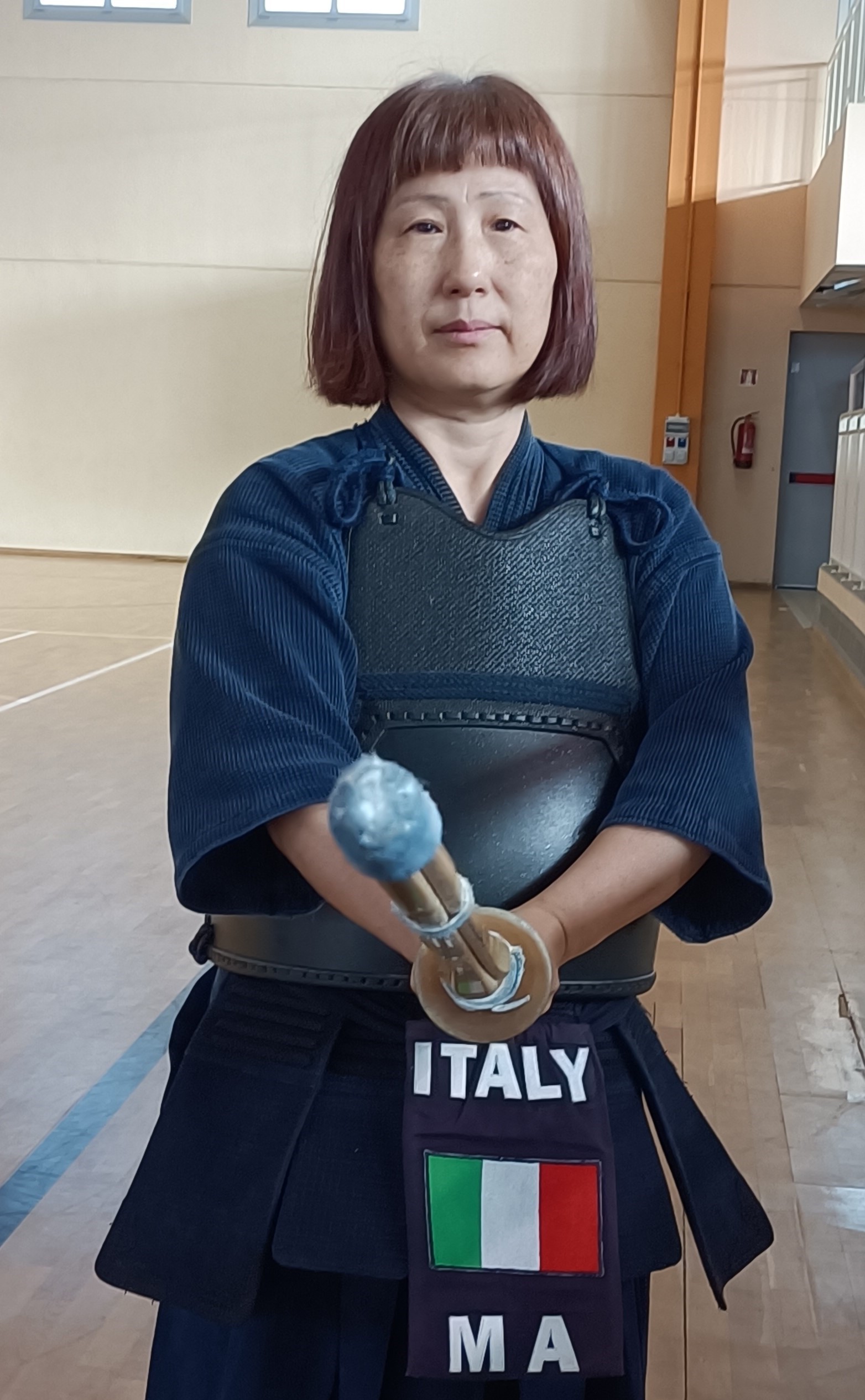
Yunsook Ma sensei (7 dan) is a coach of the Italian National Kendo Team and instructor of Kendo SeiChudo dojo in Brescia. I first met Yunsook at the Women Aki Taikai last year in France. She was one of the 7 dan sensei who led the seminar and competed in the 7 dan tournament. I was fortunate to do keiko with her during the event and felt appreciative of her advice on my kendo. During our brief encounter she had managed to observe a not so obvious shortfall in my kendo. My kendo sensei in Japan, who knows my kendo quite well, had also mentioned the same issue. The feedback reflected Yunsook’s teaching skill and depth of kendo knowledge. I was impressed by her ability to see the deep and individualised layers that constitute a kendo practitioner. Therefore, when Yunsook gave her feedback with warmth and clarity, I was moved and felt immediate respect for her teaching aptitude.

In the following passages, Yunsook shares her experiences and perspectives on coaching the Italian National Kendo Team. Her coaching approach is commendable through its focus on reliable kendo fundamentals, team cohesion, softness, and mental strength development. For kendo athletes, this type of coaching philosophy is critically important due to the constant generational change that particularly impacts on the development of women’s kendo. Undoubtedly, if more coaches and sensei shared Yunsook’s approach and perspectives on kendo, the development of women’s kendo would be accelerated.
Moreover, shiai does not always go to plan for many reasons, and as such it is important that competitive kendo gives national team members more than tactics to win shiai and meaningful experiences that are not pinned to results. Afterall, being a national team member requires great sacrifice and investment. Also, few women continue being part of the national team at the leadership level after they retire from competing, and many stop kendo altogether. As such, it is crucial for coaches and federations to investigate and implement creative ways to maintain women’s engagement in kendo through their retirement.
As Yunsook shares, being part of a national team as competitor, coach or manager, can provide a great opportunity for kendo improvement and personal development for ourselves and those we guide and support. Although women have coached male national kendo teams previously, and finally women will shimpan at this WKC, Yunsook’s perspectives spotlight that the recognition of women’s attributes and capabilities through increased gender equality in the WKC arena is long-overdue.
How and when did you start kendo?
When I was a child, I saw kendo (kumdo) dojos in Seoul, South Korea and I was always curious but I never had a chance to try. At the age of 23, I first tried kendo in Milan with the Korean Master Kim Taekjun (8 dan hanshi) who was running a kendo dojo so I decided to give it a chance. But unfortunately, my situation at that time did not allow me to continue so after just 3-months I had to stop training. After several years at the age of 28, I started kendo again when I moved to Florence for work. Not knowing anyone, I was looking for friends and I found a dojo. The same year I met my husband Livio Lancini, and my life in kendo has continued until today.
Why did you decide to become the national team coach for the Italian National Women’s Kendo Team?
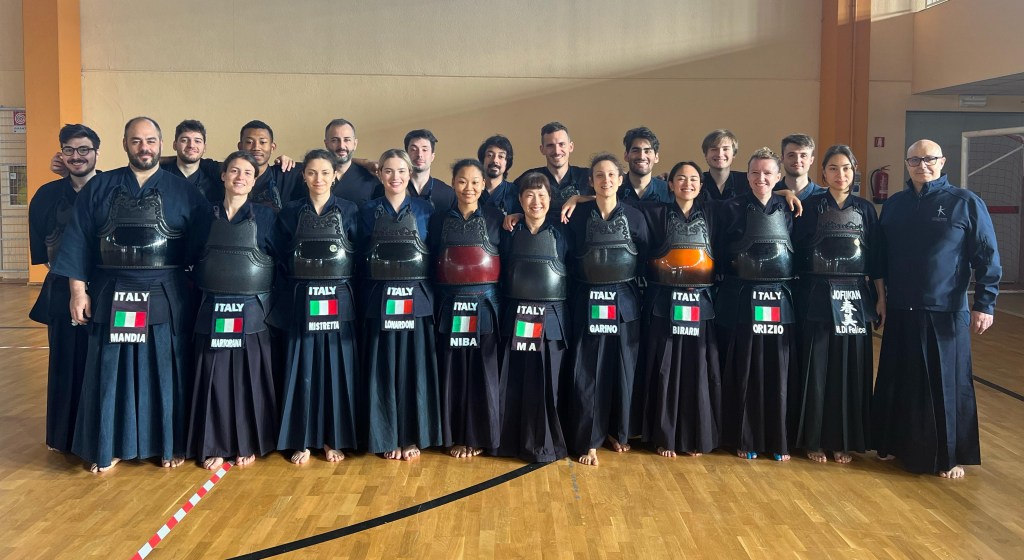
Actually, it wasn’t my decision. When my husband Livio Lancini was appointed head of the Italian National Team, he strongly asked for my cooperation and that of Fabrizio Mandia. Before accepting, I asked him if it wasn’t a problem that husband and wife were running the national team together, but he convinced me answering that he absolutely needed both me and Fabrizio and that the three of us together could create a strong collaboration to raise the level of the national team members and manage the national team together.
What is your coaching philosophy? What do you focus on when coaching the national team members?
I believe that the true strength of a team lies in the intimacy and empathy of its members. For kendo to be considered strong, it must be beautiful and elegant. This comes with softness and relaxation-both physical and mental. So, my coaching philosophy is to work in softness with great courage of spirit and in harmony to make a strong and compact team.
As soon as we started our campaign, we immediately challenged two problems. Firstly, we had to face a generational change, there was already a solid level for the men, but for the women we were faced with a radical generational change that required us to rebuild almost everything.
Moreover, the fact that we had to start our campaign at the same time as the COVID lockdown. The banning of all the meetings in person certainly did not allow us to facilitate our job. Therefore, when we finally had the chance to resume trainings, there was no other way than to focus on the consolidation of the kihon, starting from the most obvious elements such as ki-ken-tai-ichi, clear and large strikes with correct tenouchi, and proper zanshin.
At the same time, I wanted to create a healthy collaboration and cohesion among the women. It was my strong belief that from the beginning it is important to encourage them to understand that power lies in the physical looseness (relaxation in the body) as it affects our mental tranquillity and stability.
In my point of view there is no special coaching for shiai as I place a lot of importance on kihon. The same focus is also for the members of the national team. For shiai the important thing is to have a sound base and for the focus on kihon to be a constant.
How do you measure success?
This is a difficult question, as the answer has multiple levels. At the beginning I measured my personal successes based on concrete results such as whether I managed to hit my opponent correctly, or if I won a match and successfully passed a grading exam.
At the next level I started to consider how successful the small improvements of my kendo practice, such as whether I managed to move the mind of a strong opponent by my seme, or in a certain moment had I managed to attack with full sutemi or even more simply if I managed to perform a strike by a nice fumikomi and with perfect tenouchi. The small joys in a kendoka’s life.
Finally, in the period between 6th and 7th of Dan, I was very focused on my students, and I considered their progress a personal success. In the national team, in 2-years of work, we have seen great improvement in both the technical level and the mental level (strong spirit) in the members which has fostered a united team. This is what I consider as a great success in my teaching.
What do you enjoy about coaching?
It is a huge satisfaction when I see that the members practise kendo with passion and increase their level. I am also very pleased when I realise that they trust my words.
Please share a special coaching experience.
Some time ago there were some athletes, who despite having an excellent technical level, in competition they found it difficult to win matches. I identified the reason was that it was basically a problem of self-esteem and self-confidence as well as an extreme concern about the judgment and expectations of others. Therefore, I encouraged them to understand that they didn’t have to prove anything to anyone (if not to themselves), but rather concentrate to be able to express their real level, beyond the result. Specifically, to trust themselves and rely on the directions of the coaches.
Through trying not to create stress about the result and constantly showing confidence in their kendo, I gradually found clear improvements. Over time they managed to face even important competitions with courage and determination and above all, they were able to express their real level. In the end these members achieved good results in tournaments.
What are the challenging aspects of coaching?
In general terms, the hard part is to maintain their passion and to encourage them to continue the practice of kendo whilst improving their level. As coach of the national team, my goal is to create a solid and united team, and to foster self-confidence in the members so that they have the awareness that achieving victory against anyone is possible.

How have you personally grown from competitive kendo as a coach?
When I was younger obviously my goal was to become strong and win, but with the age and natural maturation of my kendo, my interest has spontaneously shifted towards teaching oriented goals. For example, I focus on ways to train members psychologically and physically for them to become strong and self-confident competitors.
As a coach, I have shifted the focus from my kendo to that of others. And trying to understand others more and their life because I think that often kendo and personal life are connected. This awareness in some cases has led me to play the role of mental coach, since understanding what are the problems in life can help us to correct our kendo and vice versa. In my personal case, I have eventually become a more sensitive and understanding person in comparison to some other people.
How have you dealt with kendo slumps or a disappointing performance?
On my first test attempt at 5 dan, my performance was so pitiful that I fell into depression and lost motivation in kendo. I foolishly decided not to do more exams and I practised kendo without direction and objectives for a period of time. I have to thank a Korean teacher who gave me simple advice that struck me deeply, “Every obstacle must be faced with courage and determination! Every opportunity left is lost!”. So, following his advice I was able to overcome this crisis, and today I have arrived where I am now.
Do you feel any additional pressure hosting the WKC in Italy?
Obviously yes. Showing our team in front of an audience that will be predominantly Italian creates many expectations and a stress much higher than a WKC in another country. The WKC in itself is a stressful event for both competitors and coaches.
This WKC will be the first WKC in history to have equal match time for women and men and also female shimpan. Do you have any thoughts on this?
I believe that the level of world kendo for women is now of the same quality as for men, and it seems obvious that they can enjoy the same conditions at international competitions. The same applies to women referees who have the same technical ability and value as men. In my view, this equality should have happened a long time ago.
There are few women coaching national kendo teams, and even fewer women coaching men. Do you think women are capable of coaching male national teams?
I firmly believe that women can easily manage a men’s national team. Characteristically women are more sensitive and empathic, they perceive many details and nuances that can escape men, in fact, as I said before, the preparation of the national team is not only technical and physical, but above all, psychological. This does not mean that women are technically inferior to men, and in fact in the Italian national team, although I devote myself more to women’s kendo, in reality we do not have dedicated and distinct roles among those who manage the junior, men or women.
What would you like to achieve as a coach at this WKC?
I am very excited because it is my first world championship ever. First of all, I would like to show a strong and cohesive team. It would be nice to reach the medal zone in all categories so as to give the Italian audience strong emotions and satisfaction.
Please share any words of wisdom or motivational words that may inspire other women and men to take up coaching after they have finished with their competitive careers.
Being an athlete and a coach are two very different feelings and experiences. If a former national team athlete becomes a coach, he(she) can definitely give much more at a technical level and can help to better manage tensions and emotions during the European and/or World Championships.
Coaching as a former competitive athlete at the international level, can have a broader vision to train athletes in a better way. I am sure that the path from athlete to coach will help to build even more solid kendo for ourselves which in the end can enrich the life of other kendoka also. Thus, I strongly recommend this kind of experience to those who will have the opportunity.
About Yunsook Ma
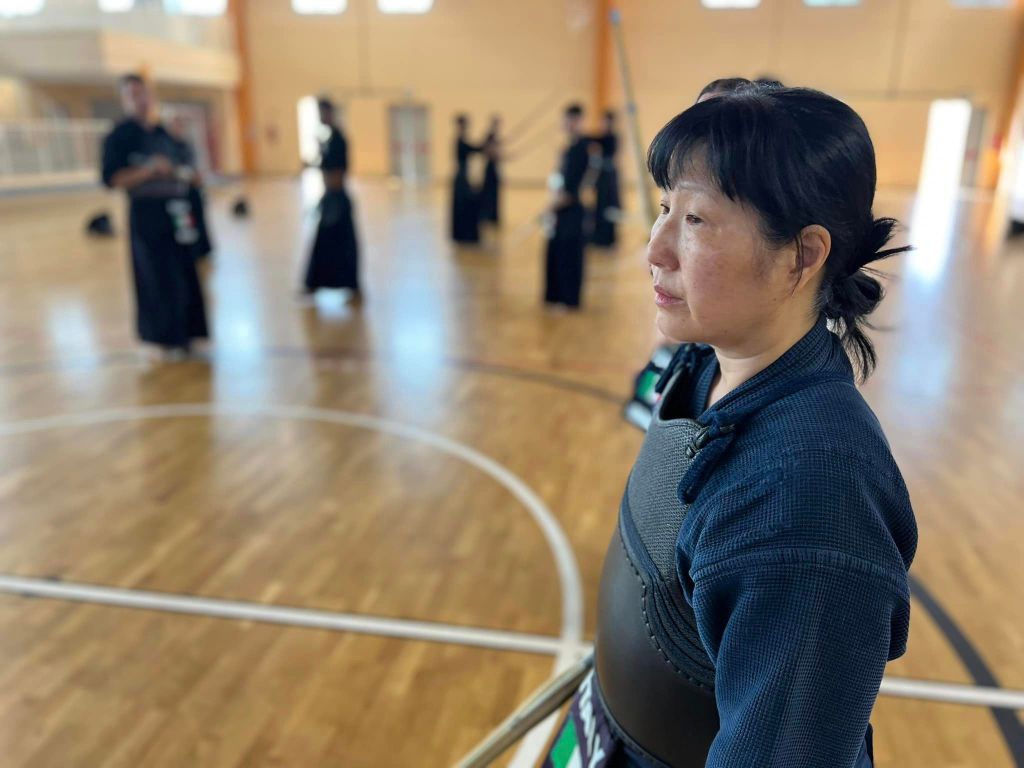
Yunsook Ma was born in Seoul (South Korea) in January 1968, the third of five siblings. From 1986 to 1988 she attended the Women Baewha University, School of Fashion in Seoul. In 1988, at the end of her studies, she was ranked first at the XI Young Designer Contest that was organised by the Korean government. This earned her a scholarship and the opportunity to study abroad and she opted for Italy. She initially lived in Perugia to study Italian at the University for Foreigners and thereafter in Milan where she was enrolled in a design course at the Art Institute of Clothing Marangoni.
At the time there was a small Korean community in Milan and Yunsook began kendo at the age of 23 under the guidance of the late Master Kim Taekjun. After only 3-months she had to stop kendo to finish school and return to Korea. After a short stay in Seoul, she decided to return to Italy and lived in Florence as a fashion designer for several years. At the age 28, Yunsook resumed kendo under the guidance of Angela Papaccio (7 dan kyoshi).
In 1997, during a seminar in Florence led by Koyama Masahiro she met her husband Livio Lancini. A few years later they gave birth to their only son Jun and moved to the city of Brescia. Together they successfully run the dojo, Kendo SeiChuDo.

Yunsook wishes she could have been a national member sooner, but was not eligible due to her citizenship status. Some job and life choices had taken her away from the world of the national team and from kendo. During her kendo career Yunsook has had the opportunity to participate in several Italian championships. Her best result was 2nd place in 2004 and she has finished 3rd place and won fighting spirit awards on a number of occasions. Yunsook’s most valued experience was when she was a national team member and the team won bronze at the EKC in Helsinki, Finland in 2008.
 Kate Sylvester Perspectives