Women Kendo Luminaries:
There are a number of women in kendo that continue to strive achieving personal goals and supporting the growth of kendo in their countries post their national team careers and amidst work/family commitments. This is the third (03) article under the category “Women Kendo Luminaries” that acknowledges the perspectives, achievements, and contributions of women in kendo from around the world.
03 Miwa Onaka (Brazil)

(Introduction by Kate Sylvester)
Miwa Onaka sensei is kendo 6 dan renshi, women’s national team coach for Brazil and instructor at Bunbunkan Dojo. She has impressively participated in 8 World Kendo Championships, 7 of those as a competitor, with her 9th approaching in Italy 2024 as women’s team coach. Onaka is one of the most well-known and successful women in the kendo world. She has won the Brazilian Kendo Championships 15 times as well as other prestigious titles in Brazil and South America (see bottom of article for list of achievements). With tireless dedication, Onaka continues to be a significant contributor to kendo in Brazil and South America. Her kendo expertise is also revered in the highly competitive arena of European kendo and was appointed as a Swiss national team coach for the European Kendo Championships (EKC) in 2011, 2013 and 2014. The Swiss men’s team won bronze medal in 2011 and 2014. I have heard first-hand, that Onaka remains a great source of inspiration in the region.

Photo: Onaka with Swiss men’s team at 2011 EKC
The Brazilian Women’s National Kendo Team has been highly successful at the World Kendo Championships (WKC) and undoubtedly remains one of the strongest teams in the world having won a number of team titles (2nd place in 2000 and 3rd place in 2009, 2012, 2015 WKC team events). In the individual event at the 1997 WKC, 17-year-old Onaka won 2nd place in the 2 dan and below category. Team mate, E. Takashina won 3rd place at the WKC in 2009. Onaka has recieved an unsurpassed number of WKC fighting spirit awards, a total of 6.

Photo: Team Brazil at 2009 WKC (Brazil) Credit: Lola Studio@lolatachibana
The female kendo population in Brazil is relatively healthy with 142 women officially affiliated with the Brazilian Kendo Confederation, which is 16% of the total membership. Some of the main reasons that Brazilian women’s team has been consistently outstanding is due to it’s rich kendo heritage and that Onaka’s continued engagement in the national team has secured the future growth and success of the women’s team on the international stage. In 2020, Onaka recieved the Merit Honor of the Minister of Foreign Affairs of Japan (Taro Kono), in recognition of the relevant services provided in the dissemination of the art of kendo and Japanese culture in Brazil.
Even as a kendo celebrity, Onaka exudes an approachable warmth and a vibrant and grounded presence. I had known of Onaka since the 2000 WKC but had never had the opportunity (or courage) to speak with her. My first close (ish) encounter with Onaka was at the WKC in 2012. The Australian women’s team fought Brazil in the quarter-finals and Onaka’s experience and finesse won the match for her team in daihyosen with a cracking de-kote in a short period of time. I can still see the point in my memory. It became clear then in that match that Onaka is a kendo tactician.
The greatest impression of Onaka’s kendo persona that resonates with me is from the WKC in Korea in 2018 when she was the head coach of the Brazilian women’s team. I vividly recall seeing her team of women executing warmup suburi with a fiercely determined focus and kiai. I had been watching her team leading up to the team competition because there was a good chance Australia would fight Brazil in the quarter-finals. A nervous pressure loomed as two members of our team and myself had some deep-seated emotions remaining from loosing to Brazil by daihyosen in 2012. Based on this history, Brazil had the advantage and their solid trail of success posed a mental pressure that we as a team would need to overcome. Poland was on fire that day and defeated Brazil, which was a relief, but also a disappointment. Personally, the painful experience of coming so close to a medal in 2012 had been a driving motivator to continue WKC participation as a coach, and a rematch with Brazil would have psychologically tested the hard work myself and our team had invested. Australia did go on to defeat Poland to win the Oceania region’s first medal in WKC history.
The reason for providing this background information is to contextualise and describe the kind of person Onaka presents herself to be. After the medal ceremony in Korea, Onaka approached me with her arms open wide and congratulated me. I could see the disappointment in her eyes but could also see that they were alight with a happiness for our success. This touching example of sports-personship was commendable and has stayed with me. Onaka is a stellar role-model to women and men in the global kendo world and certainly has a powerful aura, one that is inviting and encouraging. She lives the kendo ethic that many of us talk about and search for in others and in ourselves. To remain engaged in kendo at the national team level for such an extensive period (26-years to date), and display kendo virtue with consistently—takes a great deal of generosity, tenacity, confidence, and self-awareness. I sense Onaka embodies these qualities.
The remaining passages of the article are responses to a series of questions that are answered in Onaka’s own words. At the end of the article you can find an impressive list of Onaka’s competitive achievements, awards, training history, and vast contributions to the global kendo community.
About Miwa Onaka (Brazil)
Please share how you started kendo.
I was 6-years-old when I started kendo but it has always been present in my life. My father was the sensei of the dojo and for me as well as for my brothers, it was something that existed in our family before we were even born. We were already destined to do kendo. To cite a few examples, when my mother was pregnant with my sister, she would tell the kenshi – just don’t hit my DO please!!! When my brother and I trained and my sister was still little, she slept on the shelf where kept the bogu. I already fought the final of the Brazilian Championship with my sister and my mother.

Photo: Onaka family in 1993 (Miwa second from right)
Please share a little about yourself and your life outside of kendo.
I am currently a city councilor and also work for Brazil Japan Cultural Association in Frei Rogério, Santa Catarina. As a city councilor, I work analyzing laws, supervising the City Hall, I participate in meetings and events that involve issues relevant to the development of the municipality, listening to requests from the population and seeking State and Federal funds to apply and invest in improvements in the municipality, among other functions.
At the Brazil Japan Cultural Association, I help organize and promote traditional events of Japanese culture, in addition to working in the accounting, administrative and secretariat areas of the entity.
I am also a Japanese and kendo teacher for children and teenagers. I really like the work I do, because I know that in the future these teachings will make a difference in the lives of children as it did for me.
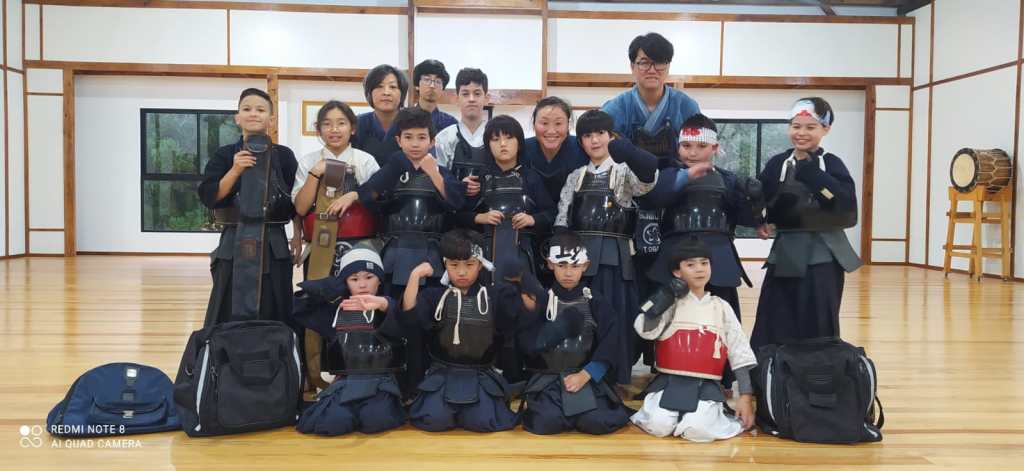
Photo: Bunbunkan Dojo
I believe that everyone who practices kendo feels how much kendo teachings guide our life (career). Kendo is always with me and directly influences my actions and decisions.
Please share a little about what inspires you to keep continuing kendo although you are not a national team member now.
My connection with kendo has always been more than participation in championships. As my father was the sensei of our dojo, kendo was something that was ingrained in my family and also strongly connected with the Japanese community where I was born and raised. My father started teaching kendo in 1973, since then kendo dojo had a lot of support from parents and community leaders, who worked together to encourage the practice of kendo.
My childhood dojo was a place where I had fun with my friends and learned many important things like values, respect and companionship. I learned from my sensei to be a strong, humble and hardworking person. Through kendo I had opportunities to meet people and travel around Brazil and the world, a dream I’ve always had since I was a little girl. I have a lot of fun training kendo, I like to train with strong people, with children and with people who are learning kendo. Kendo reminds me of the importance of having a feeling of gratitude towards life, the experiences I’ve lived and the people I’ve lived with. Every training session reminds me that I always have things to improve, and it shows me that I can still do a lot through kendo. But the answer that best fits your question is I SMILE WHEN I TRAIN. And this feeling is my biggest inspiration to keep training kendo.

Photo: Bunbunkan Dojo
What is your competitive career highlight?
I believe it was my first participation in the World Kendo Championships in Tokyo. I was 17-years-old and had never seen an international championship. Seeing so many people from around the world training in kendo and being there with everyone at that event was magical and unforgettable for me.
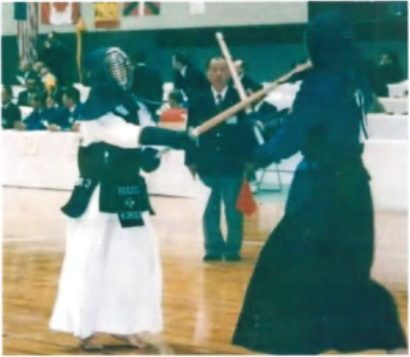
Photo: Onaka competing at the 1997 WKC (Japan)
Please share a special kendo experience.
Kendo has always given me good things and wonderful experiences. Even experiences with mistakes, defeats, physical and mental exhaustion were also very special and valuable to me. I don’t remember much of the championships I won, but I never forgot the fights I lost.
It’s hard to answer this question and share only ONE special experience. But I believe they are all the moments that I felt welcomed and cared for in a warm and attentive way by all the people who received me in their homes and dojos in Brazil and around the world. This feeling of “OMOTENASHI” お持て成し (being hospitable or receptive) friendship and bonds that we create by practicing kendo is priceless. This unique and special experience is certainly our greatest treasure and reward as a kendo practitioner.
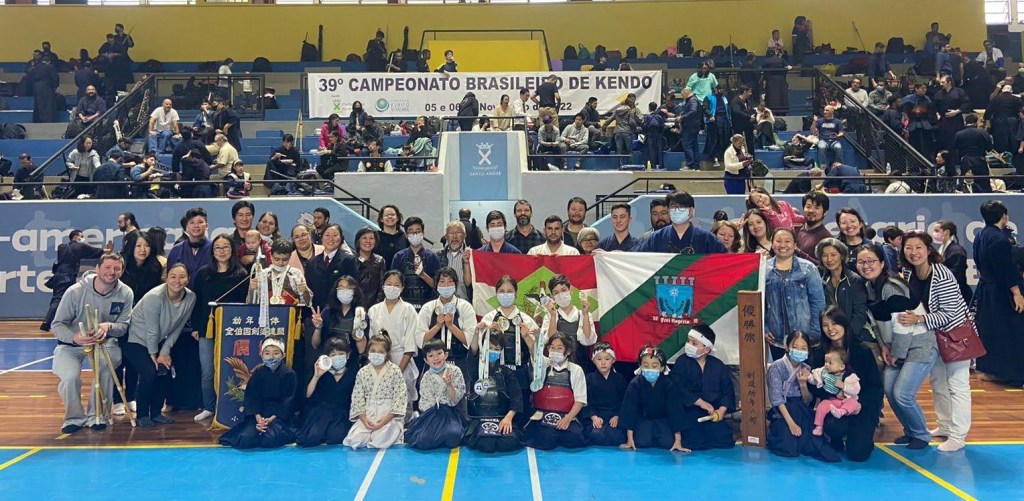
Photo: Bunbunkan Dojo members at Brazilian National Kendo Championships 2022
Please describe what you gained from coaching the Brazilian and Swiss national kendo teams.
My transition from national team athlete to coach was not a simple job. I spent so many years fighting as an athlete that the process to change my look and my posture as a coach happened very slowly and was difficult. Especially because many athletes were my fighting companions in many world kendo championships.
During the training I noticed a great technical evolution of the athletes and I felt their dedication and commitment, even knowing that they had a life, a career to dedicate themselves outside of kendo. As a coach, it was very gratifying to represent Brazil together with the girls and to have gone through this arduous process with them, which is to prepare for a world championship.
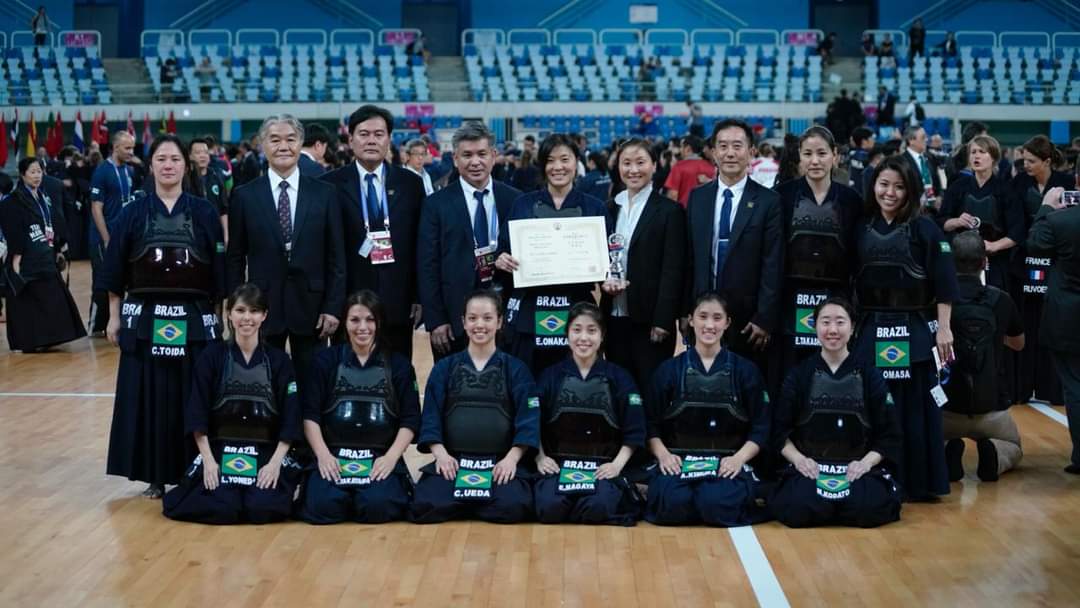
Photo: Team Brazil at the 2018 WKC (Korea)
As coach of the Swiss national team it was a very enriching experience. It was my first time as a manager and for the first time I could see and feel how great a European championship is. When my brother and I arrived, the coaching staff and everyone involved in the formation of the team had already done the most important part for a national team, which is building a team spirit. With this well-strengthened base, our job was just to convey confidence and polish the athletes’ fighting strategy. The experience I had in Switzerland as a coach was very good and the opportunity I had to meet different dojos, sensei and kenshi who received us very well. I would like to take this opportunity to thank everyone in Switzerland for their love, especially the Kimura family.
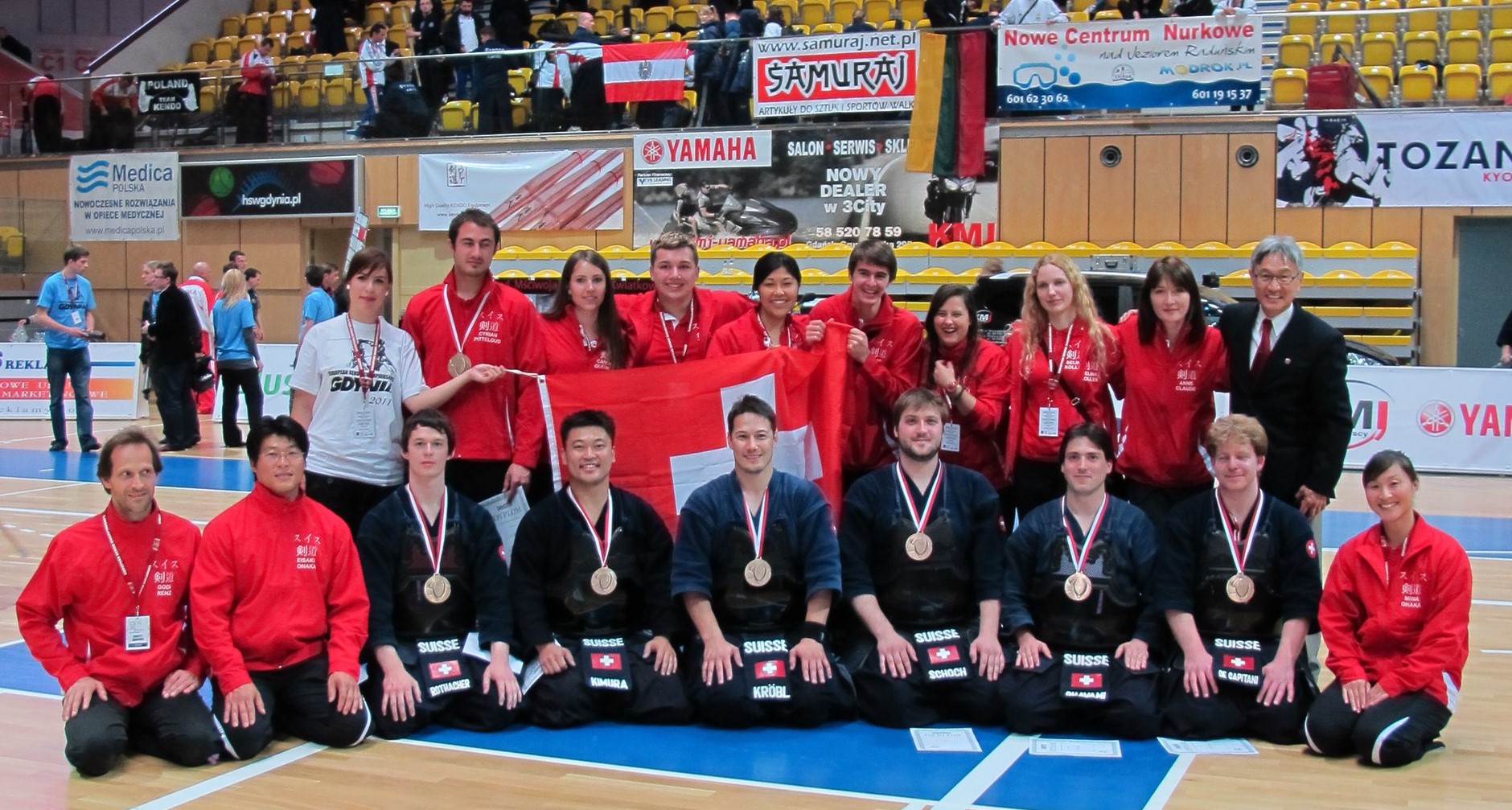
Photo: Swiss National Kendo Team (Onaka bottom far right)
Do you think there is gender inequality in kendo? If yes, can you provide some suggestions to how these issues can be improved upon?
I think that not only in kendo, but in most sports, women have little visibility and appreciation, especially in the media and marketing. Female kendo is beautiful, it is very rich in techniques, delicate movements, very well executed and at the same time strong and expressive, beautiful to look at, it would be great if more people could appreciate the beauty of female kendo.
One of the things I thought I could propose would be a change to 2 days of competition for women at the World Kendo Championships. The next World Cup looks like it will be 4 days. I hope that the commitment and fight led by women and with the help of other athletes from different countries around the world, has been fulfilled, as it would be a very important achievement for the history of female kendo.
What have you learnt from in kendo and applied to your life?
In practically everything, I always compare the kendo fight with situations in our life.
• Knowing the right time to listen and speak (attack and defence),
• Respect each other’s differences and individuality. (Knowing the fighting style of each opponent and being able to adapt).
• The importance of taking risks and leaving our comfort zone to discover our true potential (If we always fight in the HIKIWAKE style, we will never develop new skills, techniques and strategies).
• Avoid living life in such a rigid, limited and square way. (Fighting kendo hard, locked, and always with the same style, prevents technical evolution).
• If the person seeks kmowledge, studies, and dedicates themselves, they will be able to take advantage of the opportunities that appear in professional life. (A well-trained kenshi will be able to take advantage of the opponent’s “SUKI” 隙 (opening) and react with an attack, without letting the opportunity pass).
• If our work environment has good energy with a good leader, work performance improves and people are happier. (If the dojo environment is good, with a good vibe, with a sensei who teaches you well, where everyone respects each other, the possibility of the dojo strengthening is great).
These are some of the practical examples that for me are not just words, but are experiences that I lived and still live and try to apply constantly.
Do you have any words of wisdom that may inspire others to keep striving in kendo?
The path of kendo is slow but very rewarding. When you feel that you are not managing to evolve in kendo despite your commitment and dedication, be patient and enjoy the journey. These moments that make us feel stagnant can only be a test to strengthen our discipline and persistence. Imagine this moment as the stone in the slingshot or the arrow in the bow being pulled back, so that at some point it will be thrown away. The secret of kendo is continuity.

Photo credit: Augusto Marques
Kendo CV (teaching, coaching, training and shimpan)
1997 Training in Tenri University for 3 months
1997 Training in Kokushikan University for 1 month
1998 Kendo Seminar in Chile (dojos and university)
2000 First kendo class as a teacher in Florianópolis – Santa Catarina
2002 Second kendo class as a teacher in Joinville – Santa Catarina
2004 Kendo Seminar in Equador
2005 Exchange at the Tsukuba University
2006 Master of Health an Sport Science – Tsukuba University
2011 European Kendo Championships POLAND – Swiss national team coach (Men’s team 3rd Place)
2013 European Kendo Championships GERMANY – Swiss national team coach
2013 First Women’s Kendo Seminar in Mexico
2014 European Kendo Championships FRANCE- Swiss national team coach (Men’s team 3rd Place)
2014 Second Women’s Kendo Seminar in Mexico
2017 First class as a kendo teacher for children- Frei Rogério/Santa Catarina
2018 World Kendo Championship KOREA Brazil Women’s National Team Coach
2019 Invited by Zurich Dojo to teach kendo in Gashuku.
Referee at Brazilian National Kendo Championships and Latin American Championships.
Competition Results
1994 Brazilian Kendo Championship SÃO PAULO – First Place in individual (Junior)
1995 Brazilian Kendo Championship SÃO PAULO – First Place in individual (Junior)
1997 World Kendo Championship JAPAN/KYOTO – Second Place in individual (2 dan category)
1997 Brazilian Kendo Championship SÃO PAULO – First Place in individual
1998 Pan-American Kendo Championship SÃO PAULO – First Place in individual
1999 Brazilian Kendo Championship SÃO PAULO – First Place in individual
1999 Brazilian Absolute Kendo Championship SÃO PAULO – First Place in individual
2000 World Kendo Championship USA/SANTA CLARA – Second Place in time competition
2000 World Kendo Championship USA/SANTA CLARA – Fighting Spirit in individual competition
2000 Brazilian Kendo Championship SÃO PAULO – First Place in individual
2000 Brazilian Absolute Kendo Championship SÃO PAULO – First Place in individual
2001 Brazilian Kendo Championship SÃO PAULO – First Place in individual
2002 Brazilian Kendo Championship SÃO PAULO – First Place in individual
2002 Brazilian Absolute Kendo Championship SÃO PAULO – First Place in individual
2003 World Kendo Championship SCOTLAND/GLASGOW – Fighting Spirit in individual competition
2003 Brazilian Kendo Championship SÃO PAULO – First Place in individual
2004 Brazilian Kendo Championship SÃO PAULO – First Place in individual
2006 Brazilian Kendo Championship SÃO PAULO – Second Place in individual
2006 World Kendo Championship TAIWAN – Fight Spirit in individual competition
2007 Brazilian Kendo Championship SÃO PAULO – First Place in individual
2008 Brazilian Kendo Championship SÃO PAULO – First Place in individual
2009 Brazilian Kendo Championship SÃO PAULO – First Place in individual
2009 World Kendo Championship BRAZIL/SÃO PAULO– Third Place in team competition
2009 South American Kendo Championship – First Place in individual
2010 Brazilian Kendo Championship SÃO PAULO – First Place in individual
2010 Participation in World Combat Games – China
2010 Latin American Championship QUITO/EQUADOR First Place in individual
2010 Latin American Championship QUITO/EQUADOR First Place in team
2011 Brazilian Kendo Championship SÃO PAULO – Third Place in individual
2012 World Kendo Championship ITALY/ NOVARA – Fighting Spirit in individual competition
2012 World Kendo Championship ITALY/ NOVARA – Fighting Spirit in team competition
2012 World Kendo Championship ITALY/NOVARA – Third Place in team
2012 Brazilian Kendo Championship SÃO PAULO – First Place in individual
2013 Brazilian Kendo Championship SÃO PAULO – Second Place in individual
2013 Latin American Championship COLOMBIA/MEDELIN Second Place in individual
2013 Latin American Championship COLOMBIA/MEDELIN First Place in team
2014 Brazilian Kendo Championship SÃO PAULO – First Place in individual (last participation in the Brazilian Kendo Championship)
2015 World Kendo Championship JAPAN/TOKYO – Third Place in team competition
2015 World Kendo Championship JAPAN/TOKYO – Fighting Spirit in team competition
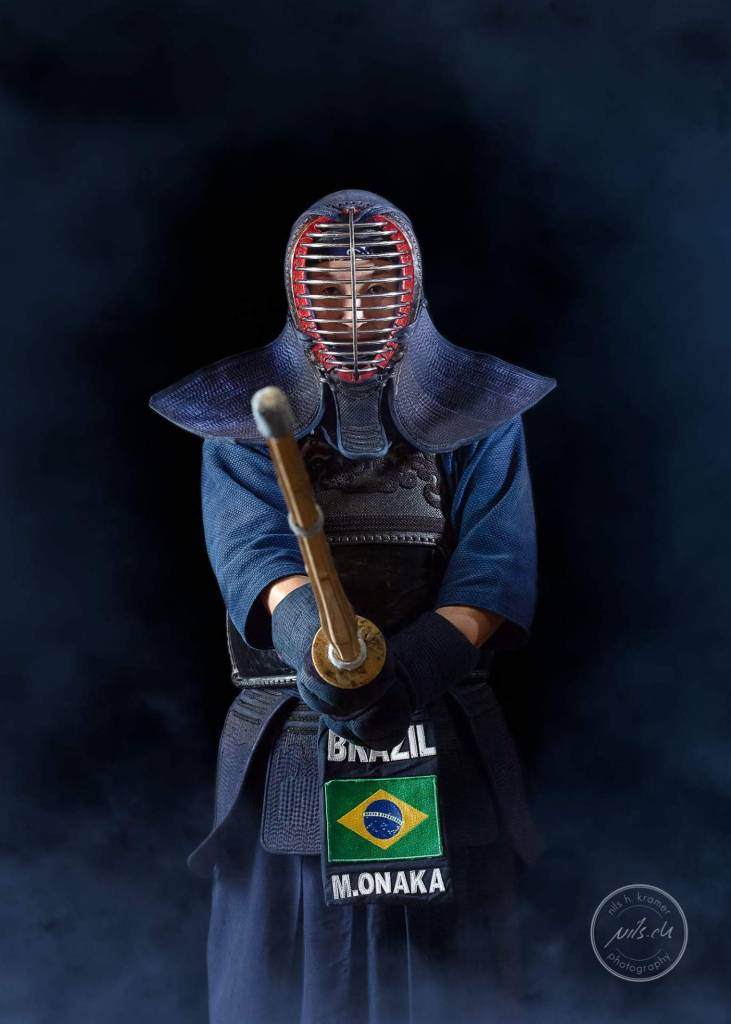
Photo credit: Nils H. Kramer
All photographs in this article were provided by Miwa Onaka.
 Kate Sylvester Perspectives