Women’s voices and achievements are under-represented across kendo-related media and literary channels. Guest essays published on this website share personal experiences, perspectives, and reflections on kendo that are written by women.
Guest Essay: A Samurai League on Her Own by Tábita Wenckstern Sáez Takayama (Brazil).
Tábita Wenckstern Sáez Takayama, 6 dan, started practicing kendo 20-years ago at the age of 20. Tábita currently lives in Japan with her son and husband. She has her own company focused on Smart City and a small kendo print company, Mikamino. The idea for the business name, which is a Japanese sounding name with the Spanish meaning “my path,” came from one of the talented designers whom she works with, Kimi Tumkus. Tábita has represented Chile and Brazil at the World Kendo Championships and won a number of prestigious kendo titles. Tábita is one of the coaches of the highly successful Brazilian Women’s National Kendo Team and also focuses her energy on developing kendo in the Latin America region.
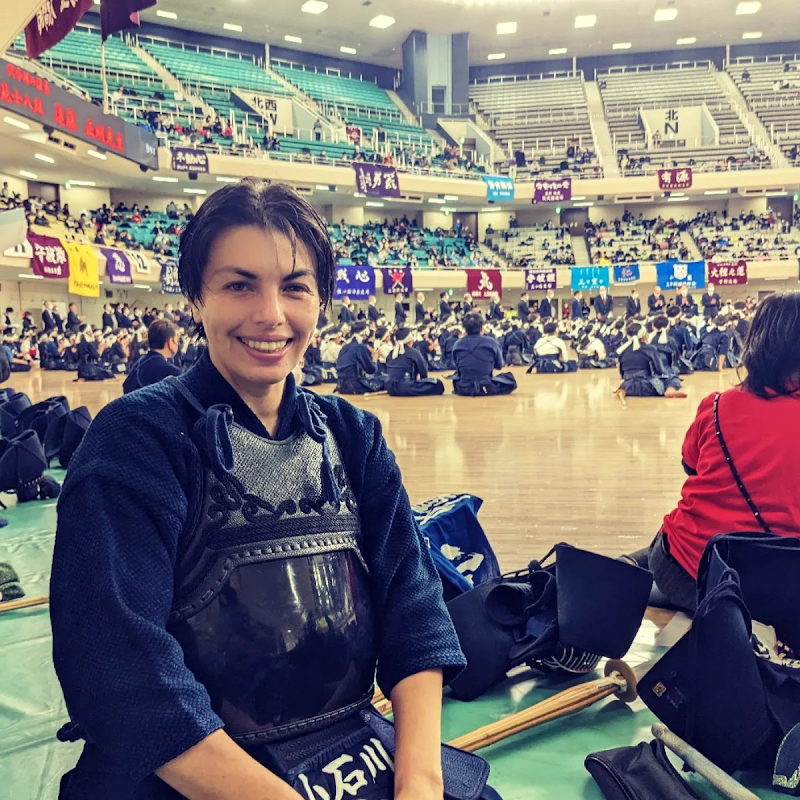
A Samurai League on Her Own
This year in August, I will complete 20-years of kendo. My sisters practiced before me and when I went to watch their classes I saw older people training with young people and that impressed me a lot and that’s why I started my training. I wanted to be able to train something that I could have fun with and at the same time make a lot of friends when I was older.
Before kendo, I practiced other martial arts competitively due to school incentives and because of that I had developed a very strong body. Because I had physical strength and stamina, the competitive part caught my attention as my body began to assimilate the movements in a more natural way. Statistically, in every Latin American country, there are few women who practice, so those who are more dedicated tend to naturally want to join their country’s national kendo teams.
My family moved to Brazil from Chile due to the military dictatorship that was taking place at the time. Even so, our cultural roots were maintained by my mother. Even with the many difficulties of an immigrant family, we maintained Spanish as our bond with the country we left. I have a different accent, but still with a strong imprint of the country I was born in and because of that affection I wanted to represent Chile when I gained the minimum technical quality to participate in my first World Kendo Championships in 2009. Even though I was born in Chile, some people didn’t consider me Chilean, but thanks to the love and affection of the Chilean women’s kendo group that welcomed me as if we were family, I felt at home again. To this day, this union exists and the connection is very strong.
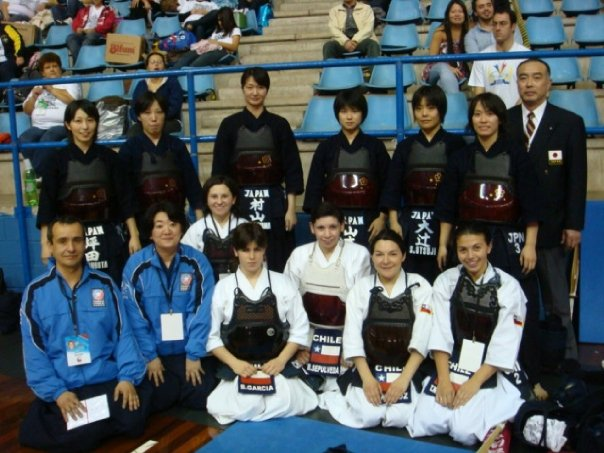
Photo: Team Chile with Team Japan at the 2009 WKC
The years passed and kendo also brought me an opportunity to form my family because I met Alberto Takayama during training for the Brazilian national team, who is currently my husband and we have a 3-year-old son. Understanding that my family would be formed in Brazil would also be the time to also consider representing the country that welcomed me in a difficult time for my family.
The Brazilian women’s group is undoubtedly one of the strongest in the world having won team titles since 1997 (2nd place in 2000 WKC team event and 3rd place in 2009, 2012, 2015), and in the individual events (M. Onaka, 2nd place (2 dan and below category) in 1997 and E. Takashina, 3rd place in 2009). I knew that gaining a spot to join this group would be a big challenge as I was not of Japanese descent and had only started kendo at the age of 20. But I have always liked challenges. I was selected to represent Brazil for the 2015 WKC in Japan and for the 2018 WKC in Korea.
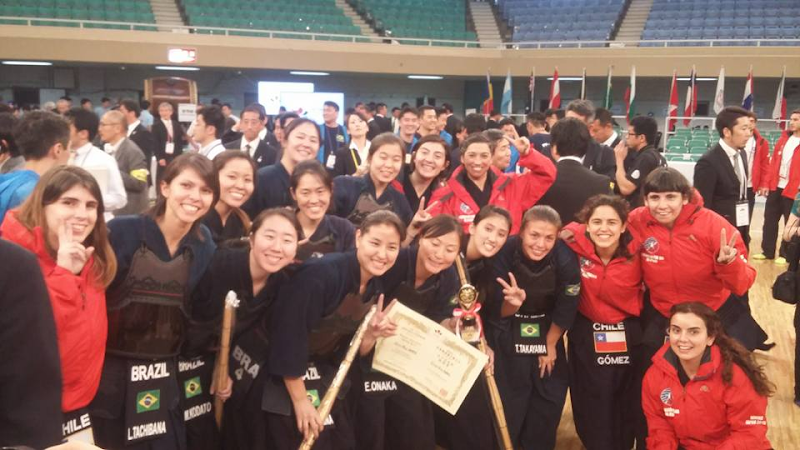
Photo: Team Brazil and Team Chile at the 2015 WKC
I realized that it was no use just wanting to join a group, but also that it was important to achieve things by my own merit. When I won the All Brazilian Championship in 2013, I cried with emotion because my competitors had trained since they were children and I had only started kendo when I was 20-years-old. Many teachers had told me that I would never be strong. Thereafter, I learned to contain my emotions because it wasn’t appropriate and I could be more discreet even when I won the title of Latin American champion in 2017. But I think everything prepared me for my 3-year stay in Japan when I managed to be champion for the Bunkyo-ku district in Tokyo in 2021. Not even in my sweetest dreams could I have imagined something like this, but on the day I managed to remain calm and respectful and it brought me friends and respect from the community.
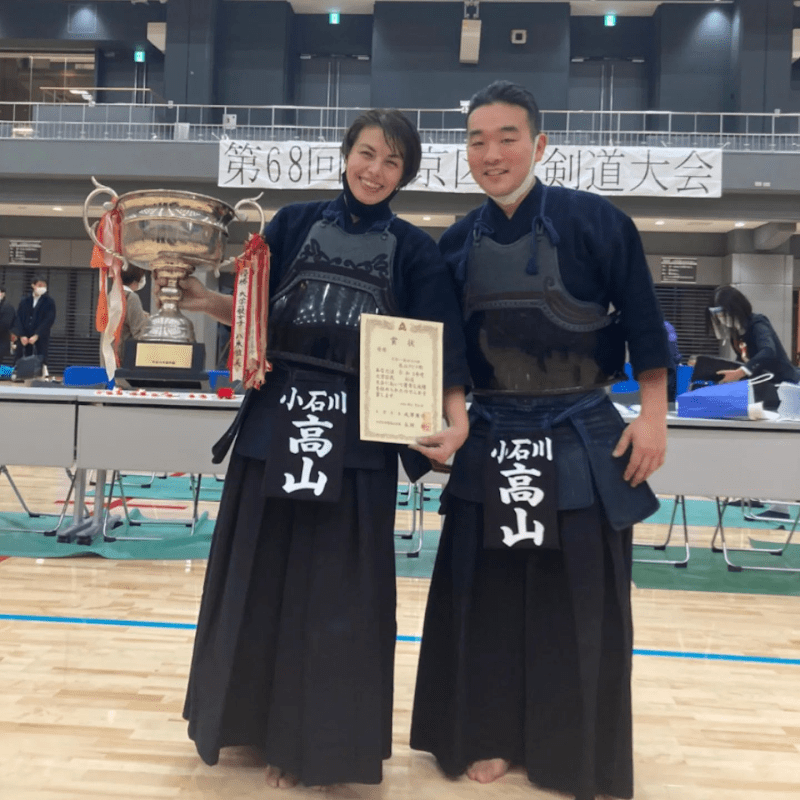
Photo: Bunkyo-ku Championship in Japan 2021
From my experience, Japanese women kendo competitors are admirable and loving people and very happy to train kendo. The passion for them to continue even with old age and with many responsibilities inspires me every day. Thanks to the support of these women, I was able to pass my 6th dan exam in Kyoto along with my husband who passed 7th dan. Last month’s Kendo Nippon magazine spoke of our grueling and also very funny journey to passing the exams.
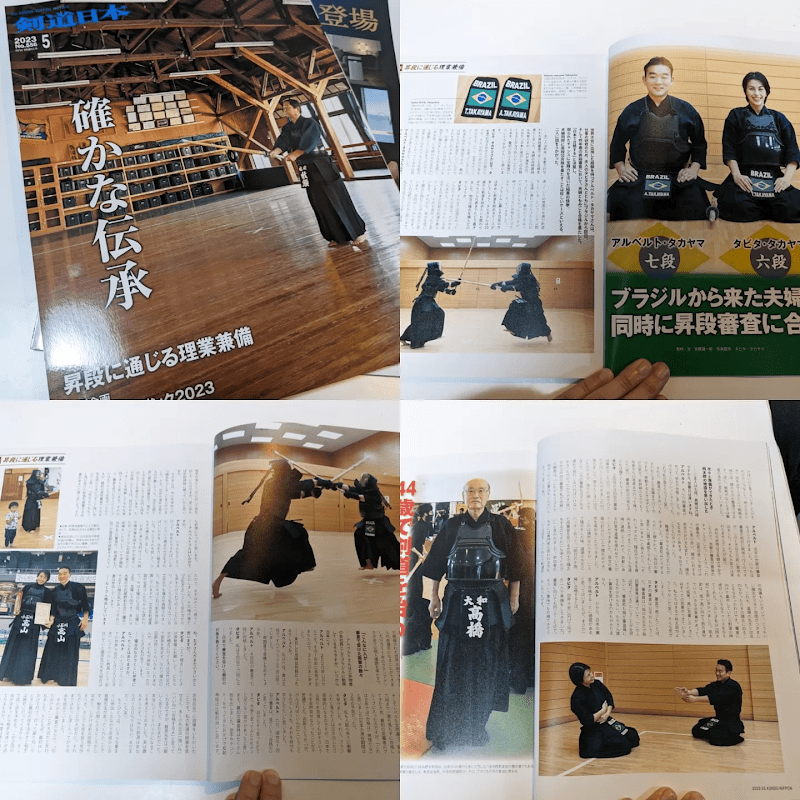
Photo: Kendo Nippon article
Making friends especially with women in kendo, has been very meaningful for me. When I was young, I thought women were competitive, but over time I realized that strong women admire one another and are also drawn to each other. That’s how I developed a beautiful friendship with Miwa Onaka and today we lead the Brazilian women’s team as coaches. I have also met admirable women’s groups in Mexico, Ecuador, Argentina, Peru, Panama and all of Latin America. Not to mention the wonderful female kendo in the US and Canada. I have traveled a lot to train and meet wonderful women from my continent.
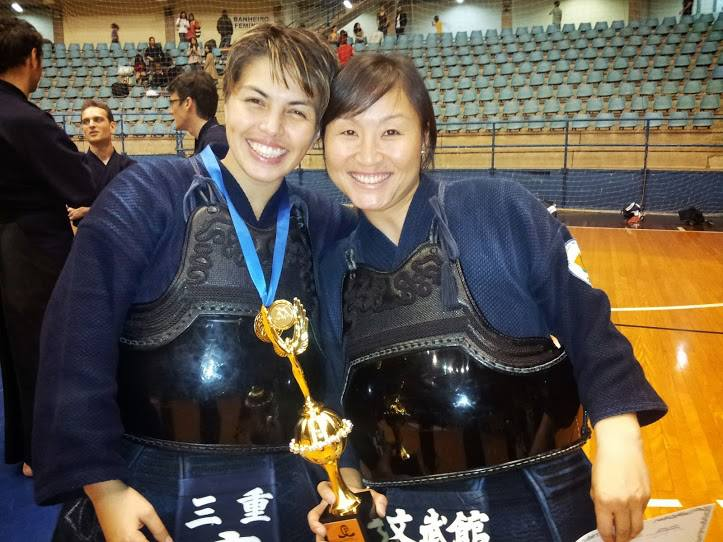
Photo: Tábita and Miwa Onaka
I remember a time when I was an immigrant child without knowing my place in the world and kendo gave me a sense of belonging to understand that I am part of a strong continent full of wonderful women. Suddenly I started to rescue my primary objective, which is to train to become strong so that I can train with young people and have many friends. And coincidentally, that’s what I’ve been doing, making friends all over the world.
On this new journey of mine to start training again for the next World Championship in Italy (which I hope will be the last! ), I returned to compete with vigour again and I therefore decided to accept the challenge of participating in the Samurai League Tournament as part of an international team. What was my surprise is when I realized that I would be the only woman competing and that our team also had the only female coach, Mariko Sato.
Thanks to this experience, Kate Sylvester invited me to speak about it and I thank her immensely for her interest and her untiring desire to shed light on the role of women in kendo.
First, I will share here the speech of Mariko Sato:
“I did not expect to be a coach this time. I was worried that I would not be able to properly apply for video confirmation because the speed of the Jitsugyodan kenshi is very fast. But as a result, I felt it was a good thing that Tabita san and I were included. Because we were asked questions from a “female” point of view, and the fact that we were both in the tournament kept it from becoming a 100% male tournament. Women are proportionally underrepresented in the kendo world, but I think the inclusion of the two of us helped to draw attention. In the future, Miyahara san from RF Technica said that he is thinking of having a mixed male-female team so that women compete against other women.”
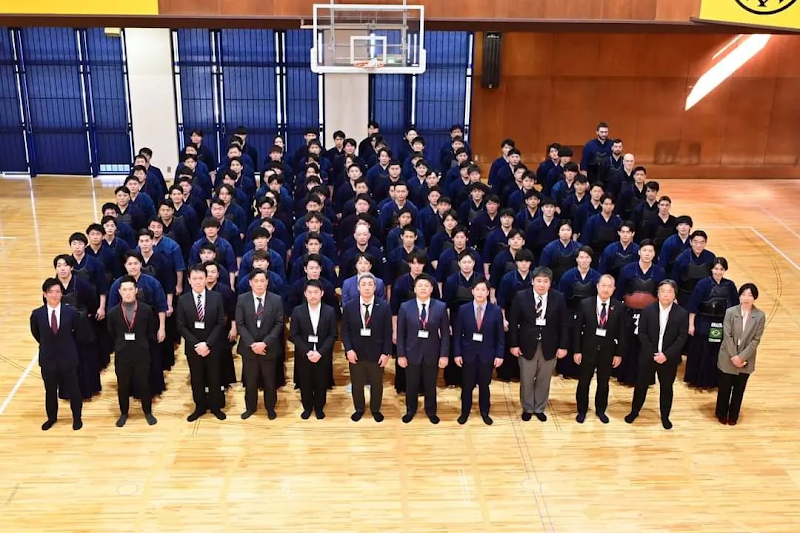
Photo: Samurai League Teams. Mariko Sato and Tábita (far right)
As for me, I can guarantee that it was an impressive experience and at the same time very funny. When I got to the arena I noticed that everyone was staring at me. Suddenly it started to bother me, I looked at my clothes to see if I was dirty or if I had something on my face, but it didn’t take long to realize that I was the only woman who would fight in the entire event.
Santiago Farias, a great athlete from Argentina, told me that I was like Mulan. We even wanted to start singing the famous song from the animation “I’ll Make a Man Out of You,” but I soon realized that I wasn’t pretending to be a man, but a woman who would fight like a woman.
When I started watching the fights I realized that the highest level of Japanese kendo was being represented there and suddenly everyone looked at me and told me how brave I was. When it was our turn I felt scared, I can’t deny it. But afraid of what? I lost by two legitimate ippons, but despite being late, my counterattacks landed perfectly and I’m glad I wasn’t submissive to the conflict. My opponent was very strong and skillful and he won because he was superior and that is kendo. But the experience raised some questions to ponder on.
Video link: Tábita competing in Samurai League Tournament
I feel that when I do keiko against strong men they never show their true power maybe even instinctively they consider women as “children.” However, when high level men compete, they show their true kendo and I think that it would be wonderful if it was like that all the time because women’s skills would improve and be more adapt to the reality of high quality kendo.
Even though the men I competed against were physically powerful, I never felt afraid of getting hurt. I feel that kendo is evolving more and more to become more efficient and clean. I think that if men can learn and execute this beautiful kendo, as was seen in the Samurai League, then they need not be afraid to show their full potential when fighting women. It can only make both sides stronger. I believe that unintentionally training with women in an easier way is like sabotaging women’s kendo development, even if it is done with “good intention.”
I believe that an official mixed kendo category is possible in the future. It would be fun and could certainly take kendo to a higher level than it already is. Maybe the Samurai League is the way and it was a tournament that earned my respect in that sense.
I will now leave you with an impressionable quote. During the pandemic, Ecuador interviewed many people from Latin America about kendo and Miwa Onaka was asked:
“Do you think kendo is for women?”
And she replied:
“Yes, I believe that kendo was actually made for women.”
All photographs in this article were provided by Tábita Wenckstern Sáez Takayama.
 Kate Sylvester Perspectives