This article post discusses the exclusion of women referees at the World Kendo Championships. It also includes the article The History of Women’s Participation at the World Kendo Championships Part 2 which was first published in Fine Ladies Kendo Worldwide Magazine Vol. 02 /2021 prior to the 18th WKC that was cancelled due to the global pandemic.
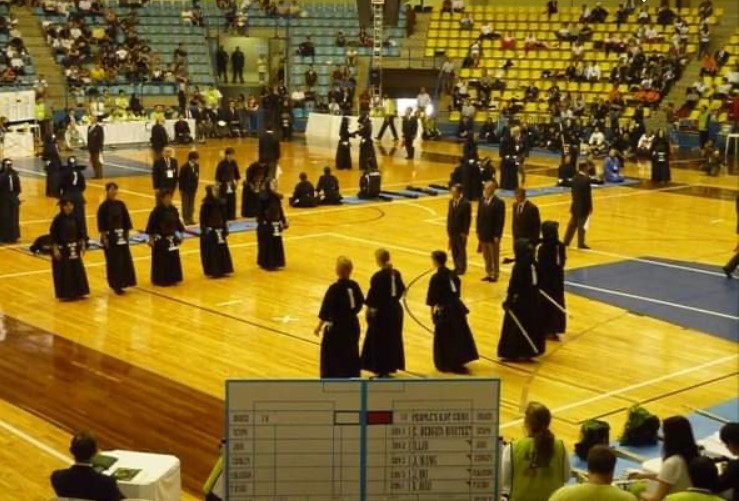
Australia v Japan at the 2009 WKC Brazil
According to statistics published in Gekkan Budō as of January 2020, 568 women were registered with the rank of 7 dan in Japan. Forty-five women passed the grade in 2020 and 160 in 2021 (All Japan Women’s Kendo Championship pamphlet 2022). Including the 2022 statistics, it can be estimated that there are approximately 900 female 7 dan in Japan today. This number indicates exponential growth in women’s kendo in Japan when considering that in 1991 there were only two women who held the rank (Takano Hatsue passed in 1966 and Kobayashi Setsuko passed in 1991).
Many elite level female kendo competitions in Japan, such as the All Japan Women’s Kendo Championships and the All Japan Women’s Interprefectural Championships are now referred by women. Referee seminars for women are also held on a regular basis in Japan. Although women do not generally referee men’s competitions in Japan, there are several other high level female competitions that women do referee. Highly skilled women referees ranked 7 dan kyoshi have an embodied understanding of kendo, with many starting kendo at a primary age and attending elite kendo institutions through their schooling. Kendo continues to influence career choices for a number of women. Due to changes in social role norms in contemporary Japan, many women continue high level kendo through various life stages (see Sylvester’s Women and Martial Art in Japan, 2022).
Needless to say, the level of women’s kendo in Japan is growing and many are highly experienced capable referees yet, female referees are absent at World Kendo Championships (WKC). Currently only 8 dan and 7 dan male sensei from around the world referee at the championships. We can therefore assume that some of the women 7 dan in Japan have had more referee experience at the elite level than some 7 dan males who referee at the WKC.
Another related issue is that despite the increasing number of women 7 dan in Japan, there are no 7 dan women’s kendo competitions although selected men can participate in the prestigious 7 dan and 8 dan male competitions. Compared to men, there are also far fewer competitive opportunities for highly ranked women who are senior in age.
As discussed in an earlier post article (Is Chi (Ki) Gendered in Kendo?), it appears that some international competitions follow suit by hindering status and skill building opportunity through limiting women’s competitive chances.
Although women outside of Japan regularly referee women’s and men’s competition categories, women referees in Japan are generally limited to refereeing female matches. This gender segregation and the exclusion of women referees at the highest level of international competition (the WKC) is problematic. Restricting women’s developmental opportunity is blatantly unprogressive when considering that women refereed at the 2022 FIFA men’s world cup in Qatar although soccer is considered “traditionally” a man’s game. These are important topics and will be discussed in future article posts.
Women’s exclusion from refereeing opportunity at the WKC is an example of how status and privilege is reserved for men in kendo. To referee at the WKC is honourable and symbolic of status. A realm from which women are currently occluded from.
Although women attend international referee seminars with the aspiration of being selected to referee at the World Kendo Championships, regardless of their aptitude (and there are some excellent female candidates attending these seminars), it is highly unlikely that a woman outside of Japan will be selected before Japan-based women referees. It is therefore unfair to these women who invest hope, time and money to attend these seminars.
The way that the WKC is currently organised is deeply bias. The less time afforded to women’s competition categories and absence of female referees at the WKC currently symbolises kendo as a patriarchal system that stymies women’s kendo development and access to status. The organisational structure currently projects a sentiment that women’s kendo is less important and of a lower status compared to men’s kendo.
As discussed in the below article, the referee selection process and bias refereeing at the WKC sustains gender and cultural status inequalities and myths about women’s capabilities in the international kendo context. This system of power undervalues the extent of what competitors and coaches invest during the 3-years leading up to a WKC and opposes progress occurring in other sporting spaces.
The WKC in Italy 2024 is set to allocate equal time to women’s and men’s competition categories for the first time. Can the federations come together and make a progressive and fair decision to include highly experienced women referees in 2024? From a competitor’s perspective, it is reasonable to have referees selected based on experience and skill—not their gender. It is also critical for the development of kendo to apply the same set of rules to all matches regardless of gender and country.
The below article, The History of Women’s Participation at the World Kendo Championships Part 2, is the second instalment of a two-part series that outlines the development and achievements of women’s participation at the WKC between 2006-2018. It also discusses gender and cultural bias relating to the tournament. Part one summarised the WKC between 1970-2003. These articles feature women kendo luminaries from around the world that are still very active in kendo.
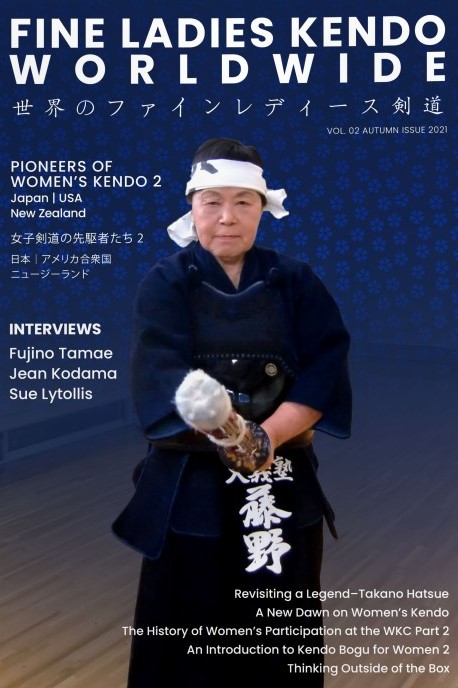
This article is published here with permission from Fine Ladies Kendo Worldwide Magazine (FLKWW). It was first published in Fine Ladies Kendo Worldwide Magazine Vol. 02 /2021 (read more about the magazine at the bottom of this article).

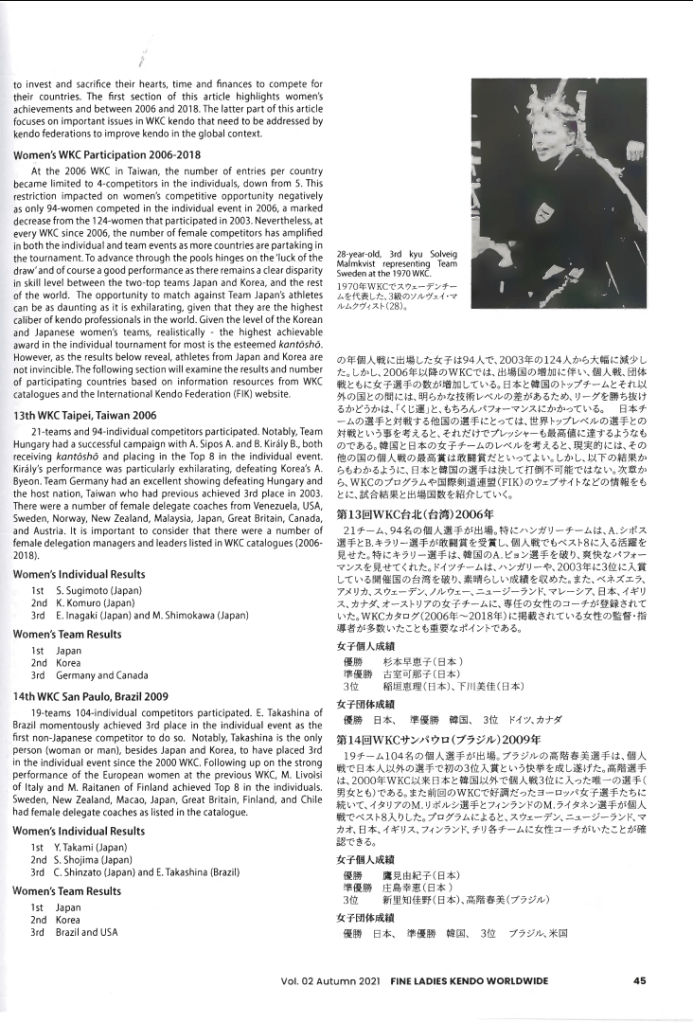
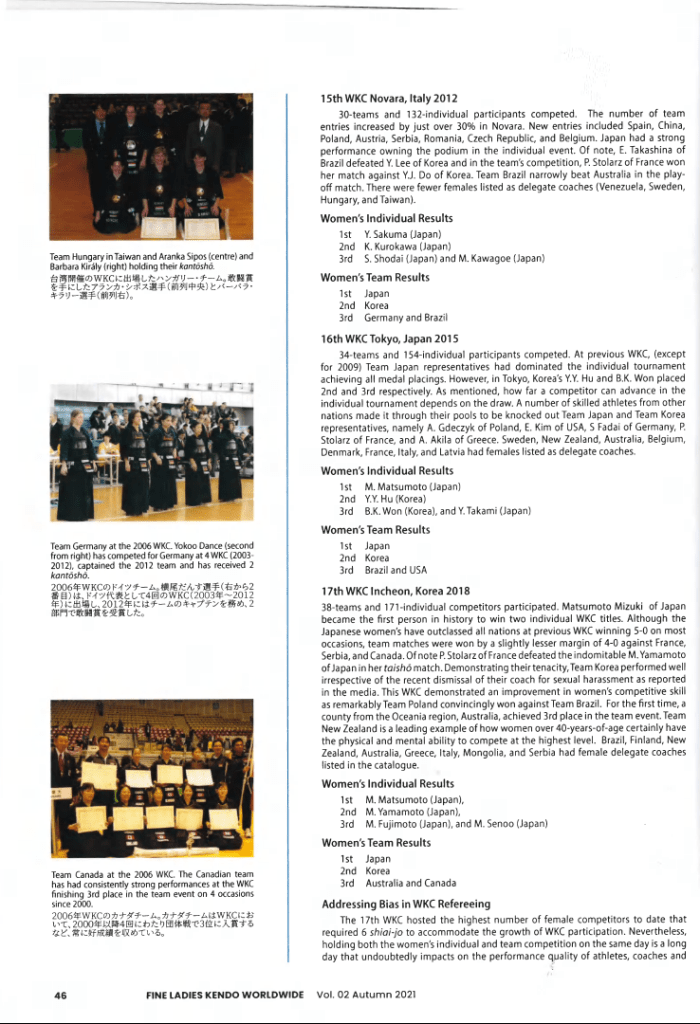
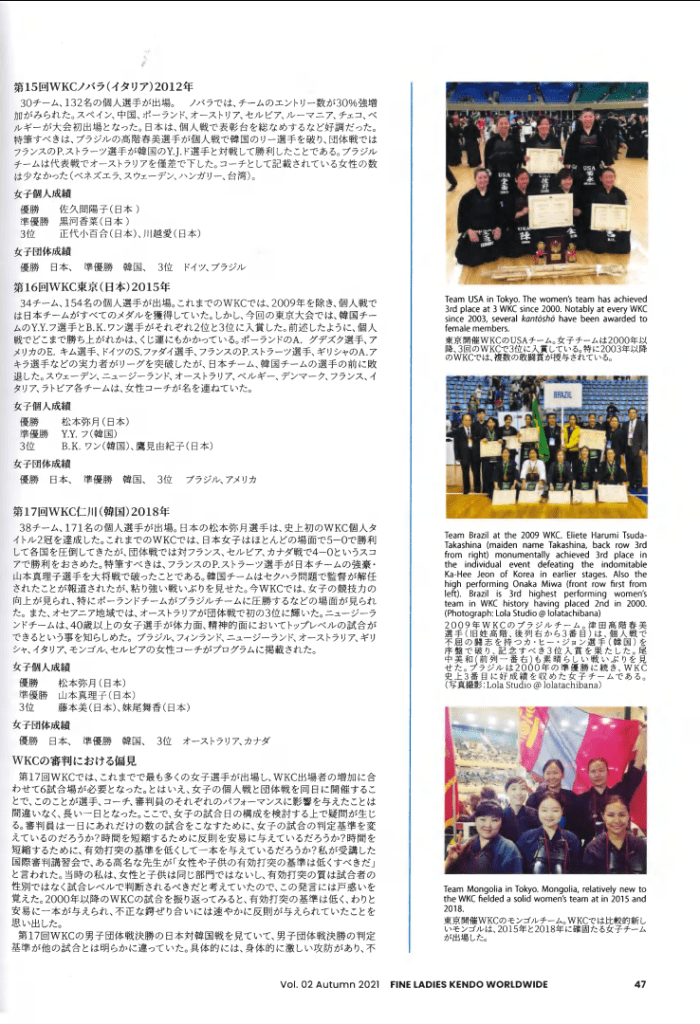
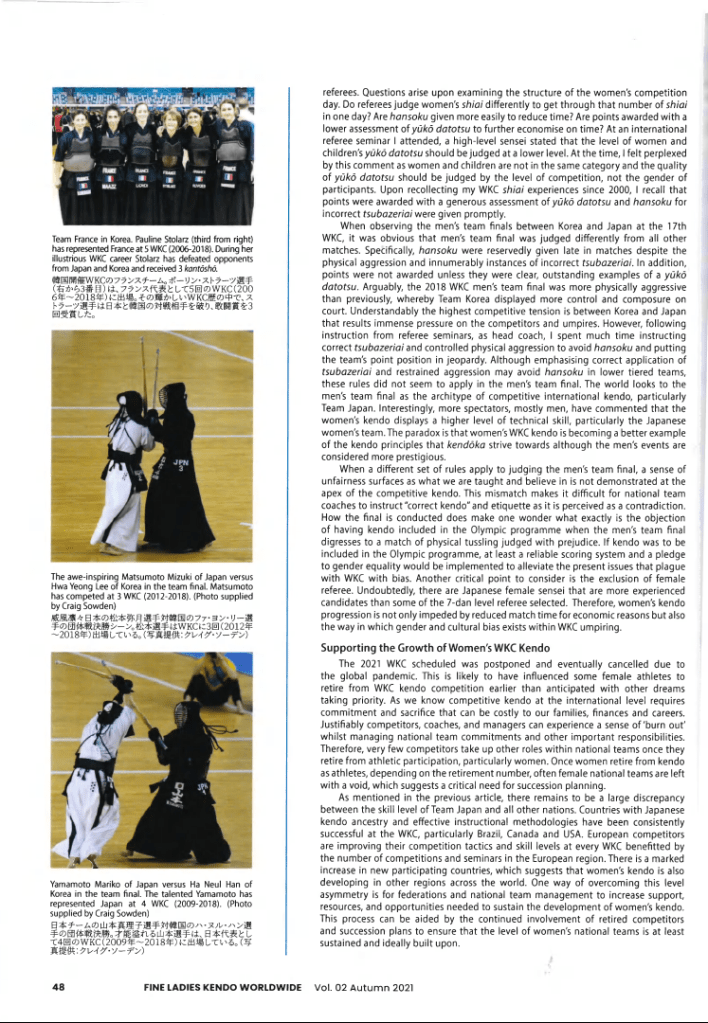
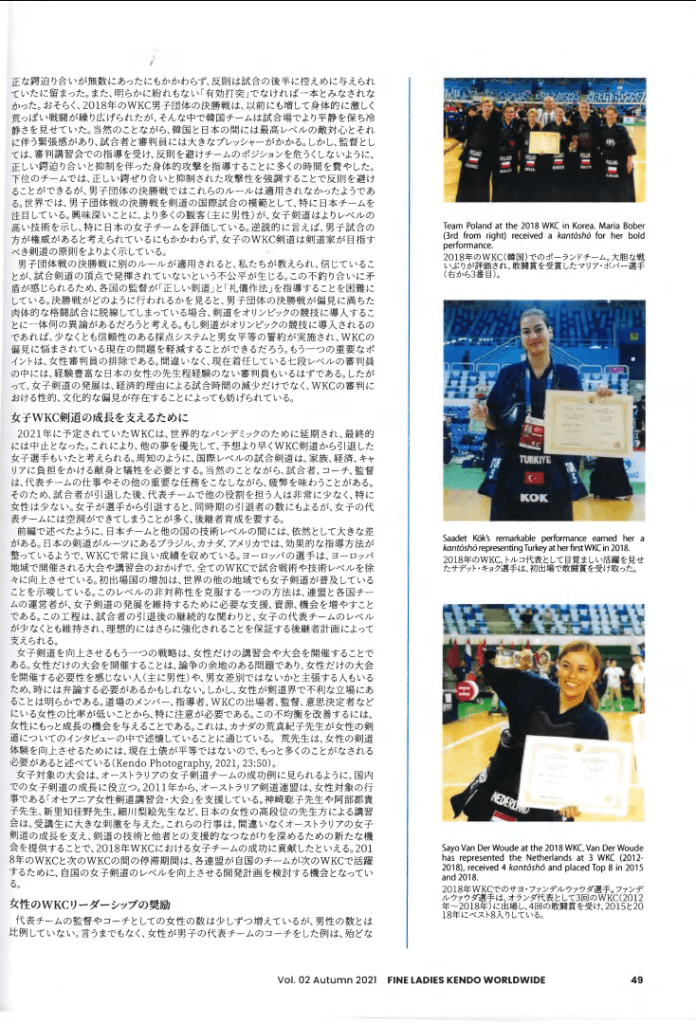
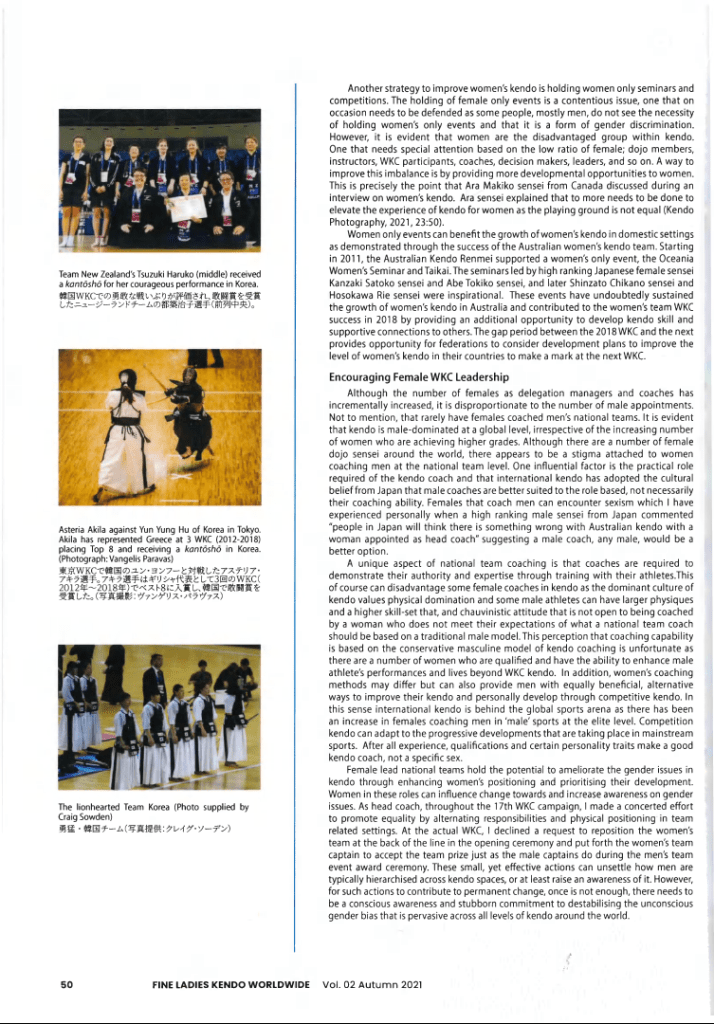
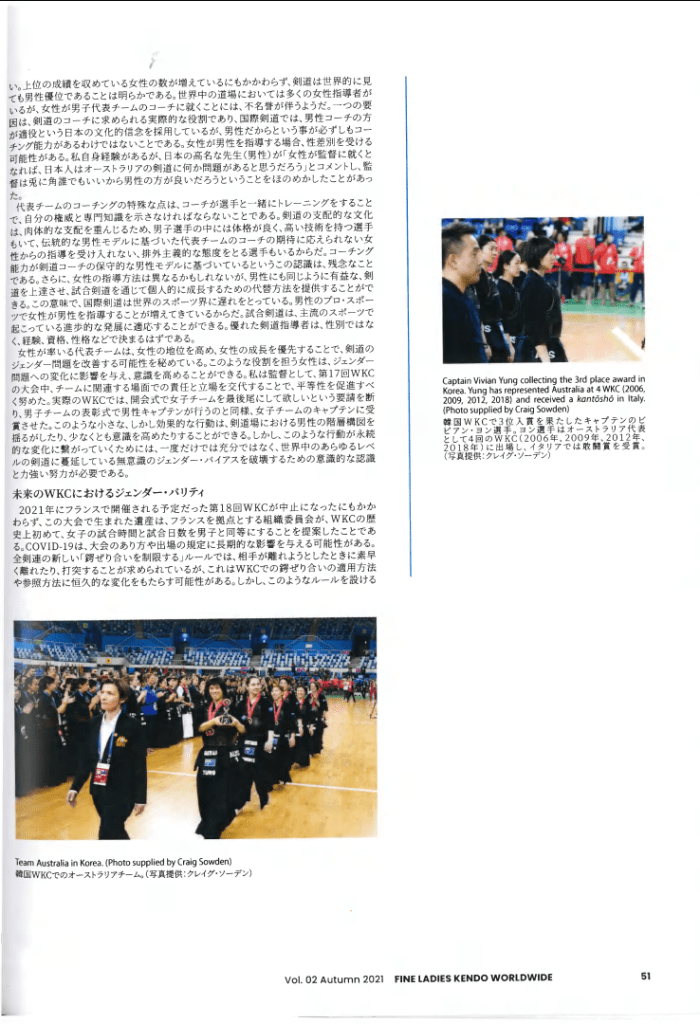

Fine Ladies Kendo Worldwide Magazine is the first (and only) women’s kendo magazine. It was launched in 2020 by CEO/Editor Matsuda Kazuyo and her team in response to the growing population of women practising kendo worldwide and a need for for a better medium that provides information promoting kendo for women practitioners worldwide.
This magazine is significant as women are under-represented in the kendo media. Notably women’s kendo perspectives and achievements are minimised and high graded Japanese female sensei are generally absent from mainstream kendo media platforms.
This magazine is an inspirational resource as it acknowledges women’s kendo histories and accomplishments, women specific topics, and importantly it bridges a gap between Japan and the global kendo community as articles are published in both Japanese and English. Click on the link below to find out more and to subscribe.
 Kate Sylvester Perspectives